Every year, camera rumors get louder — but not every rumor deserves your attention.
As 2026 approaches, photographers and creators are once again asking the same question:
Should I buy now, or wait for what’s coming next?
At DailyCameraNews, we don’t treat rumors as promises. Instead, we look at patterns, manufacturer behavior, and long-term system strategies. This article isn’t about chasing leaks — it’s about understanding what major brands are most likely to focus on in 2026.
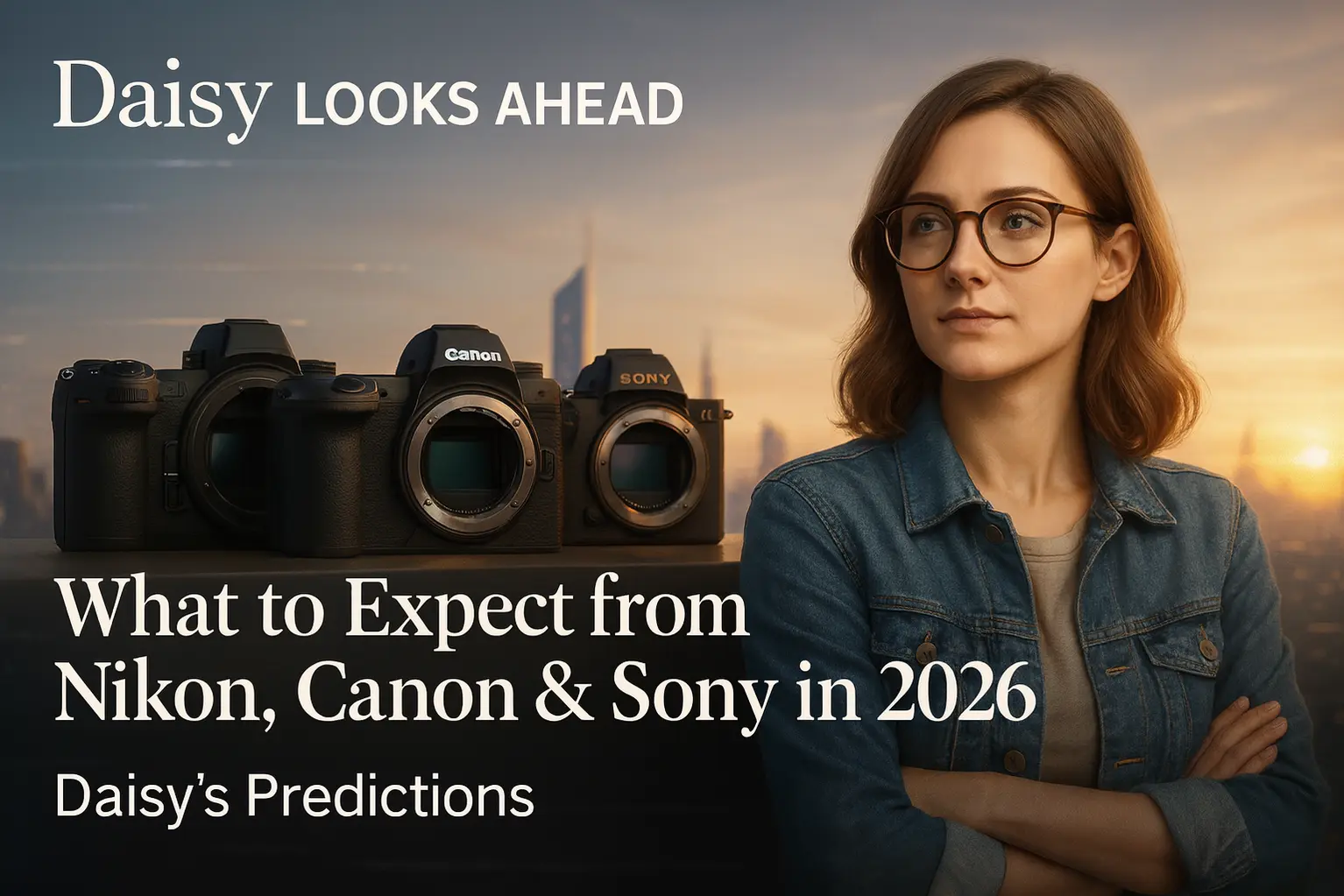
In this edition of Daisy LOOKS AHEAD, we’ll examine what Nikon, Canon, and Sony are likely preparing for 2026, how recent rumor activity supports these expectations, and which trends could matter most for photographers, hybrid shooters, and content creators.
Daisy says:
“Rumors don’t predict the future — they reveal direction.
My goal is to help you read between the lines, not chase every headline.”
Throughout this article, you’ll also find links to detailed rumor breakdowns already published on DailyCameraNews — including expected Canon RF updates, Nikon Z-mount developments, and Sony’s next-generation Alpha and FX-series directions.
Whether you’re planning an upgrade, tracking industry trends, or simply curious about what 2026 may bring, this guide will help you separate what’s likely from what’s just noise.
How Daisy Evaluates Camera Rumors
Not all camera rumors are created equal. Some are early signals of real products, while others are speculation based on incomplete information or misunderstood documents.
The first thing Daisy looks at is whether a rumor comes from a short-term leak or a long-term product roadmap. Leaks usually appear close to launch and involve regulatory filings, internal images, or firmware references, while roadmaps reflect a brand’s broader strategy over several years.
Another key distinction is firmware versus hardware rumors. Firmware updates often hint at features being tested or refined for existing models, whereas hardware rumors suggest physical changes such as new sensors, processors, or body designs.
Daisy also pays attention to generation gaps. When a model skips an expected update cycle, it often means the manufacturer is planning a more significant leap rather than a minor refresh.
Understanding why some camera lines pause or disappear helps explain why certain rumors make sense and others do not. Brands rarely abandon successful segments without a strategic reason.
Daisy explains: Reading rumors without hype means asking one simple question: does this fit the brand’s long-term direction, or is it just noise reacting to market pressure?
What to Expect from Canon in 2026
Canon enters 2026 with one of the most mature full-frame mirrorless ecosystems on the market, and the focus is no longer on filling gaps but on refining performance, reliability, and segmentation within the RF system.
According to current reports summarized in the Canon upcoming cameras 2026 overview, Canon’s roadmap suggests fewer but more purpose-driven releases rather than a flood of new bodies.
One area where rumors strongly align is hybrid performance. Canon is expected to continue blending stills and video capabilities more tightly, especially for creators who need dependable autofocus, strong color science, and consistent thermal performance during longer recording sessions.
High-end rumor activity points toward a potential update to Canon’s professional flagship line, with the Canon EOS R3 Mark II being discussed as a model focused on speed, reliability, and refined pro workflows rather than headline-grabbing resolution changes.
In the APS-C segment, expectations are building around a next-generation hybrid body, with the Canon EOS R7 Mark II rumored to push deeper into wildlife, sports, and creator-friendly video features while maintaining a compact form factor.
Canon’s long-term strategy also appears to include experimentation with form and nostalgia, as discussions around a possible retro-style Canon camera suggest the brand may explore emotional design alongside modern RF technology.
Another important signal is Canon’s continued cinema-to-mirrorless trickle-down. Features traditionally reserved for Cinema EOS models are increasingly expected to influence hybrid bodies, improving codecs, heat management, and usability for serious video creators.
Expected Canon Focus Areas: Hybrid RF bodies designed for creators, improved video thermals for long-form recording, and ongoing refinement of AI-powered autofocus across multiple camera lines.
What to Expect from Nikon in 2026
Nikon’s strategy heading into 2026 appears focused on consolidation rather than expansion, with an emphasis on refining its Z-mount lineup and strengthening its position among serious enthusiasts and professionals.
Recent activity outlined across multiple reports suggests that Nikon is prioritizing sensor performance, autofocus reliability, and long-term system consistency over frequent cosmetic updates.
In the high-resolution segment, attention has turned toward a potential successor to the Z7 line, with the Nikon Z7 III rumored to focus on improved readout speeds, better video usability, and refined dynamic range rather than a dramatic resolution jump.
At the flagship level, speculation continues around Nikon’s next-generation professional body, with the Nikon Z9 Mark II expected to build on the original’s stacked sensor architecture while addressing workflow refinements requested by sports and wildlife professionals.
Nikon’s APS-C roadmap is also generating interest, particularly with rumors surrounding the Nikon Z90, which is widely discussed as a potential performance-oriented APS-C body aimed at action, travel, and wildlife shooters.
Another intriguing direction involves experimentation beyond traditional camera categories, as suggested by reports on the Nikon Zr-C, a model that may reflect Nikon’s response to evolving creator workflows and compact hybrid demands.
Overall, Nikon’s rumored approach to 2026 emphasizes fewer releases with clearer roles, reinforcing the Z-mount ecosystem rather than fragmenting it with overlapping models.
Likely Nikon Priorities: Refined stacked sensor performance, improved autofocus tracking for wildlife and sports, and clearer differentiation between APS-C and full-frame Z-mount bodies.
What to Expect from Sony in 2026
Unlike Canon and Nikon, Sony’s 2026 roadmap is less about filling gaps and more about evolving its existing strengths — especially in hybrid imaging and cinema-inspired mirrorless technology.
According to recent speculation from multiple rumor sources, Sony may launch a new version of its popular cinema-oriented mirrorless camera with an updated model like the Sony FX3 II, potentially using a refreshed sensor and improved thermal management to better serve video creators and hybrid shooters in demanding workflows.
In the realm of high-resolution stills, rumors are building around the Sony A7R VI, which is widely expected to offer a significant sensor and autofocus upgrade over its predecessor — appearing as a “detail-first” flagship with strong AI-assisted tracking and creative capability while maintaining Sony’s mirrorless image quality pedigree.
Meanwhile, compact camera enthusiasts have been watching the long-rumored Sony RX100 VIII, a possible successor to the RX100 VII aimed at addressing market demand for a feature-rich, pocketable all-around camera with improved autofocus and video features in 2026.
Across these model categories, the common theme in Sony rumors isn’t simply “more cameras” — it’s smarter cameras: bodies that refine sensor performance, incorporate stronger AI-assisted features, and improve thermal handling to support extended 4K/8K shooting without compromising ergonomics or battery life.
Sony’s Likely 2026 Focus: cinema-ready mirrorless improvements with the FX3 II, a next-generation high-resolution stills flagship in the A7R VI, and a refreshed compact camera experience with the RX100 VIII — all wrapped in stronger AI autofocus and real-world usability.
How Fujifilm Fits into the 2026 Camera Landscape
Fujifilm continues to follow a clearly defined niche strategy going into 2026, focusing on APS-C excellence, tactile camera design, and distinct photographic experiences rather than competing directly in the full-frame volume race.
Based on ongoing discussion collected in the Fujifilm upcoming cameras 2026 rumors guide, Fujifilm’s roadmap suggests refinement of its most successful APS-C lines instead of radical system changes.
At the core of this strategy is the X-T series, with expectations surrounding the Fujifilm X-T6 focusing on performance improvements, autofocus refinement, and enhanced hybrid usability while preserving the traditional control layout that defines the line.
For photographers who value rangefinder-style ergonomics and documentary-focused shooting, interest remains high around a possible Fujifilm X-Pro4, which many expect to continue serving a dedicated audience rather than chasing mainstream appeal.
Meanwhile, the X-H line is widely discussed as Fujifilm’s most hybrid-oriented platform, with the Fujifilm X-H3 rumored to further blur the line between stills and video while leveraging APS-C’s size and heat advantages.
Rather than expanding endlessly, Fujifilm appears committed to doing fewer things exceptionally well, reinforcing its identity as a brand that prioritizes shooting experience, color science, and creative intent over sheer specification dominance.
Major Camera Trends to Watch in 2026
Across all major brands, one of the most visible trends heading into 2026 is the near-universal adoption of AI-driven autofocus systems, with subject recognition expanding beyond people and animals into vehicles, objects, and complex motion scenarios.
Another defining theme is heat management, particularly as hybrid cameras continue to absorb features once reserved for cinema bodies, making thermal efficiency a core design priority rather than an afterthought.
At the same time, manufacturers appear increasingly willing to release fewer models with clearer positioning, reducing internal overlap and helping users understand exactly who each camera is designed for.
These shifts align closely with broader industry outlooks already explored in previous DCN analysis, including Daisy’s take on mirrorless systems from 2026 to 2028 and the wider mirrorless camera trends forecast.
Long-term innovation discussions around computational imaging and sensor design also support this direction, as outlined in Daisy’s outlook on AI in photography and her analysis of the future of camera sensor technology.
Best For: Photographers planning upgrades in 2026, content creators tracking future releases, and buyers who prefer informed patience over rushing into every new announcement.
Should You Buy Now or Wait for 2026?
Whether you should buy now or wait for 2026 depends less on rumors and more on how well today’s cameras already meet your real-world needs.
If your current camera limits your work due to autofocus reliability, video overheating, or missing features that affect your workflow, waiting for rumored models may not be necessary, as many current-generation cameras already deliver professional-level performance.
On the other hand, waiting can make sense if you are specifically targeting improvements that are unlikely to arrive through firmware updates, such as new sensor architectures, faster readout speeds, or clearer separation between hybrid and cinema-oriented bodies.
Buyers who benefit most from waiting are those planning a major system investment, especially photographers considering a full ecosystem switch where lens availability, long-term support, and future-proofing matter as much as the camera body itself.
For many users, the smartest decision is not choosing between buying now or waiting, but understanding that modern cameras age more slowly than rumors suggest, making well-informed purchases safer than ever.
Daisy’s advice: If your camera already helps you create the images you want, don’t let rumors take that away from you. If it doesn’t, waiting only makes sense when the expected change truly matters to your work.
Final Thoughts — Reading Rumors the Smart Way
Camera rumors will always be part of the photography world, but the real value lies in understanding what they represent rather than reacting to every new headline.
As 2026 approaches, the patterns are clearer than ever: brands are refining systems, improving reliability, and focusing on real-world usability instead of chasing spec-sheet dominance.
Daisy’s approach to rumors is simple — look for direction, not promises, and focus on how future trends align with your own photography or content creation goals.
Whether you choose to buy now or wait, informed decisions will always outperform emotional ones, especially in an era where modern cameras remain capable for years.
For ongoing updates, deeper rumor analysis, and future-facing guides, DailyCameraNews will continue tracking what truly matters — without hype, and without shortcuts.
Daisy’s final note: Rumors don’t exist to make you wait. They exist to help you understand where the industry is heading.
FAQ: Camera Rumors and Expectations for 2026
- Are camera rumors reliable?
- Some camera rumors are based on regulatory filings, supply chain activity, or long-term roadmaps, while others are pure speculation, making it important to evaluate the source and context.
- Should I wait for 2026 cameras or buy now?
- Waiting makes sense only if upcoming models are expected to introduce changes that directly affect your workflow, such as new sensor technology or major autofocus improvements.
- Which brand is expected to release the most cameras in 2026?
- Rather than releasing many models, most major brands are expected to focus on fewer, more refined cameras with clearer positioning across their lineups.
- Will AI features be standard in future cameras?
- AI-powered autofocus and subject recognition are becoming standard features across mirrorless systems and are expected to expand further in 2026.
- Do rumors affect camera prices?
- Rumors can influence short-term buying behavior, but long-term pricing is usually driven by actual product releases and market demand rather than speculation.
- Is it safe to invest in a camera system before 2026?
- Modern mirrorless systems are designed for longevity, and investing in a well-established ecosystem remains a safe choice even as new models approach.