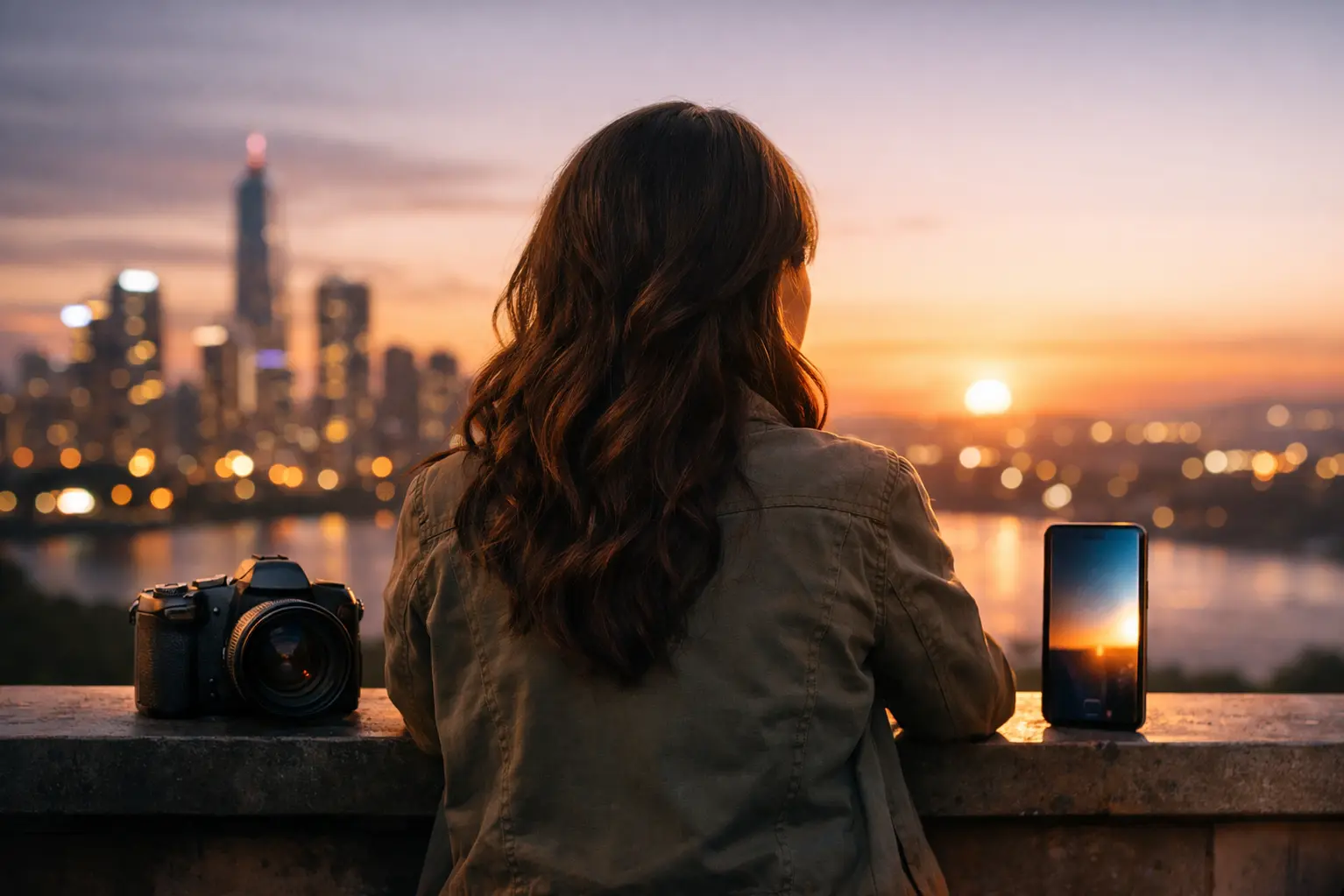
Every few years, the same question returns — and it’s louder than ever now: will smartphones finally replace entry-level cameras for good?
With computational photography evolving at breakneck speed and smartphone cameras improving faster than most beginners ever upgrade their first mirrorless body, the gap feels smaller than it’s ever been.
But this isn’t just a tech question — it’s a behavioral shift.
People don’t choose cameras based on specs alone anymore; they choose based on friction, convenience, and whether a device fits naturally into their daily life.
So instead of asking “Which is better?”, the real question becomes: Which tool removes more friction for beginners in 2026 — and what will that look like by 2028?
This article isn’t about defending cameras or praising phones; it’s about understanding where each one truly wins and why that matters for the future of entry-level photography.
What Smartphones Already Do Better
To understand where entry-level cameras may struggle, we have to be honest about what smartphones already do exceptionally well — often better than beginner cameras right out of the box.
Always With You (Zero Decision Friction)
The biggest advantage smartphones have isn’t image quality — it’s presence.
A phone is already in your pocket, charged, connected, and familiar, while even the smallest mirrorless camera still requires a conscious decision to bring it along.
For beginners, that difference alone can mean the difference between taking photos daily and leaving a camera untouched for weeks.
Computational Photography That Works Instantly
Modern smartphones don’t just capture light; they interpret it.
HDR blending, night modes, portrait separation, skin tone optimization, and scene recognition all happen automatically, delivering results that feel polished without requiring any technical knowledge.
For someone new to photography, that instant gratification is powerful — and often more emotionally rewarding than learning exposure fundamentals. See more Computational Photography.
Social, Editing, and Sharing Built In
Smartphones remove every step between capture and sharing.
You shoot, edit, caption, and publish from the same device, which aligns perfectly with how most beginners consume and create content today.
Entry-level cameras, by comparison, still rely on apps, transfers, and workflows that can feel unnecessarily complex for someone who just wants to post and move on.
What Smartphones Already Do Better
Before predicting the future, we need to be clear-eyed about the present: smartphones already outperform entry-level cameras in several areas that matter deeply to modern beginners.
Computational Photography
Smartphones don’t rely on optics alone; they rely on software intelligence.
Multiple frames are merged instantly, noise is reduced selectively, faces are detected and optimized, and scenes are interpreted automatically — all without the user needing to understand a single technical setting.
For beginners, this removes the learning curve entirely and replaces it with consistent, polished results.
Night Mode & HDR
Low light is where smartphones quietly changed expectations.
Dedicated night modes and aggressive HDR processing allow phones to produce bright, shareable images in conditions where entry-level cameras often require manual adjustments or external support.
While the files may not be technically superior, the perceived result often feels more impressive to casual users.
Always-Connected Workflow
Smartphones eliminate friction between shooting and sharing.
There is no transfer step, no separate editing environment, and no workflow decision — everything happens on one device, instantly.
This matters because beginners don’t abandon cameras due to image quality; they abandon them due to workflow fatigue.
Social-First Content
Vertical video, short-form clips, live photos, and instant stories are native to smartphones.
Entry-level cameras can technically produce higher-quality files, but they still feel disconnected from platforms that reward speed, frequency, and immediacy.
Where Entry-Level Cameras Still Win (and Why It Matters by 2028)
Despite rapid smartphone progress, entry-level cameras continue to dominate in areas that shape long-term photographic growth — and these advantages won’t disappear by 2028.
True Optical Flexibility
Interchangeable lenses remain the single biggest differentiator.
Being able to change perspective, focal length, and rendering characteristics fundamentally alters how photographers see and approach scenes — something software simulation still struggles to replicate convincingly.
This flexibility encourages intentional shooting, not just reactive capture.
Sensor Size and Image Depth
Even modest APS-C sensors collect more light and tonal information than smartphone sensors.
This translates into better dynamic range, more natural depth of field, and greater editing latitude — benefits that become more noticeable as photographers grow beyond automatic modes.
By 2028, this gap may shrink, but it won’t disappear.
Learning Through Control
Entry-level cameras still teach photography in a way smartphones do not.
Physical dials, manual exposure, autofocus modes, and lens behavior force users to understand cause and effect.
This learning curve can feel slower at first, but it builds skills that compound over time.
Creative Separation From the Phone
Using a dedicated camera creates a psychological shift.
It separates photography from notifications, apps, and distractions, encouraging focus and intentional image-making.
For many creators, that separation becomes more valuable — not less — as content saturation increases.
The Real Problem: Who Entry-Level Cameras Are For
This is the uncomfortable question camera brands rarely answer directly.
The problem isn’t that entry-level cameras are bad — it’s that the definition of “beginner” has fundamentally changed.
The Death of the Traditional “Beginner”
For decades, a beginner photographer was someone starting from zero.
Today, almost everyone begins with a smartphone.
Modern users already understand framing, exposure compensation, portrait mode, HDR, and video formats before they ever touch a dedicated camera.
Calling these users “beginners” undersells their expectations.
Casual Users Choose Phones
If photography is occasional, spontaneous, and primarily social, smartphones win by default.
They are always present, instantly connected, and good enough in nearly every everyday scenario.
Entry-level cameras struggle here not because of image quality, but because they introduce friction where none existed.
Enthusiasts Skip the Bottom
At the other end of the spectrum, motivated users often skip entry-level cameras entirely.
Many jump straight to used gear, mid-range APS-C models, or even affordable full-frame mirrorless systems.
The second-hand market and online education have made this leap less intimidating than ever.
Caught in the Middle
This leaves entry-level cameras trapped between two shrinking groups.
They are too complex and inconvenient for casual users, yet too limited and short-lived for serious enthusiasts.
Unless brands redefine who these cameras are truly for, the category risks becoming irrelevant rather than obsolete.
What Camera Brands Are Doing About It
Camera manufacturers are aware of this pressure, and their recent strategies reveal a clear shift in priorities.
APS-C Video-Focused Models
Instead of positioning APS-C cameras as “cheap full-frame alternatives,” brands are emphasizing video performance.
High-quality 4K, advanced autofocus, and creator-friendly codecs are becoming standard even in lower-priced bodies.
This reframes entry-level cameras as tools for content creation rather than traditional photography training.
The Creator and Vlogger Pivot
Flip screens, compact bodies, lightweight lenses, and simplified menus now dominate new releases.
Brands are targeting YouTubers, streamers, and hybrid shooters — users who value speed, portability, and video-first features.
Photography becomes part of a broader content workflow, not the sole focus.
Firmware and Software as Compensation
Rather than relying on hardware alone, manufacturers increasingly use firmware updates to extend product life.
Improved autofocus algorithms, subject detection, and video features are delivered post-launch.
This mirrors smartphone development cycles and helps entry-level cameras feel less static.
Apps, Subscriptions, and Ecosystems
Some brands are experimenting with companion apps, cloud services, and subscription-based features.
While adoption remains mixed, the intent is clear: reduce workflow friction and keep users inside a brand ecosystem.
By 2028, software integration may matter as much as sensor performance.
2028 Prediction: Replacement or Redefinition?
By 2028, the entry-level camera market won’t disappear — but it will look very different.
The idea of smartphones completely replacing dedicated cameras is too simplistic.
What’s actually happening is a redefinition of purpose, not a mass extinction.
Fewer Models, Less Noise
Brands will likely reduce the number of true entry-level models they offer.
Instead of overlapping product lines with minor spec differences, we’ll see fewer cameras with clearer positioning.
This alone will reduce buyer confusion — something smartphones already solved years ago.
A Sharper Target Audience
Entry-level cameras will no longer try to appeal to everyone.
The casual user is already fully absorbed by smartphones.
The remaining audience is intentional, curious, and willing to learn — even if they’re not professionals.
From “First Camera” to “First Serious Camera”
The biggest shift is semantic but powerful.
Entry-level cameras will stop being marketed as a person’s first camera.
They will become the first serious camera someone buys after outgrowing their phone.
This reframing aligns expectations, pricing, and feature sets far more realistically.
Daisy’s Take
There’s a lot of panic around smartphones “killing” cameras.
But panic usually comes from misunderstanding what’s actually changing.
Phones removed the question of “Should I bring a camera?”
What remains is intent.
And when someone decides photography or video truly matters to them, a dedicated camera still has a clear role to play.
Final Thoughts: The Question Was Never About Replacement
For years, the conversation around smartphones and cameras has been framed as a competition.
But replacement was never the real story.
Smartphones didn’t win by becoming better cameras.
They won by becoming good enough, always available, and decision-free.
That doesn’t erase the need for entry-level cameras — it clarifies it.
By 2028, buying a dedicated camera will be a more deliberate choice than ever.
And that’s not a weakness.
It means entry-level cameras will serve people who want to learn, grow, and create — not just document.
If you’re happy with your phone: you’re exactly where you should be.
If you feel limited by it: that’s not marketing — that’s your signal.
The future of entry-level cameras isn’t about convincing everyone.
It’s about being ready for the moment when someone decides that creativity matters more than convenience.
And when that moment comes, the right camera won’t feel exciting.
It will feel obvious.
That’s when entry-level cameras stop being an option — and start being a direction.
Frequently Asked Questions
Will smartphones fully replace entry-level cameras by 2028?
No. Smartphones will continue to replace casual photography needs, but entry-level cameras are shifting toward a more focused role as the first serious step into photography.
Who should still consider an entry-level camera today?
If you want manual control, interchangeable lenses, and a deeper understanding of photography, an entry-level camera still makes sense even as smartphone cameras improve.
Are beginner cameras becoming obsolete?
The term “beginner camera” is changing. Instead of serving everyone, these cameras are increasingly designed for intentional learners and content creators.
Is computational photography better than real cameras?
Computational photography excels at speed and convenience, but dedicated cameras still offer more control, consistency, and creative flexibility.
Should I upgrade from my phone to a camera now or wait?
If your phone no longer lets you create the images or videos you imagine, waiting won’t solve that problem. If you’re satisfied, there’s no rush.



[…] each year, Flickr remains a living record of photography trends. The 2025 data shows how both mirrorless and smartphone cameras continue to define the platform’s creative […]