Introduction
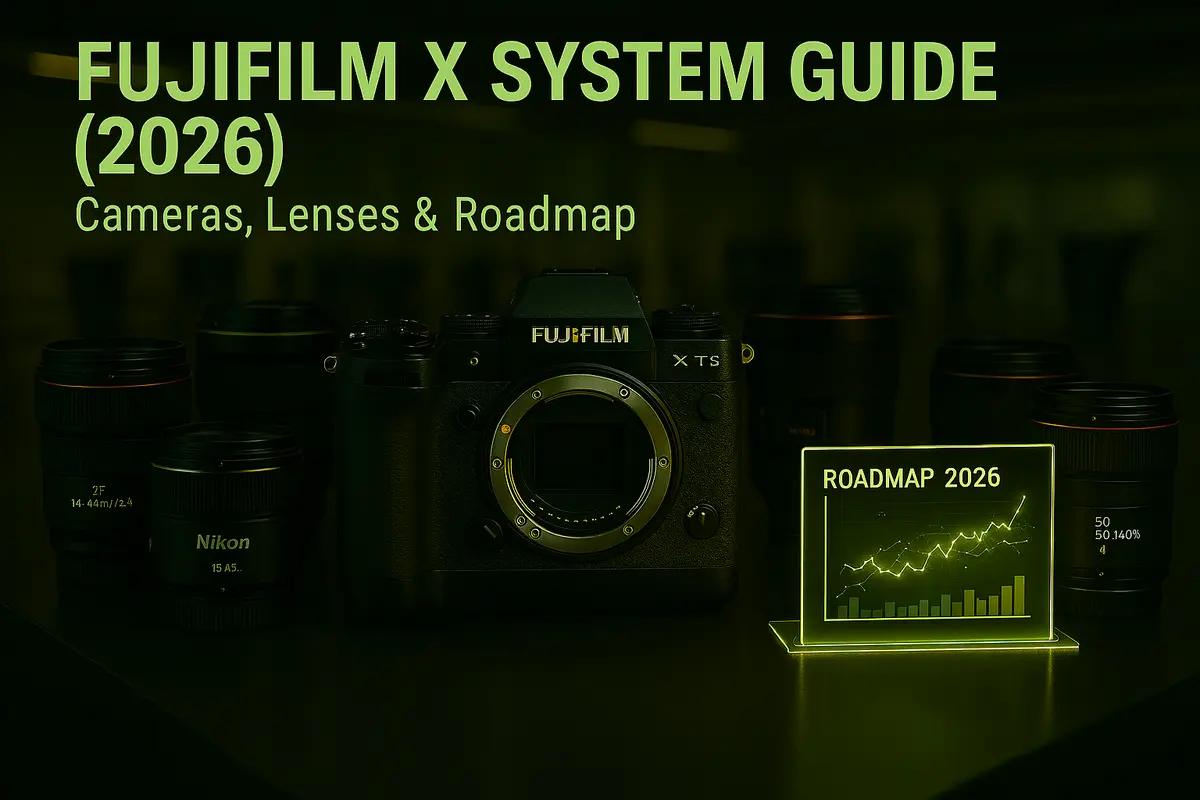
Fujifilm’s X System has become one of the most beloved mirrorless ecosystems in the world — praised for its compact bodies, film-inspired color science, premium XF lenses, and a shooting experience that feels uniquely “Fujifilm.” Whether you’re a beginner looking for your first hybrid camera or a professional seeking a lightweight but powerful system, the X-mount platform delivers exceptional versatility.
In this comprehensive 2026 Fujifilm X System Guide, we break down the entire camera lineup (X-T, X-H, X-Pro, X-S, X-E, and X-A series), explore the XF & XC lens ecosystem, and look ahead at Fujifilm’s future roadmap, including major rumored releases like the X-T6, X-Pro4, X-H3, and the new half-frame model.
You’ll also find links to in-depth Fujifilm lens resources, buying recommendations, and curated guides that help you choose the right gear for your style — whether it’s travel, portrait, landscape, documentary, or hybrid creator work.
Related Fujifilm Cornerstone Guides
- Complete Guide to Fujifilm X-Mount Lenses (2025)
- Full List of Fujifilm X-Mount Lenses
- Best Lenses for Fujifilm X-T5 – Top Picks from Budget to Pro
- Best Fujifilm Cameras for Beginners
- Fujifilm Rumors: X-T6, X-Pro4 & X-H3 Updates
- X-Pro4 Early Expectations
- Fujifilm X Half-Frame Camera (Official Announcement)
Fujifilm X Camera Lineup (Explained)
Fujifilm’s X system is centered on APS-C X-Trans sensors and a clear family structure that serves beginners, enthusiasts and professionals alike. Below is a polished breakdown of the major X-series families, what each one is designed for, and which users will benefit most from them. Where relevant, links to in-depth DailyCameraNews coverage are included.
■ X-T Series — The Classic Hybrid Workhorse
The X-T line balances stills and video in a traditional SLR-style body with an electronic viewfinder and dedicated exposure dials. It’s the versatile, do-everything series that appeals to travel, portrait, documentary and hybrid creators.
- Who it’s for: Photographers seeking tactile controls, strong JPEG/film simulations, and reliable hybrid performance.
- Key traits: Dial-based exposure control, excellent Fujifilm color science, strong 4K/6K video on higher-end models, and weather sealing on mid/high-end bodies.
■ X-H Series — Flagship Hybrid & Video Powerhouse
The X-H series targets pros and demanding hybrid shooters. These bodies prioritize IBIS, advanced autofocus, robust heat management and cinema-friendly video pipelines.
- Who it’s for: Filmmakers, event photographers, and hybrid pros who need top-tier stabilization, sustained recording and pro ergonomics.
- Key traits: Best AF and IBIS in the X lineup, deep grips, pro I/O and strong thermal performance for long shoots.
■ X-Pro Series — The Rangefinder Experience
X-Pro cameras deliver Fujifilm’s hybrid OVF/EVF experience in a premium, rangefinder-style body. They are optimized for photographers who prefer a deliberate, street-focused shooting style.
- Who it’s for: Street, documentary and travel photographers who value compact ergonomics and the hybrid optical/electronic viewfinder workflow.
- Key traits: Hybrid OVF/EVF, retro rangefinder ergonomics, premium materials and a focus on stills-centric shooting experience.
■ X-S / X-E Series — Compact, Lightweight & Portable
The X-S and X-E families offer smaller, more affordable bodies with modern features. They’re ideal for creators and travelers who want Fujifilm image quality in a pocketable package.
- Who it’s for: Travellers, vloggers, and photographers who prioritize size and portability without sacrificing image quality.
- Key traits: Slim profiles, straightforward controls, great prime-lens pairing and excellent value for money.
■ X-A / Entry-Level Series (Legacy / Used Market)
While newer Fujifilm bodies have mostly replaced the X-A line, these models remain relevant for budget buyers on the used market who want Fujifilm color science and a friendly entry point.
- Who it’s for: Beginners or second-camera buyers looking for low-cost entry into the X ecosystem.
- Key traits: Lightweight, very affordable (used), easy-to-use controls and strong JPEG output for casual shooting.
Key Recent Models & Notable Mentions
- X-M5: A popular compact enthusiast body — see our full review for hands-on impressions and sample images. (X-M5 review)
- Half-Frame Announcement: Fujifilm’s half-frame model was officially announced and represents an interesting new direction for creative shooters. (Half-frame official announcement)
- Upcoming Rumors: Major updates such as the X-T6, X-Pro4 and X-H3 are widely discussed for early 2026 — check the latest rumor roundup. (Fujifilm rumors)
Fujifilm X Camera Lineup — Quick Comparison Table
| Series | Target User | Key Strengths | Notable Models |
|---|---|---|---|
| X-T Series | Enthusiasts & hybrid shooters | Dial controls, balanced stills/video, weather sealing | X-T5, X-T4 |
| X-H Series | Professional hybrid creators | Top-tier AF, IBIS, pro video, thermal stability | X-H2, X-H2S |
| X-Pro Series | Street & documentary photographers | Hybrid OVF/EVF, rangefinder style, premium build | X-Pro3 (X-Pro4 rumored) |
| X-S / X-E Series | Travelers & compact-camera users | Lightweight bodies, strong value, modern features | X-S20, X-E4 |
| X-A Series (Legacy) | Entry-level / budget buyers (used market) | Simple controls, affordable, great JPEG colors | X-A7, X-A5 |
Fujifilm X Lens System Explained
The Fujifilm X-mount lens ecosystem is one of the strongest APS-C systems on the market, trusted by photographers worldwide for its exceptional image quality, film-like rendering, and compact design philosophy. With over a decade of development, the X-mount now includes a complete lineup of XF (premium) and XC (affordable) lenses, covering everything from ultra-wide landscapes to portraits, macro, sports, and professional video work.
Whether you’re building your first X-Series kit or refining a professional setup, this section breaks down how the system works, the differences between XF and XC lenses, and which lens categories matter most depending on your shooting style.
XF vs XC Lenses — What’s the Difference?
- XF Lenses: Premium optics, weather-sealing on many models, fast apertures, metal construction, and Fujifilm’s best autofocus and image quality.
- XC Lenses: Lightweight, plastic construction, budget-friendly, and often paired with entry-level bodies — but still capable of excellent results.
If you want the best performance for stills or video, XF lenses are the way to go. XC lenses, on the other hand, offer outstanding value for hobbyists and travel shooters.
Key Fujifilm X Lens Categories
Below is a quick overview of the main lens types available in the X-mount ecosystem — from versatile zooms to creative primes.
- Wide-Angle Primes (14–24mm): Ideal for landscapes, architecture, travel, street, and environmental portraits.
- Standard Primes (23–35mm): The classic focal lengths for everyday shooting, documentary work, and video.
- Portrait Primes (50–90mm): Known for beautiful background separation and Fuji’s signature color rendering.
- Standard Zooms (16–55mm / 18–55mm): Great all-around options for hybrid shooters.
- Telephoto Zooms (50–140mm / 70–300mm): Perfect for wildlife, sports, events, and travel.
- Macro Lenses: Essential for product, food, detail shots, and creative close-up photography.
- Video-Focused Lenses: Parfocal, smooth focusing, and optimized for cinema workflows (especially third-party options).
Lens Ecosystem & Cornerstone Resources
For a deeper look into Fujifilm’s expanding lens system — including full lists of XF/XC lenses and model-specific recommendations — here are essential reference guides on DailyCameraNews:
- Complete Guide to Fujifilm X-Mount Lenses (2025 Update)
- Full List of Fujifilm X-Mount Lenses (Legacy Reference)
- Best Lenses for Fujifilm X-T5 — Top Picks from Budget to Pro
- Best Fujifilm Cameras for Beginners — Top Picks Worth Buying
Why Fujifilm Lenses Stand Out
Fujifilm’s commitment to APS-C means its lenses are purpose-built, not adapted from full-frame designs. This leads to lighter builds, consistent optical quality, and excellent performance even on future high-resolution sensors — making the X-mount a future-proof investment for photographers and filmmakers alike.
Recommended Fujifilm X Lenses (By Category)
Below is a curated, easy-to-digest list of the best Fujifilm lenses by category — perfect for beginners, hybrid creators, and professional X-Series shooters.
🏞️ Best Wide-Angle Lenses (Landscapes, Travel, Architecture)
- Fujifilm XF 14mm f/2.8 R — Ultra-sharp, distortion-free, lightweight landscape classic.
- Fujifilm XF 16mm f/1.4 R WR — Stunning sharpness, weather sealing, and pro-level low-light performance.
- Fujifilm XF 8mm f/3.5 R WR — Fujifilm’s newest ultra-wide with beautiful rendering and minimal distortion.
📷 Best Standard Primes (Everyday, Street, Hybrid Video)
- Fujifilm XF 23mm f/1.4 R LM WR — The must-have Fuji prime for street and video.
- Fujifilm XF 33mm f/1.4 R LM WR — Best-in-class sharpness, fast AF, gorgeous bokeh.
- Viltrox 27mm f/1.2 Pro — Pro-grade 40mm-equivalent at a great price; superb video AF.
📸 Best Portrait Lenses (People, Weddings, Editorial)
- Fujifilm XF 56mm f/1.2 R WR — Fuji’s ultimate portrait prime with a cinematic look.
- Fujifilm XF 90mm f/2 R LM WR — Incredibly sharp, fast AF, perfect for headshots & compression.
- Viltrox 75mm f/1.2 Pro — Stunning bokeh and flagship optics at a lower price.
🎒 Best Standard Zooms (All-Around Use, Travel, Hybrid Work)
- Fujifilm XF 16–55mm f/2.8 R LM WR — The pro workhorse zoom, equivalent to a 24–84mm f/2.8.
- Fujifilm XF 18–55mm f/2.8–4 R LM OIS — The “kit lens that isn’t a kit lens”; lightweight and sharp.
- Fujifilm XF 16–80mm f/4 R OIS WR — Great travel zoom with excellent stabilization.
🏆 Best Telephoto Zooms (Sports, Wildlife, Events)
- Fujifilm XF 50–140mm f/2.8 R LM OIS WR — The flagship tele-zoom; fast, sharp, and reliable.
- Fujifilm XF 70–300mm f/4–5.6 R LM OIS WR — Lightweight wildlife zoom with excellent reach.
- XF 150–600mm f/5.6–8 R LM OIS WR — For serious birding and wildlife shooters.
🔍 Best Macro Lenses (Product, Food, Detail Work)
- Fujifilm XF 80mm f/2.8 R LM OIS WR Macro — True 1:1 macro with pro-grade sharpness.
- Laowa 65mm f/2.8 2× Ultra Macro — Manual focus, extreme 2× magnification, stunning optics.
🎬 Best Fuji Lenses for Video Creators
- Fujifilm XF 18mm f/1.4 R LM WR — Sharp, fast, lightweight, and perfect for hybrid YouTube creators.
- Fujifilm XF 23mm f/1.4 LM WR — Zero focus breathing, reliable AF, excellent for interviews and talking heads.
- Viltrox Pro Series Primes — Affordable, fast, reliable AF for video workflows (27mm / 75mm / 16mm).
Fujifilm X System Buying Advice (Which Body + Lens Combo to Choose?)
Choosing the right Fujifilm X-Series setup depends heavily on your experience level, shooting style, and budget. Below are optimized body + lens combinations designed to deliver excellent value while keeping your workflow simple and effective.
📸 Best Starter Kit (Beginner Upgrade Path)
Fujifilm X-S20 + XF 18-55mm f/2.8–4 R LM OIS
A lightweight, hybrid-friendly setup ideal for beginners who want strong photo quality and excellent video features.
- Reliable AF for everyday shooting
- Excellent JPEG color and easy learning curve
- Lens provides pro-level image quality without a pro-level price
Buy the X-S20: Amazon | B&H | Adorama
Buy the XF 18-55mm f/2.8–4: Amazon | B&H | Adorama
📷 Best Compact Travel Kit
Fujifilm X-E4 (or X-E5 when available) + XF 27mm f/2.8 R WR
Perfect for travelers who want a minimal, stylish street camera that fits in any bag.
- Ultra-light and discreet
- 27mm pancake keeps the whole setup pocketable
- Great for casual travel, cafés, portraits, and everyday snapshots
Buy the X-E4: Amazon | B&H | Adorama
Buy the XF 27mm f/2.8 R WR: Amazon | B&H | Adorama
🎬 Best Hybrid Photo & Video Setup
Fujifilm X-H2S + XF 16-55mm f/2.8 R LM WR
A fast, powerful hybrid setup with industry-leading subject tracking and outstanding color science.
- Ideal for sports, wildlife, events, and YouTube creators
- 16-55mm f/2.8 is Fujifilm’s “workhorse” pro zoom
- Advanced stabilisation and high-speed performance
Buy the X-H2S: Amazon | B&H | Adorama
Buy the XF 16-55mm f/2.8: Amazon | B&H | Adorama
👤 Best Fujifilm Portrait Kit
Fujifilm X-T5 + XF 56mm f/1.2 R WR
A dream combination for portrait shooters looking for maximum sharpness, shallow depth of field, and Fuji’s film-like color.
- 40MP resolution is excellent for retouching
- 56mm f/1.2 is one of the best portrait lenses ever made
- Compact yet premium handling
Buy the X-T5: Amazon | B&H | Adorama
Buy the XF 56mm f/1.2 R WR: Amazon | B&H | Adorama
🏞 Best Landscape / Outdoor Kit
Fujifilm X-T5 + XF 10-24mm f/4 R OIS WR
Made for landscape, architecture, travel, and environmental photography.
- High resolution + wide angle = perfect detail recovery
- IBIS + OIS helps stabilize long exposures
- Weather sealing for harsh conditions
Buy the XF 10-24mm f/4: Amazon | B&H | Adorama
🐦 Best Wildlife / Sports Kit
Fujifilm X-H2S + XF 150-600mm f/5.6–8 R LM OIS WR
A professional-level crop-sensor wildlife system capable of tracking birds, action, and fast subjects with top-tier accuracy.
- Best AF Fujifilm has ever made
- 150–600mm = massive reach
- Stabilization system excellent for handheld shooting
Buy the XF 150–600mm: Amazon | B&H | Adorama
💰 Best Budget-Friendly Starter Kit
Fujifilm X-T30 II + XF 35mm f/2 R WR
A compact, affordable entry into the Fujifilm world—great for street, portraits, travel, and everyday photography.
- 35mm f/2 is sharp, fast, weather-sealed
- X-T30 II is one of the best value APS-C cameras ever made
Buy the XF 35mm f/2: Amazon | B&H | Adorama
Memory Cards & Media Recommendations (Fujifilm X System)
Choosing the right memory card is essential for getting consistent performance from Fujifilm X cameras — especially when shooting high-bitrate video (4K/6.2K/ProRes), long RAW bursts, or sustained timelapse sessions. Below you’ll find supported formats, recommended cards by camera class, minimum speed guidance, and quick picks with store links.
Supported Formats (Quick overview)
Most modern Fujifilm X bodies support UHS-II SD cards, and Fujifilm’s higher-end models (X-H2, X-H2S, GFX professional bodies) also include a CFexpress Type B slot for the highest sustained write speeds and ProRes workflows. Fuji’s official compatibility pages list validated UHS-II and CFexpress cards for each model.
Recommended Card Types by Camera Group
- Professional Hybrid / Pro Video (X-H2, X-H2S, GFX bodies)
Use CFexpress Type B for ProRes and highest-bitrate recording; keep a fast UHS-II SD card as a backup/secondary slot. - High-Resolution Stills (X-T5, X-T4)
Dual UHS-II SD slots are recommended — choose V60/V90 cards when shooting high-bit-rate video or continuous RAW burst sequences. Fuji’s X-T5 / X-T4 compatibility pages explicitly recommend UHS-II media for high-performance use. - Entry & Compact Models (X-S20, X-E4, X-T30 II, X-M5)
High-quality UHS-II SD cards give the best all-around performance (video + burst). For most creators, V30 is the bare minimum for 4K; prefer V60/V90 for heavier workloads.
Top Recommended Cards
- CFexpress Type B — Pro picks
ProGrade Cobalt CFexpress Type B — Amazon | B&H | Adorama - CFexpress Type B — Rugged / Fast
Sony TOUGH CFexpress Type B — Amazon | B&H | Adorama - UHS-II SD — High performance (V90)
SanDisk Extreme Pro UHS-II (V90) — Amazon | B&H | Adorama - UHS-II SD — Value / Reliable (V60)
Angelbird AV PRO SD V60 Mk II — Amazon | B&H | Adorama - UHS-II SD — Budget but solid
Lexar Professional UHS-II (V60/V90 options) — Amazon | B&H | Adorama
Minimum Speeds & Quick Guidance
| Use Case | Minimum Card Recommendation |
|---|---|
| ProRes / High-bitrate 6K/4K (X-H2 / X-H2S) | CFexpress Type B (high sustained write) — use ProGrade / Sony TOUGH / Delkin-rated cards |
| 4K 60p / 4K 120p (where supported) | UHS-II V90 SD or CFexpress |
| High-speed RAW burst & continuous shooting | CFexpress Type B (preferred) or fastest UHS-II SD (V90) |
| General photography / 4K30 | UHS-II V60 (good) / V30 (minimum for 4K30) |
Practical Tips
- Always format cards in-camera before use and keep multiple cards for redundancy.
- For pro shoots (weddings, commercial, film) use CFexpress + UHS-II backup to avoid interruptions.
- Label your cards and keep a rotation system — do not overwrite on critical shoots.
- Check Fujifilm’s official compatibility page for validated card models per camera before large purchases.
Not sure which Canon, Nikon, Sony, or Fujifilm mirrorless camera fits your budget? Check our
Best Mirrorless Cameras in 2025 guide for a full comparison.
Conclusion: Should You Choose Fujifilm X?
The Fujifilm X System stands out thanks to its unique color science, lightweight APS-C bodies, excellent ergonomics, and an impressively complete lens ecosystem. Whether you’re a beginner looking for your first interchangeable-lens camera, or a professional seeking a compact yet capable hybrid setup, the X System offers long-term value with strong creative flexibility.
If you prioritize tactile controls, film simulations, compact lenses, and a system that continues to innovate on both photo and video performance, then Fujifilm X is an excellent choice for 2026 and beyond.
Ready to Buy? Start with These Fujifilm X Cameras & Lenses
- Fujifilm X-T5 — Amazon | B&H | Adorama
- Fujifilm X-S20 — Amazon | B&H | Adorama
- Fujifilm XF Lenses (Full List) — Amazon | B&H | Adorama
Explore More System Guides
- Canon EOS R System Guide (2026)
- Nikon Z System Guide (2026)
- Sony E-mount System Guide (2026)
- OM System & Micro Four Thirds Camera Guide
- Panasonic L-Mount System Guide
Back to the Main Camera System Hub
Looking for comparisons, system breakdowns, and more buying advice?
Return to the full guide here: Mirrorless Camera Systems Hub (2026)
Thank you for reading — and enjoy your Fujifilm journey!