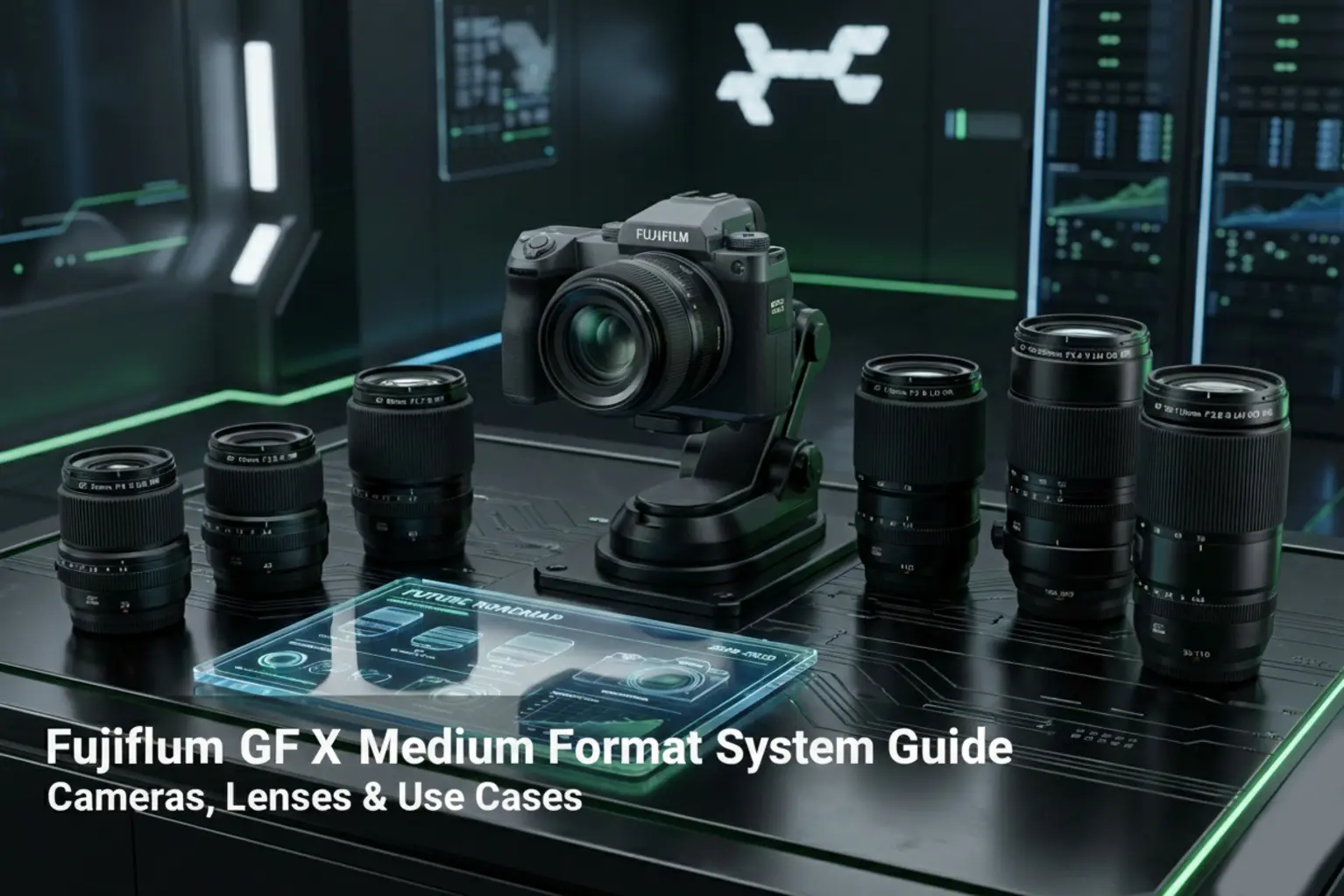
In an era where mirrorless cameras are often judged by speed, autofocus points, and video specs, the Fujifilm GFX Medium Format System exists in a very different category. It is not designed to win specification battles or appeal to mass-market users. Instead, GFX represents a deliberate focus on ultimate image quality, resolution, and tonal depth — priorities that still matter deeply to certain photographers.
Medium format has long been associated with studio work, commercial photography, and fine art. With the GFX system, Fujifilm successfully brought medium format into the mirrorless era, offering modern usability, relatively compact bodies, and a growing native lens ecosystem. Over the years, the system has evolved beyond slow, tripod-only workflows into a flexible platform capable of handling landscapes, location shoots, and even select hybrid use cases.
As part of our Ultimate Mirrorless Camera Guide series, this article explores where the Fujifilm GFX system stands heading into 2026. We’ll look at current GFX cameras — including the latest GFX100RF — the GF lens ecosystem, real-world strengths and limitations, and who medium format is truly for today.
If you’re considering medium format, this guide will help you decide whether the Fujifilm GFX system aligns with your creative goals, workflow, and expectations.
Fujifilm GFX Camera Lineup (2025–2026)
Fujifilm’s GFX system is now clearly positioned around three distinct user profiles: maximum performance, portable high resolution, and accessible medium format. As of 2025, the GFX lineup is no longer defined solely by megapixels, but by real-world usability and professional workflow integration.
Fujifilm GFX100 II — The Flagship Benchmark
The GFX100 II represents the peak of Fujifilm’s medium format vision. With its 102MP backside-illuminated CMOS II HS sensor paired with the X-Processor 5, the GFX system is no longer associated only with resolution, but also with speed, reliability, and modern performance.
- 102MP Medium Format BSI CMOS II HS sensor
- Up to 8-stop In-Body Image Stabilization (IBIS)
- Advanced subject-detection autofocus
- 8K video recording with internal ProRes
- CFexpress Type B memory card support
With this camera, Fujifilm deliberately challenges the long-standing perception that medium format cameras are slow and restrictive. While it is not designed for sports or wildlife, the GFX100 II now sits comfortably alongside high-end full-frame systems in demanding professional environments.
Fujifilm GFX100S II — The Balanced Workhorse
The GFX100S II is arguably the most balanced camera in the entire GFX lineup. It delivers the same 102MP resolution in a more compact, lighter, and more approachable body, making medium format genuinely usable outside the studio.
- 102MP medium format sensor
- 8-stop IBIS
- Improved autofocus algorithms
- More compact and travel-friendly body design
For many photographers, the GFX100S II represents the ideal balance between
ultimate image quality and everyday usability.
Fujifilm GFX100RF — A New Category Inside GFX (2025)
Announced in 2025, the Fujifilm GFX100RF is one of the most radical additions to the GFX system to date. As a fixed-lens medium format camera, it occupies a virtually unique position in the market.
- 102MP medium format sensor
- Fixed prime lens optimized specifically for GF optics
- Leaf shutter benefits including silent operation and flash sync
- Exceptionally compact body for a medium format camera
The GFX100RF is not designed around speed or versatility. Instead, it prioritizes intentional shooting, optical excellence, and a slower, more deliberate creative process — a philosophical camera for photographers who value image character above all else.
Fujifilm GFX50S II — The Entry Point to Medium Format
The GFX50S II remains the most accessible entry point into the GFX ecosystem. Its 51.4MP sensor delivers unmistakable medium format rendering at a more approachable price point.
- 51.4MP medium format sensor
- In-body image stabilization
- Lower cost entry into the GFX system
- Full compatibility with the GF lens ecosystem
While it lacks the speed and processing power of newer GFX models, the GFX50S II still delivers the distinctive medium format look that defines the system.
The GFX system isn’t about replacing your full-frame camera.
It’s about choosing the moments when image quality matters more than speed. Today, the Fujifilm GFX ecosystem no longer assumes a single type of medium format photographer. Whether you prioritize ultimate studio quality, high-resolution travel work, or a minimal, intentional shooting experience, there is a clear place for you within the GFX system.
GF Lens Ecosystem — Primes, Zooms & Optical Philosophy
The strength of the Fujifilm GFX system is not defined by camera bodies alone. Its true long-term value lies in the GF lens ecosystem, which has been built from the ground up specifically for medium format digital photography.
Unlike adapted full-frame lenses, GF lenses are designed to fully exploit the larger sensor area, delivering exceptional corner-to-corner sharpness, smoother tonal transitions, and a distinctive three-dimensional rendering often referred to as the medium format look.
GF Prime Lenses — Maximum Image Quality
GF prime lenses form the optical backbone of the system. These lenses are optimized for absolute resolution, minimal distortion, and refined micro-contrast — qualities that are especially critical at 100MP resolutions.
- GF 23mm f/4 R LM WR — ultra-wide landscapes & architecture
- GF 45mm f/2.8 R WR — everyday documentary & environmental portraiture
- GF 63mm f/2.8 R WR — classic standard perspective
- GF 80mm f/1.7 R WR — shallow depth-of-field portrait work
- GF 110mm f/2 R LM WR — flagship portrait lens
GF Zoom Lenses — Flexibility Without Compromise
Zoom lenses within the GF lineup challenge the assumption that zooms are inherently inferior to primes. Fujifilm’s optical design ensures that GF zooms maintain impressive sharpness across the frame, even at higher megapixel counts.
- GF 32–64mm f/4 R LM WR — ultra-wide to standard coverage
- GF 45–100mm f/4 R LM OIS WR — versatile professional zoom
- GF 100–200mm f/5.6 R LM OIS WR — telephoto landscapes and compressed perspectives
- GF 20–35mm f/4 R WR — wide-angle work with minimal distortion
Lens Compatibility & System Longevity
All GF lenses are fully compatible across the entire GFX lineup, from the entry-level GFX50S II to the flagship GFX100 II and the fixed-lens GFX100RF. This ensures a consistent shooting experience and protects long-term system investment.
Fujifilm’s roadmap indicates a continued focus on optical refinement rather than rapid, fragmented lens expansion — a strategy that aligns perfectly with the philosophy of medium format photography.
GF lenses are not about collecting focal lengths.
They’re about choosing a small number of lenses that you’ll trust for a decade.
System Advantages & Trade-Offs — Medium Format vs Full Frame
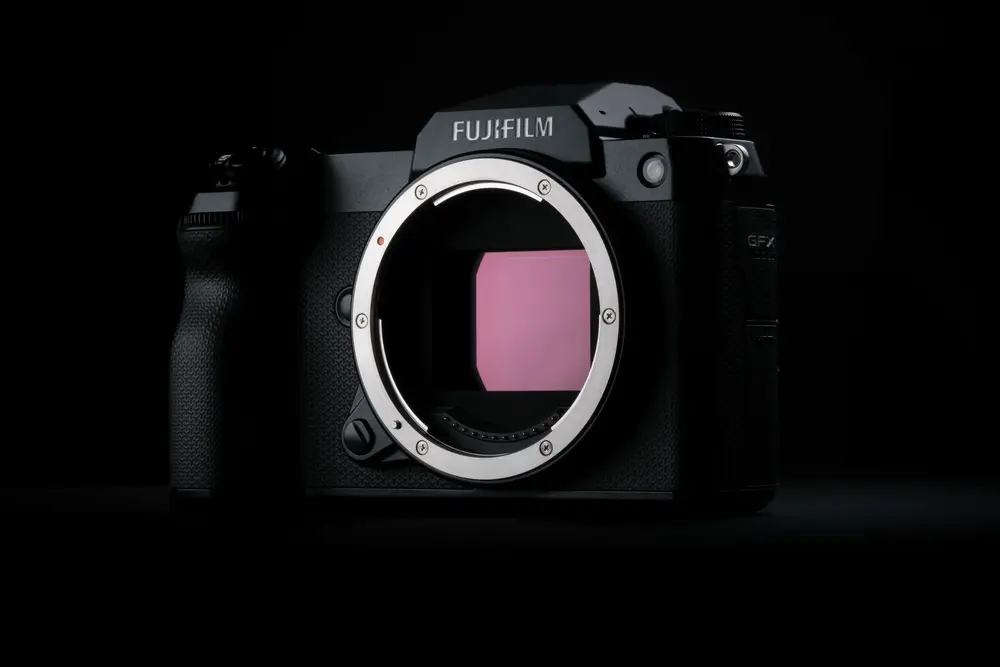
Choosing the Fujifilm GFX system is not about chasing specifications. It is about understanding what medium format does better — and where full-frame systems still hold practical advantages.
Image Quality & Sensor Advantage
The most obvious advantage of the GFX system is its larger sensor size. Compared to full-frame, medium format sensors offer increased surface area, which translates into smoother tonal transitions, richer color depth, and a more natural separation between subject and background.
At high resolutions like 102MP, the benefits become even more apparent in large prints, commercial retouching, and fine art reproduction. This is where the medium format look is not marketing — it is visible.
In-Body Image Stabilization (IBIS)
Modern GFX cameras feature up to 8 stops of IBIS, significantly reducing one of the traditional disadvantages of medium format systems. This allows photographers to handhold high-resolution shots at slower shutter speeds without sacrificing image sharpness.
For landscape and travel photographers, IBIS effectively replaces the need for a tripod in many real-world situations.
Autofocus & Speed — The Honest Reality
Despite major improvements in recent generations, medium format autofocus still prioritizes accuracy over speed. While subject detection and face/eye AF have improved dramatically, GFX cameras are not designed for high-speed action.
Full-frame mirrorless systems continue to dominate in areas such as:
- Sports and wildlife photography
- Fast-moving event coverage
- High burst-rate tracking scenarios
Low-Light Performance — Medium Format vs Full Frame
A common misconception is that larger sensors automatically outperform full-frame cameras in low light. In reality, modern full-frame sensors often retain an advantage at very high ISO values due to faster readout speeds and optimized noise processing.
Medium format cameras excel in low ISO dynamic range, but full-frame cameras may still deliver cleaner results at extreme ISO levels during fast-paced shooting.
Size, Weight & System Commitment
While GFX bodies have become significantly more compact, the overall system still requires a higher level of commitment. Lenses are larger, storage requirements are heavier, and workflow demands more computing power.
This is not a casual system — it is a deliberate one. Photographers who thrive with GFX tend to plan their shoots, slow down their process, and prioritize final output over speed.
Medium format doesn’t make photography easier.
It makes it more intentional — and for some photographers, that’s exactly the point.
Who Should Choose the Fujifilm GFX System?
The Fujifilm GFX system is not designed to replace full-frame cameras. Instead, it exists for photographers who understand when image quality matters more than speed. Knowing whether GFX is right for you depends largely on how — and why — you shoot.
Commercial & Studio Professionals
For commercial, fashion, product, and advertising photographers, the GFX system offers exceptional resolution, color depth, and flexibility in post-production. The ability to crop aggressively while maintaining detail is a major advantage in client-driven workflows.
- High-end product photography
- Fashion and beauty work
- Advertising and campaign imagery
- Art reproduction and archival work
Landscape & Fine Art Photographers
Landscape photographers benefit enormously from the GFX system’s dynamic range, tonal transitions, and ability to resolve fine textures. Large prints reveal a level of depth and realism that is difficult to replicate with smaller formats.
For fine art photographers, GFX cameras support a slower, more intentional shooting style, perfectly aligned with contemplative image-making.
Hybrid Shooters — Photo First, Video Second
Recent GFX models have significantly improved video capabilities, including 8K recording, advanced codecs, and reliable autofocus. However, the system remains primarily photo-centric. Hybrid shooters who prioritize photography but occasionally require cinematic video will find the GFX system capable — but those focused mainly on video production may still prefer full-frame or cinema-oriented platforms.
Who Should Not Choose GFX?
Just as important as knowing who GFX is for, is understanding who it is not designed for.
- Sports and wildlife photographers requiring high burst rates
- Fast-paced event and wedding shooters
- Travelers prioritizing minimal weight and storage
For these use cases, modern full-frame mirrorless systems remain the more practical choice.
GFX rewards patience. If your workflow depends on speed, it may feel restrictive.
If your workflow rewards precision, it can feel liberating.
Future Outlook — Where Does Fujifilm GFX Fit in the Mirrorless Future?
As the mirrorless camera market continues to mature, the role of medium format is becoming more clearly defined. Rather than competing directly with full-frame systems, the Fujifilm GFX ecosystem is evolving as a specialized, high-end creative platform.
According to Daisy’s outlook on mirrorless systems for 2026–2028, the future of mirrorless is less about spec wars and more about ecosystem differentiation. This trend strongly favors systems like GFX, which are built around a clear photographic philosophy rather than mass-market versatility.
Medium Format in a Full-Frame-Dominated Market
Full-frame mirrorless systems will continue to dominate volume sales due to their balance of size, speed, and cost. However, this dominance also creates space for medium format to thrive as a deliberate alternative — particularly for professionals and enthusiasts who value image character over convenience.
Instead of chasing burst rates or AI-driven automation, Fujifilm has positioned GFX as a system that prioritizes sensor quality, lens performance, and long-term creative consistency.
Sensor Innovation & Why It Matters for GFX
Sensor development will play a decisive role in the next generation of mirrorless cameras. As explored in
Daisy’s analysis of future camera sensor technology, improvements in dynamic range, readout speed, and color science will increasingly favor larger sensors in controlled shooting environments.
Medium format sensors inherently benefit from lower pixel density and larger photosites, which allows Fujifilm to push resolution without compromising tonal smoothness. This makes GFX particularly well positioned for future sensor advancements that focus on image quality rather than computational shortcuts.
Long-Term Investment & System Stability
Unlike rapidly evolving consumer mirrorless platforms, the GFX system shows signs of intentional stability. Lens releases are slower but more deliberate, and backward compatibility across bodies ensures that existing investments remain relevant.
For photographers planning long-term projects or building a system meant to last a decade or more, this approach significantly reduces upgrade pressure and protects creative consistency.
As mirrorless systems become increasingly automated, medium format will remain a space for photographers who want to stay deeply involved in the creative process.
Looking ahead, Fujifilm GFX is likely to remain a niche by choice — a system that values image integrity, optical excellence, and thoughtful evolution over chasing every market trend.
Conclusion — Is Fujifilm GFX the Right System for You?
The Fujifilm GFX system is not designed to win spec comparisons or dominate market share. Its purpose is far more focused: to deliver the highest possible image quality within a mirrorless ecosystem that values intentional photography over speed and automation.
Across its current lineup — from the flagship GFX100 II to the compact GFX100RF — Fujifilm has built a medium format system that is no longer confined to studios. It is now a viable creative tool for landscape, fine art, commercial, and hybrid photographers who prioritize final output above all else.
Where GFX Stands in the Mirrorless Ecosystem
Within the broader mirrorless landscape, GFX occupies a clearly defined role. Full-frame systems continue to dominate versatility and speed, while APS-C and Micro Four Thirds offer portability and value. GFX exists above these categories as a specialized image-quality-first platform.
If you are still exploring other mirrorless ecosystems, our complete Ultimate Mirrorless Camera Guide provides a system-level comparison across all major mounts.
How GFX Compares to Other System Guides
For photographers weighing long-term system decisions, it is important to understand how GFX contrasts with other popular platforms:
- Canon EOS R System Guide — speed, AF intelligence, and system breadth
- Nikon Z System Guide — optical excellence and balanced performance
- Sony E-Mount System Guide — cutting-edge technology and market depth
- Fujifilm X System Guide — APS-C performance with strong creative identity
- Panasonic L-Mount System Guide — full-frame flexibility and video-centric workflows
The Bottom Line
Choose Fujifilm GFX if you:
- Prioritize image quality over shooting speed
- Print large or work in high-end commercial environments
- Value optical rendering, tonal depth, and long-term system stability
- Prefer a slower, more deliberate creative process
If your work depends on speed, portability, or rapid turnaround, full-frame systems remain the more practical choice. But if your photography rewards patience and precision, GFX offers something few systems can match.
In a world where cameras are becoming faster and smarter, Fujifilm GFX chooses to become better — not louder.
As the final system spoke in the DCN Mirrorless Hub series, this guide completes a full-picture view of today’s mirrorless ecosystem. Whether you choose GFX or another platform, the best system is always the one that supports how you see the world.
Frequently Asked Questions About the Fujifilm GFX System
Is Fujifilm GFX better than full-frame cameras?
Fujifilm GFX is not universally better than full-frame systems. It excels in image quality, tonal depth, and resolution, especially for commercial, landscape, and fine art photography. Full-frame cameras remain superior for speed, autofocus tracking, and low-light action.
Who should choose a medium format camera like Fujifilm GFX?
The GFX system is ideal for photographers who prioritize image quality over speed, work in controlled environments, print large, or require maximum detail for professional use.
Is Fujifilm GFX suitable for video and hybrid shooters?
Modern GFX cameras offer advanced video features, including 8K recording and professional codecs. However, the system remains photo-first and is best suited for hybrid shooters who prioritize photography.
Are Fujifilm GF lenses compatible with all GFX cameras?
Yes. All GF lenses are fully compatible across the entire Fujifilm GFX lineup, from entry-level models to flagship bodies.
Is Fujifilm GFX a good long-term investment?
Fujifilm’s slow and deliberate system evolution, combined with strong lens compatibility, makes GFX a solid long-term investment for photographers committed to medium format.




[…] Desteği: Yılın Fotoğrafı kazananı ve finalistlerine prestijli FUJIFILM GFX kamera ve lens […]