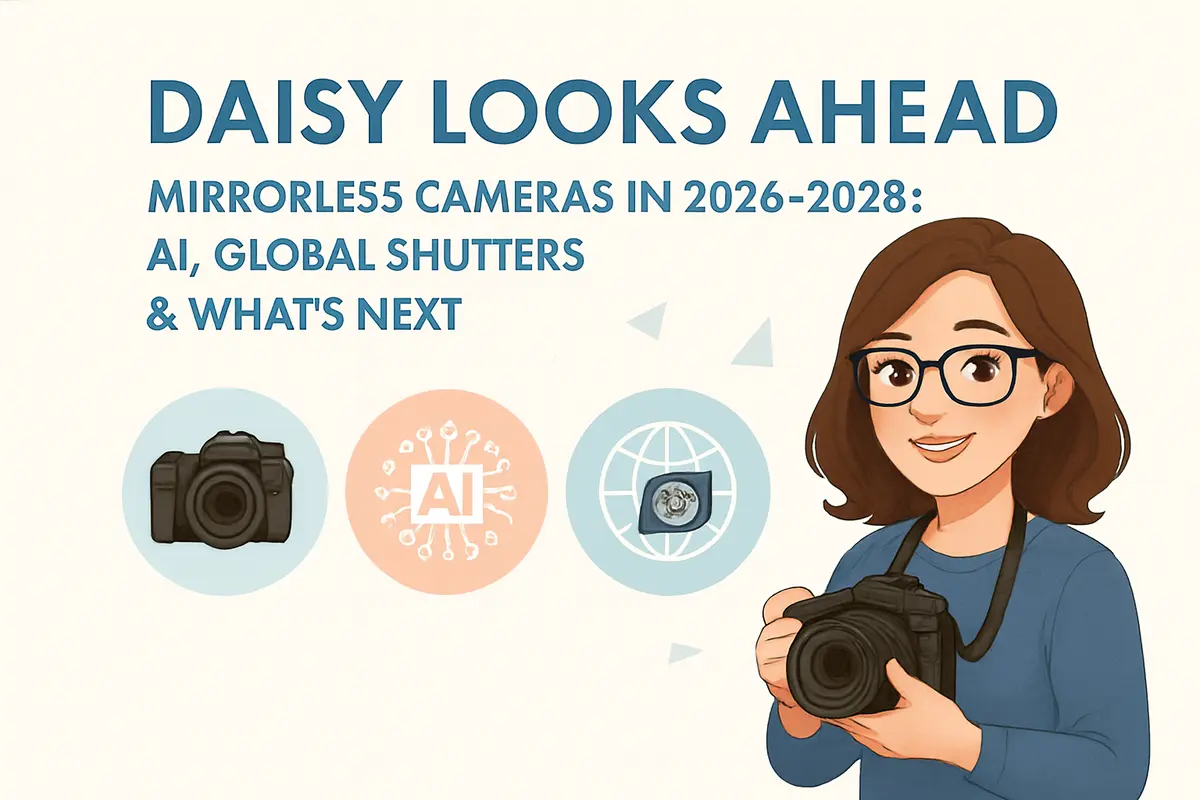
Welcome back to Daisy Looks Ahead — I’m Daisy, your guide to the future of photography. If you’ve been following my series, you know I love exploring where our cameras are headed next. Today we’re diving into the future of mirrorless cameras — a space that’s evolving faster than ever, shaped by AI photography, global shutter sensors, and computational imaging.
Mirrorless cameras have already overtaken DSLRs, becoming the dominant format across beginner kits and professional full-frame bodies. But the real story is what’s coming next. Between 2026 and 2028, expect breakthroughs that will redefine how we shoot: smarter autofocus, cameras that learn your style, and sustainability-driven designs that last longer. Whether you’re a beginner, a hybrid creator, or a seasoned pro, these changes will impact how you capture and share your vision.
Let’s break it down together — here’s where we are now, and where we’re going next.
Where We Are Now: Mirrorless Takes the Lead
Mirrorless cameras have already reshaped the photography landscape. DSLRs, once the kings of every segment, are now the minority. From entry-level kits to flagship full-frame bodies, mirrorless has taken over. I’ve watched this shift unfold, and it’s clear: the future belongs to cameras that are lighter, smarter, and more connected.
Brands like Sony, Canon, Nikon, and Fujifilm are racing forward with faster sensors, smarter autofocus, and deeper AI integration. Meanwhile, smartphones continue to pressure the entry-level market, forcing camera makers to innovate or risk fading away. Enthusiasts and professionals alike expect more performance, more automation, and more computational tools built directly into the body.
Tech Shifts Ahead: AI, Global Shutters & More
Remember the megapixel wars? Daisy says AI is the new battleground. Just as the industry once chased resolution numbers, we’re now entering an era where cameras compete on intelligence. Expect dedicated AI chips inside bodies, handling predictive autofocus, advanced noise reduction, and real-time scene recognition.
- AI becomes the new megapixel race — autofocus that predicts your subject’s next move, noise reduction that feels invisible, and cameras that learn your shooting style.
- Global shutter sensors go mainstream — eliminating rolling shutter, unlocking faster burst speeds, and making video capture smoother than ever.
- Computational photography enters serious territory — in-camera focus stacking, multi-frame blending, AI-enhanced dynamic range, even background cleanup without post-production.
- Lens innovation — expect more f/1.2 primes, compact travel zooms, and hybrid photo-video lenses designed for creators on the move.
- Sustainability pressures — longer product cycles, modular upgrades, recycled materials, and energy-efficient manufacturing will become industry standards.
Brand-by-Brand Forecast
Canon
I believe Canon will expand its RF lineup dramatically. Expect AI-enhanced autofocus modules, next-gen Eye Control AF, and more compact L lenses. A global shutter EOS R model aimed at hybrid shooters is almost inevitable. Canon will push hard in the mid-range ($1,500–$2,500) to dominate creators who want pro features without pro prices.
Sony
Sony remains the innovation leader. Predictions include stacked global shutter sensors in the A7 and A9 series, advanced video codecs with better cooling, and an expanded GM II lens lineup. A new AI processing unit co-developed with Sony Semiconductor could redefine autofocus intelligence. The A7 VI and A9 IV may become the cameras that finally feel like creative partners rather than just tools.
Nikon
Nikon’s Z system is evolving rapidly. Between 2026–2028, I expect a breakthrough Z6 III successor with global shutter, stronger third-party lens support, and computational tools inspired by Nikon’s smartphone collaborations. A video-focused ZR cinema line could expand further, helping Nikon close the gap with Sony in autofocus and burst performance.
Fujifilm
Fuji will double down on X-Trans sensor innovations, film simulation upgrades, and AI-driven auto composition. More compact WR primes will arrive, and rumors of a stacked global shutter X-Trans body may finally become reality. Fuji’s strength lies in blending nostalgia with cutting-edge tech — and I see that continuing.
What It Means for You
So what does all this mean if you’re behind the camera? Here’s Daisy’s take:
- Better results with less technical effort — AI and computational features will make pro-quality images easier to achieve, even for beginners.
- Hybrid shooters prioritized — every brand is optimizing for creators who shoot both photo and video. Expect better codecs, cooling, IBIS, and low-light performance.
- Higher prices but longer product life cycles — advanced components may raise costs, but sustainability pressures will keep cameras relevant longer.
- Skill shifts toward creative direction — with exposure, focus, and noise handled by the camera, photographers will focus more on storytelling, style, and composition.
Imagine a wedding photographer who no longer worries about missed focus in low light, or a travel creator who edits less because the camera already balances dynamic range intelligently. That’s the kind of shift we’re talking about.
Daisy’s Forecast: Smart Cameras as Creative Partners
By 2028, I believe mirrorless cameras won’t just be tools — they’ll be smart creative partners. Imagine a wedding photographer whose camera anticipates the kiss before it happens, or a travel creator whose body automatically balances dynamic range in a sunset shot. Picture a system that recognizes your framing habits, assists in color grading, and even suggests composition tweaks in real time.
These cameras will manage workflow from capture to cloud, narrowing the gap between professional gear and smartphones not through hardware alone, but through intelligent processing and seamless integration. In other words, your camera will know you — and help you tell your story better, faster, and with less friction than ever before.
Final Frame: The Mirrorless Era Accelerates
The future of mirrorless cameras from 2026 to 2028 will be shaped by AI acceleration, smarter autofocus, global shutters, and deep computational features. This isn’t just another upgrade cycle — it’s the most transformative era in digital imaging since the shift from film to digital. Cameras will become faster, smarter, and more sustainable, giving photographers more freedom to focus on creativity rather than technical barriers.
For beginners, this means learning photography will feel less intimidating. For professionals, it means tools that adapt to their style and extend their creative reach. And for hybrid creators, it means seamless transitions between photo and video, with cameras that understand both worlds equally well.
Stay tuned — Daisy will be watching the trends as they evolve, and I’ll be here to guide you through them. Together, we’ll navigate the next chapter of photography’s story — one frame at a time.





[…] makalenin orijinali İngilizce olarak DailyCameraNews.com üzerinde Daisy tarafından […]
[…] And if you like future predictions, don’t miss Daisy’s trend article:👉 Read also: Daisy Looks Ahead: The Future of Mirrorless Cameras & Computational Imaging […]
[…] ahead, reports like Daisy Looks Ahead: Mirrorless Cameras 2026–2028 and Mirrorless Camera Trends 2026–2028 show how Flickr’s data aligns with industry […]