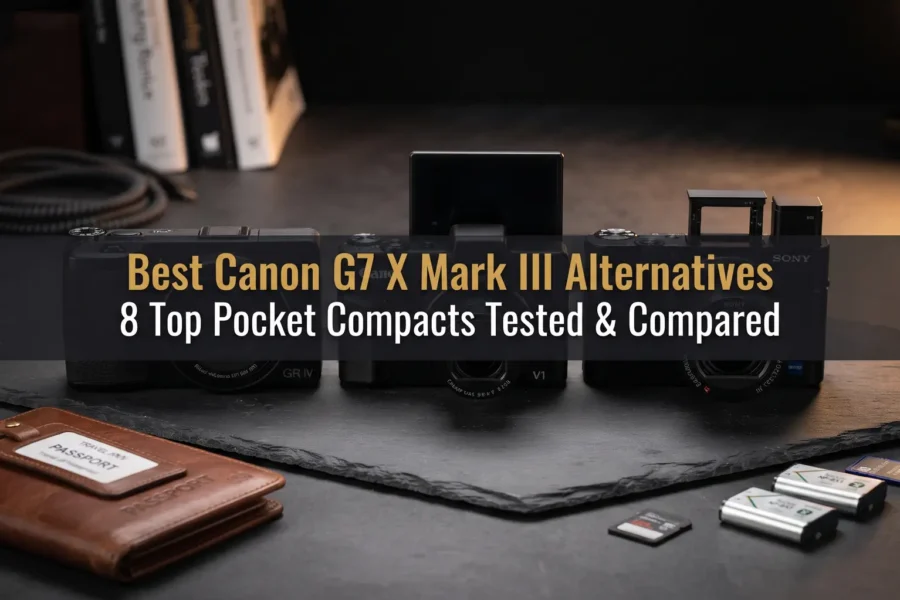
If you have tried buying a Canon PowerShot G7 X Mark III anytime recently, you already know the frustration: chronically empty store shelves, third-party scalper markups north of $1,300, and perpetual backorder notices. Even Canon’s celebratory Canon PowerShot G7 X Mark III 30th Anniversary Limited Edition vanished almost instantly into collectors’ hands rather than solving everyday creator demand.
Naturally, hopeful buyers spent the spring watching headlines closely after reports surfaced around a Canon PowerShot G7 X successor confirmed for 2026, only for months of silence to stall any official launch window. Soon after, chatter shifted toward 2026 Canon PowerShot rumors pointing to an all-new sensor architecture—exciting news on paper, yet cold comfort if you have a trip or filming schedule next month and need a reliable pocket camera right now.
Let’s be honest—waiting indefinitely for a restock or chasing overpriced secondary-market listings rarely makes sense when several in-stock alternatives outperform the 2019 G7 X Mark III in autofocus, video capability, zoom reach, or raw sensor quality. If you want to compare the broader point-and-shoot landscape beyond Canon-specific replacements, our roundup of the best compact cameras in 2026 maps out every sensor tier side by side. Below, I have organized the eight smartest replacements by the exact strengths people love most about the G7 X Mark III.
Quick Answer: The Best Canon G7 X Mark III Alternatives at a Glance
If you want the best overall replacement that preserves true pocketability while upgrading autofocus and telephoto reach, the Sony RX100 VII is still the safest pick. If staying inside the Canon ecosystem with modern 4K/60p video and a larger sensor matters most, the Canon PowerShot V1 is the strongest native upgrade.
- Sony RX100 VII — Best Pocket-Sized 1-Inch Powerhouse (Check Price on Amazon | B&H)
- Canon PowerShot V1 — Best Next-Gen Canon Creator Compact (Check Price on Amazon | B&H)
- Sony ZV-1 — Best Value 1-Inch Hybrid Vlogger (Check Price on Amazon | B&H)
- Sony ZV-1 II — Best Ultra-Wide Pocket Vlog Camera (Check Price on Amazon | B&H)
- Panasonic Lumix ZS99 — Best 30x Travel Zoom on a Budget (Check Price on Amazon | B&H)
- Canon PowerShot SX740 HS — Best 40x Pocket Superzoom for Canon Fans (Check Price on Amazon | B&H)
- Ricoh GR IV — Best True Pocket APS-C Street & Stills Upgrade (Check Price on Amazon | B&H)
- Fujifilm X100VI — Best Tactile APS-C All-Rounder & Film Simulation Icon (Check Price on Amazon | B&H)
Comparing the Top Canon G7 X Mark III Alternatives in 2026
| Camera Model | Sensor & Lens | Autofocus | Low Light | Video Reliability | Pocketability | 2026 Status |
|---|---|---|---|---|---|---|
| Sony RX100 VII | 1-inch | 24–200mm f/2.8–4.5 | ★★★★★ | ★★★☆☆ | ★★★★☆ | ★★★★★ | ✅ Recommended |
| Canon PowerShot V1 | 1.4-inch | 16–50mm f/2.8–4.5 | ★★★★★ | ★★★★☆ | ★★★★★ | ★★★☆☆ | ✅ Recommended |
| Sony ZV-1 | 1-inch | 24–70mm f/1.8–2.8 | ★★★★★ | ★★★★☆ | ★★★★☆ | ★★★★★ | ✅ Recommended |
| Sony ZV-1 II | 1-inch | 18–50mm f/1.8–4.0 | ★★★★★ | ★★★☆☆ | ★★★★☆ | ★★★★★ | ✅ Recommended |
| Panasonic Lumix ZS99 | 1/2.3-inch | 24–720mm f/3.3–6.4 | ★★★☆☆ | ★★☆☆☆ | ★★★☆☆ | ★★★★★ | ⚠️ Depends (Daylight Zoom) |
| Canon PowerShot SX740 HS | 1/2.3-inch | 24–960mm f/3.3–6.9 | ★★☆☆☆ | ★★☆☆☆ | ★★★☆☆ | ★★★★★ | ⚠️ Depends (Max Reach) |
| Ricoh GR IV | APS-C | 28mm f/2.8 Prime | ★★★☆☆ | ★★★★★ | ★★☆☆☆ | ★★★★★ | ✅ Recommended (Stills) |
| Fujifilm X100VI | APS-C | 35mm f/2.0 Prime | ★★★★☆ | ★★★★★ | ★★★★☆ | ★★★☆☆ | ✅ Recommended (Hybrid) |
| Check Current Deals | — | RX100 VII | PowerShot V1 | Sony ZV-1 II | Ricoh GR IV | X100VI |
1. Sony RX100 VII — Best Pocket-Sized 1-Inch Powerhouse
At a Glance
- Sensor: 20.1MP 1-inch Stacked Exmor RS CMOS
- Lens: ZEISS Vario-Sonnar T* 24–200mm equivalent, f/2.8–4.5
- Autofocus & Speed: 357 PDAF points, Real-Time Eye AF, 20fps blackout-free bursts
- Viewfinder & Screen: Pop-up 2.36M-dot OLED EVF + 3.0-inch 180° tilting touchscreen
- Weight: 302g (10.7 oz) with battery and card
Pros
- Doubles the G7 X Mark III’s telephoto reach (200mm vs. 100mm) in an identical jeans-pocket footprint
- Flagship-caliber Real-Time Tracking and Eye AF completely outclass Canon’s older contrast-detect system
- Built-in pop-up OLED viewfinder makes bright outdoor composition effortless
- Includes a 3.5mm external microphone input and oversampled 4K/30p video
Cons
- Variable f/2.8–4.5 lens is dimmer indoors than the G7 X Mark III’s f/1.8–2.8 optic
- Steep 2026 retail pricing (~$1,498–$1,699) and aging Micro-USB port
- Short ~260-shot NP-BX1 battery life requires carrying spares
Why We Choose
If your main attraction to the G7 X Mark III was slipping a genuine 1-inch sensor zoom camera into a jacket pocket, the Sony RX100 VII is the closest direct substitute—and in several ways, a major upgrade. Where Canon’s older contrast-based autofocus often hunted during walk-and-talk clips or fast street action, Sony’s stacked sensor delivers instantaneous phase-detection tracking and 20fps blackout-free bursts.
In my field testing, the trade-off comes down to light versus reach. You lose the bright f/1.8–2.8 aperture that gave the G7 X Mark III creamy indoor background blur, trading it for a razor-sharp 24–200mm ZEISS range and a crisp pop-up EVF. Add a $15 Sony AG-R2 stick-on grip and two spare batteries, and you have the most capable pocket travel zoom still in production.
Check Current Availability & Pricing: Sony Cyber-shot DSC-RX100 VII
Check Price on Amazon | Check Price at B&H Photo | Check Price at Adorama
2. Canon PowerShot V1 — Best Next-Gen Canon Creator Compact
At a Glance
- Sensor: 22.3MP 1.4-inch CMOS (18.4 × 12.3mm) with Dual Pixel CMOS AF II
- Lens: 16–50mm equivalent, f/2.8–4.5 with Optical IS and built-in 3-stop ND filter
- Video Specs: Oversampled 4K/30p (full width), 4K/60p (1.4x crop), Canon Log 3, active cooling fan
- Screen & Audio: 3.0-inch fully articulating vari-angle touchscreen, mic + headphone jacks, multi-function shoe
- Weight: 426g (15.0 oz) with LP-E17 battery and card
Pros
- Significantly larger 1.4-inch sensor delivers cleaner high-ISO files and stronger dynamic range than any 1-inch rival
- Ultra-wide 16–50mm lens eliminates cramped selfie framing while keeping a built-in 3EV ND filter
- Internal cooling fan, Canon Log 3, and 4K/60p make it a legitimate pocket cinema rig
- Familiar Canon color science, menus, and Dual Pixel AF reliability
Cons
- Chunkier 426g body is coat-pocketable rather than jeans-pocketable
- 50mm telephoto ceiling stops well short of the G7 X Mark III’s 100mm reach
- No electronic viewfinder or built-in pop-up flash
Why We Choose
While Canon kept fans waiting on a traditional G-series stills refresh, the Canon PowerShot V1 arrived around $899 as Canon’s true modern answer for hybrid creators. Built around a larger 1.4-inch sensor—roughly double the surface area of a standard 1-inch chip—it brings Dual Pixel CMOS AF II, Canon Log 3, a built-in cooling fan, and a side-flipping vari-angle screen into a fixed-lens body.
If I were upgrading from a G7 X Mark III primarily for YouTube, TikTok, or travel storytelling, this is the easiest transition you can make. You keep Canon’s flattering skin tones and intuitive touch interface while gaining a 16mm ultra-wide field of view that makes handheld vlogging effortless without a selfie stick.
Check Current Availability & Pricing: Canon PowerShot V1
Check Price on Amazon | Check Price at B&H Photo | Check Price at Adorama
3. Sony ZV-1 — Best Value 1-Inch Hybrid Vlogger
At a Glance
- Sensor: 20.1MP 1-inch Exmor RS stacked CMOS
- Lens: ZEISS Vario-Sonnar T* 24–70mm equivalent, f/1.8–2.8 with Optical SteadyShot
- Video & Audio: 4K/30p, S-Log2/S-Log3, built-in 3-capsule directional mic + wind muff, 3.5mm mic jack
- Screen & Extras: 3.0-inch side-flipping vari-angle touchscreen, built-in 3-stop ND filter, Product Showcase mode
- Weight: 294g (10.4 oz) with battery and card
Pros
- Matches the G7 X Mark III’s bright f/1.8–2.8 aperture and built-in ND filter while adding phase-detect Eye AF
- Side-articulating touchscreen never gets blocked by a hot-shoe microphone
- Frequently available new or certified refurbished well below inflated G7 X Mark III prices
- Includes a directional 3-capsule mic and furry windscreen right in the box
Cons
- 24mm wide end crops tight when electronic Active SteadyShot is turned on
- Uses an older Micro-USB port and lacks a viewfinder or built-in flash
Why We Choose
In terms of pure optical DNA, the original Sony ZV-1 is practically the G7 X Mark III’s twin—pairing a 20.1MP 1-inch stacked sensor with a fast 24–70mm f/1.8–2.8 ZEISS lens and a built-in 3-stop neutral density filter. What separates them in daily use is reliability: Sony’s Real-Time Eye AF locks onto faces instantaneously, and its Product Showcase setting transitions focus smoothly when you hold items up to the lens.
Because the ZV-1 has matured into a high-value staple among vlogging cameras, it routinely undercuts scalped Canon prices by hundreds of dollars while delivering superior audio out of the box.
Check Current Availability & Pricing: Sony ZV-1 Digital Camera
Check Price on Amazon | Check Price at B&H Photo | Check Price at Adorama
4. Sony ZV-1 II — Best Ultra-Wide Pocket Vlog Camera
At a Glance
- Sensor: 20.1MP 1-inch Exmor RS stacked CMOS
- Lens: ZEISS Vario-Sonnar T* 18–50mm equivalent, f/1.8–4.0 with built-in ND filter
- Connectivity & Audio: USB-C port (UVC webcam support), intelligent 3-capsule mic, 3.5mm mic jack
- Screen & Controls: 3.0-inch vari-angle touchscreen with full touch UI and Cinematic Vlog presets
- Weight: 292g (10.3 oz) with battery and card
Pros
- 18mm ultra-wide lens keeps two people and scenic backgrounds comfortably in frame at arm’s length
- Modern USB-C charging, webcam streaming, and revamped touch-friendly Sony menu interface
- Featherweight 292g pocket chassis with built-in 3-stop ND filter
- Intelligent multi-directional microphone automatically prioritizes voices in front of or behind the camera
Cons
- Replaces optical lens stabilization with electronic-only stabilization
- Stops at f/4.0 at 50mm, offering less telephoto reach and background blur than the original ZV-1
Why We Choose
Anyone who has vlogged at arm’s length with a 24mm lens knows how quickly electronic stabilization turns a wide shot into a tight forehead close-up. The Sony ZV-1 II fixes that single annoyance by swapping in an 18–50mm equivalent lens, USB-C connectivity, and Sony’s modernized touch menu system while keeping the body under 300 grams.
If your workflow leans toward walk-and-talk travel diaries, group selfies, and quick plug-and-play USB-C livestreaming rather than zoomed-in portraits, the ZV-1 II feels far more modern in hand than a 2019 Canon compact.
Check Current Availability & Pricing: Sony ZV-1 II Vlog Camera
Check Price on Amazon | Check Price at B&H Photo | Check Price at Adorama
5. Panasonic Lumix ZS99 — Best 30x Travel Zoom on a Budget
At a Glance
- Sensor: 20.3MP 1/2.3-inch High-Sensitivity MOS sensor
- Lens: LEICA DC Vario-Elmarit 24–720mm equivalent (30x optical zoom), f/3.3–6.4 with 5-axis Hybrid O.I.S.
- Video & Screen: UHD 4K/30p video, 4K Photo 30fps bursts, 3.0-inch 180° tilting touchscreen (1.84M-dot)
- Battery & Connectivity: 380-shot CIPA battery life, USB-C charging, Bluetooth 5.0 & Wi-Fi
- Weight: 322g (11.4 oz) with battery and SD card
Pros
- Massive 24–720mm LEICA-branded 30x optical zoom fits inside a 322g pocket body
- USB-C charging and a sharp 1.84M-dot 180-degree flip screen modernize daily travel use
- Generous 380-shot battery life outlasts most 1-inch compacts
- Typically priced around $498–$698—well below $1,000+ enthusiast compacts
Cons
- Smaller 1/2.3-inch sensor and f/3.3–6.4 aperture struggle in dim indoor lighting compared to 1-inch models
- No electronic viewfinder or external microphone input
Why We Choose
Not every shopper looking at the G7 X Mark III actually needs shallow depth of field—many simply want a real pocket camera that outperforms a smartphone zoom on vacation without costing four figures. The Panasonic Lumix ZS99 delivers an astonishing 24–720mm optical reach alongside USB-C charging, a high-resolution 180-degree selfie screen, and Panasonic’s clever 4K Photo burst tools.
In bright outdoor light—whether capturing distant mountain peaks, architectural details, or stadium concerts—the ZS99 runs circles around digital smartphone crops while keeping your travel budget intact.
Check Current Availability & Pricing: Panasonic Lumix DC-ZS99
Check Price on Amazon | Check Price at B&H Photo | Check Price at Adorama
6. Canon PowerShot SX740 HS — Best 40x Pocket Superzoom for Canon Fans
At a Glance
- Sensor: 20.3MP 1/2.3-inch CMOS with DIGIC 8 processor
- Lens: 24–960mm equivalent (40x optical zoom), f/3.3–6.9 with Intelligent IS
- Video & Screen: 4K/30p video, 10fps continuous shooting, 3.0-inch 180° tilting LCD
- Extras: Built-in pop-up flash, Zoom Framing Assist, Wi-Fi & Bluetooth
- Weight: 299g (10.5 oz) with battery and SD card
Pros
- Unrivaled 24–960mm (40x) optical zoom inside a sub-300g Canon body
- Includes a built-in pop-up flash for nostalgic Y2K/party flash aesthetics
- Zoom Framing Assist button makes re-acquiring distant subjects at 960mm intuitive
- Familiar Canon menu ergonomics and pleasing out-of-camera JPEG colors
Cons
- Small 1/2.3-inch sensor shows noticeable grain above ISO 800
- Uses Micro-USB charging, lacks RAW capture, and has no touchscreen or mic jack
Why We Choose
Interestingly, social media trends have turned the Canon PowerShot SX740 HS into one of Canon’s most viral point-and-shoots alongside the G7 X Mark III—largely thanks to its built-in flash look, flip-up screen, and Canon color profile. While its 1/2.3-inch sensor cannot match the G7 X Mark III in low-light dynamic range, its 40x optical zoom reaches an astonishing 960mm equivalent in a 299g chassis.
If your priority is daylight travel reach, candid flash snapshots with friends, and staying inside Canon’s familiar interface without spending $1,500, the SX740 HS remains a fun, pocket-ready companion.
Check Current Availability & Pricing: Canon PowerShot SX740 HS
Check Price on Amazon | Check Price at B&H Photo | Check Price at Adorama
7. Ricoh GR IV — Best True Pocket APS-C Street & Stills Upgrade
At a Glance
- Sensor: 25.7MP Back-Illuminated APS-C CMOS with GR ENGINE 7
- Lens: 18.3mm f/2.8 GR Lens (28mm full-frame equivalent)
- Stabilization & Storage: 5-axis sensor-shift Shake Reduction (IBIS) + 53GB built-in memory + microSD
- Features: Snap Distance Priority AE, 12 Image Control film profiles, USB-C PD
- Weight: Ultra-compact pocket magnesium-alloy body (~262g)
Pros
- Massive APS-C sensor delivers vastly cleaner night shots and richer RAW latitude than any 1-inch compact
- Truly slips into a front jeans pocket while housing a razor-sharp 28mm f/2.8 prime
- 5-axis IBIS, Snap Focus, and 53GB of internal storage make it the fastest street shooter alive
- Near-instant startup time captures fleeting candid moments before subjects notice you
Cons
- Fixed 28mm wide-angle lens offers zero optical zoom
- No tilting screen, no viewfinder, and basic 1080p video—strictly a still photographer’s camera
Why We Choose
If your reason for wanting a G7 X Mark III had less to do with vlogging and everything to do with getting real DSLR/mirrorless image quality out of a jacket pocket, the Ricoh GR IV is a revelation. Upgrading to a 25.7MP back-illuminated APS-C sensor, GR ENGINE 7 processor, and 5-axis in-body stabilization, it produces crisp, three-dimensional files that dwarf 1-inch sensors in both dynamic range and high-ISO cleanliness.
You give up zoom and a flip screen entirely, so this isn’t a vlogging camera—but for street photography and everyday visual journaling, nothing else packs this much image quality into a true pocket footprint.
Check Current Availability & Pricing: Ricoh GR IV Digital Camera
Check Price on Amazon | Check Price at B&H Photo | Check Price at Adorama
8. Fujifilm X100VI — Best Tactile APS-C All-Rounder & Film Simulation Icon
At a Glance
- Sensor: 40.2MP APS-C X-Trans CMOS 5 HR with X-Processor 5
- Lens: Fujinon 23mm f/2.0 II (35mm full-frame equivalent) with built-in 4-stop ND filter
- Stabilization & Finder: Up to 6.0-stop 5-axis IBIS + Advanced Hybrid Optical/Electronic Viewfinder
- Video & Color: 6.2K/30p & 4K/60p 10-bit video, 20 Film Simulations including REALA ACE
- Weight: 521g (18.4 oz) with battery and SD card
Pros
- 40.2MP APS-C sensor, 6-stop IBIS, and built-in 4-stop ND filter produce breathtaking stills and 10-bit video
- 20 iconic Fujifilm Film Simulations deliver gorgeous straight-out-of-camera color with zero editing
- Unique hybrid optical/electronic viewfinder and physical shutter/aperture dials elevate shooting joy
- Versatile 35mm-equivalent focal length flatters portraits, food, architecture, and street scenes
Cons
- Larger 521g rangefinder body requires a coat pocket or small crossbody sling
- Higher $1,799 retail price and fixed 35mm prime lens without optical zoom
Why We Choose
For photographers who admire the G7 X Mark III’s straight-out-of-camera color charm and built-in ND filter—but are willing to carry a slightly larger camera for flagship image quality—the Fujifilm X100VI sits in a league of its own. Combining a 40.2MP APS-C sensor, 6-stop in-body stabilization, 4K/60p 10-bit video, and 20 beloved Film Simulations, it turns every walk into a tactile creative experience.
While it is heavier and pricier than a 1-inch pocket zoom, its 35mm f/2.0 lens and internal 4-stop ND filter handle bright beach afternoons and moody candlelit dinners with equal grace.
Check Current Availability & Pricing: Fujifilm X100VI Digital Camera
Check Price on Amazon | Check Price at B&H Photo | Check Price at Adorama
Buying Guide: How to Choose the Right G7 X Mark III Alternative
Before pulling the trigger on a replacement, it helps to diagnose which specific feature of the Canon G7 X Mark III you actually rely on most—because no single camera in 2026 combines a fast f/1.8–2.8 zoom, 1-inch sensor, pocket size, and budget pricing all at once. If you are weighing fixed-lens compacts against ultra-light mirrorless kits for an upcoming trip, our guide to the best cameras for travel photography breaks down how both form factors pack on the road.
1. Sensor Size vs. True Jeans-Pocket Size
Sensor physics always dictates camera volume. Cameras with 1-inch or 1/2.3-inch sensors—like the Sony RX100 VII, Sony ZV-1, and Panasonic Lumix ZS99—use collapsible lens barrels that slide effortlessly into a trouser or small purse pocket. Stepping up to 1.4-inch or APS-C sensors in the Canon PowerShot V1 or Fujifilm X100VI rewards you with dramatically cleaner night photos and richer dynamic range, though you will carry them on a wrist strap or in a jacket pocket. The Ricoh GR IV is the rare exception that squeezes an APS-C sensor into a true jeans-pocket shell by sticking to a retractable 28mm prime.
2. Optical Zoom Versatility vs. Fixed Prime Speed
Think honestly about how you frame your shots. If you frequently photograph distant architecture, stage performances, or wildlife where cropping isn’t enough, prioritize optical zoom—ranging from the 24–200mm reach of the RX100 VII to the 30x–40x superzooms on the ZS99 and Canon SX740 HS. Conversely, if 90% of your photography happens in cafes, city streets, or indoor gatherings, a bright fixed prime like the Ricoh GR IV (f/2.8) or Fujifilm X100VI (f/2.0) gathers far more light and produces cleaner, sharper results.
3. Vlogging Ergonomics, ND Filters & Stabilization
For video creators, lens focal length and screen articulation matter more than megapixel counts. When filming yourself at arm’s length, a 24mm lens feels tight once electronic stabilization crops in, which is why the 16mm wide end on the Canon PowerShot V1 and the 18mm wide end on the Sony ZV-1 II feel immediately more natural. Equally important is a built-in neutral density (ND) filter—included on the PowerShot V1, ZV-1, ZV-1 II, and Fujifilm X100VI—so you can keep cinematic shutter speeds outdoors without screwing filters onto tiny retractable barrels.
Hunting for Seasonal Compact Camera Savings? Before paying full retail, check our live tracker of best compact camera Black Friday deals alongside our dedicated roundup of Canon Black Friday deals to see which PowerShot, Sony, and Fujifilm models are currently discounted.
Frequently Asked Questions
Why is the Canon PowerShot G7 X Mark III still so hard to find and expensive in 2026?
Viral social media demand collided with limited compact camera production capacity, creating a persistent supply bottleneck that Canon has never fully cleared. Even though the G7 X Mark III launched back in 2019, waves of creators seeking its warm JPEG color profile, built-in flash, and flip-up screen continue buying up retail shipments within hours. As a result, third-party resellers routinely list new or open-box units far above Canon’s original retail price. Buying an in-stock alternative like the Sony ZV-1, Canon PowerShot V1, or Sony RX100 VII gives you newer autofocus technology and full manufacturer warranty protection without paying scalper markups.
Which alternative has the closest image quality and look to the Canon G7 X Mark III?
For a nearly identical 1-inch sensor look with a bright f/1.8–2.8 zoom lens and built-in ND filter, the Sony ZV-1 is the closest optical match while offering far superior eye-tracking autofocus. If you specifically love Canon’s signature warm skin tones and color science, the Canon PowerShot V1 is your best native match—and its larger 1.4-inch sensor actually produces cleaner low-light images and stronger dynamic range than the G7 X Mark III. For pure photographic color charm in a fixed-lens body, the Fujifilm X100VI’s 20 Film Simulations deliver extraordinary straight-out-of-camera results.
Should I wait for the rumored Canon G7 X Mark IV or buy one of these alternatives now?
Unless you already own a working camera and have zero upcoming trips or filming deadlines, buying one of today’s proven alternatives makes far more practical sense than waiting. While industry reports confirm Canon is actively exploring next-generation PowerShot compacts and new sensor architectures, no firm retail shipping date has been guaranteed—and any new G-series launch will likely face intense initial backorders. Cameras like the PowerShot V1, Sony RX100 VII, and Ricoh GR IV are available now, hold strong resale value, and let you start capturing memories immediately.
Are 1-inch compact cameras still better than flagship smartphones in 2026?
Yes, particularly when you inspect fine textures, highlights, and optical zoom shots on a larger screen. While flagship smartphones rely on aggressive computational sharpening, artificial portrait blur, and digital cropping between fixed lenses, a 1-inch or APS-C compact camera captures genuine optical depth of field and natural tonal transitions with full RAW flexibility. Dedicated cameras also give you physical exposure dials, built-in ND filters, hot-shoe microphone expansion, and uninterrupted battery swaps—making intentional travel photography and hybrid video creation vastly more reliable.
Final Recommendation & Daisy’s Last Word
Chasing a single sold-out camera model often blinds us to a simple principle: the best pocket camera isn’t the one trending on social feeds—it is the one that matches your real shooting habits and is actually in your bag when the light turns golden.
Once you build the everyday practice of carrying a compact camera—whether slipping the 24–200mm Sony RX100 VII into your jacket before a flight or framing ultra-wide walk-and-talks on the Canon PowerShot V1—your visual storytelling will progress faster than waiting months for a backorder notification. Pick the sensor and lens combination that fits your daily routine, pack one spare battery, and focus on capturing the moments right in front of you.
Daisy’s Advice: Don’t pay $1,400+ to a scalper for a 2019 Canon G7 X Mark III. Put that money toward the Canon PowerShot V1 if you shoot hybrid video and love Canon colors, the Sony RX100 VII if you want a true pocket zoom with a viewfinder, or the Ricoh GR IV if pure pocket-sized photo quality is your top goal.
Daisy’s Last Word: Compact cameras are enjoying a well-deserved renaissance, and having this many strong alternatives means you never have to settle for inflated prices or outdated autofocus. Which compact camera made it into your pocket or travel bag this year—and are you still holding out for a future G7 X Mark IV? Share your setup in the comments below!

See More DCN on Google
Add Daily Camera News as a trusted source to see our latest camera reviews, deal alerts, and photography news first in Google Search.
Explore Recommended Gear
Looking for the best cameras, lenses, and accessories? Check out our curated, hand-picked gear lists on Amazon.