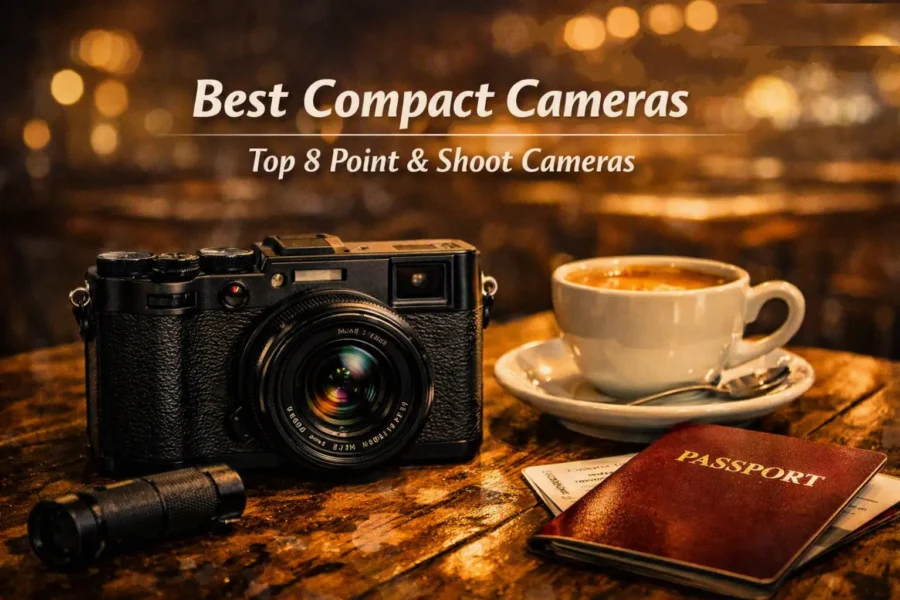
Smartphone cameras have come a long way, but dedicated compact cameras continue to thrive—and for good reason. In 2026, the best point-and-shoot compact cameras offer physical controls, optical zoom, larger APS-C or full-frame sensors, superior dynamic range, and an irreplaceable tactile shooting experience that no mobile screen can match.
Whether you’re seeking a pocket-sized travel companion, a stealthy street photography camera, or an all-in-one everyday shooter for family memories, the compact camera market has matured into distinct categories tailored to every style and budget. From modern cult classics like the Fujifilm X100VI to high-end full-frame powerhouses like the Leica Q3, this comprehensive buyer’s guide breaks down the top compact cameras available today.
Daisy’s Take: Don’t make the mistake of assuming all compact cameras are created equal! A fixed-focal-length street camera like the Ricoh GR IV requires a completely different mindset than a versatile travel-zoom like the Sony RX100 VII. Decide whether maximum pocketability, optical zoom versatility, or absolute image quality is your top priority before choosing.
Quick Comparison: Best Compact Cameras at a Glance
| Model | Best For | Sensor Size | Lens (Equiv.) |
|---|---|---|---|
| Fujifilm X100VI | Best Overall Compact | 40.2MP APS-C | 35mm f/2.0 |
| Ricoh GR IV / GR IIIx | Best Pocketable Street Cam | 26MP APS-C | 28mm / 40mm f/2.8 |
| Sony RX100 VII | Best Compact Travel Zoom | 20.1MP 1.0-type | 24-200mm f/2.8-4.5 |
| Leica Q3 | Best Premium Full-Frame | 60.3MP Full-Frame | 28mm f/1.7 Summilux |
| Canon PowerShot G7 X Mark III | Best Compact for Vlogging | 20.1MP 1.0-type | 24-100mm f/1.8-2.8 |
1. Best Overall Compact Camera: Fujifilm X100VI
The Fujifilm X100VI remains the undisputed king of enthusiast compact cameras. Building on the massive success of its predecessor, the X100VI pairs a sharp 40.2-megapixel APS-C X-Trans sensor with 5-axis in-body image stabilization (IBIS). Its signature hybrid optical/electronic viewfinder, analog-style exposure dials, and famous Film Simulation modes make it one of the most rewarding everyday cameras ever made.
Key Specifications
- Sensor: 40.2MP APS-C X-Trans CMOS 5 HR
- Lens: 23mm f/2.0 (35mm equivalent)
- Stabilization: 5-axis In-Body Image Stabilization (IBIS, up to 6 stops)
- Viewfinder: Hybrid Optical / 3.69m-dot OLED Electronic
- Video: 6.2K at 30fps / 4K at 60fps
Despite adding sensor stabilization, Fujifilm maintained virtually the same compact dimensions as previous generations. The 35mm-equivalent fixed focal length is incredibly flexible for street scenes, travel, environmental portraits, and family life. While demand remains high, its image quality, styling, and joy of use justify its reputation as the gold standard of modern compacts.
Check Prices & Availability
2. Best Truly Pocketable Camera: Ricoh GR IV / GR III Series
For photographers who want serious image quality in a body that actually fits into a jeans pocket, nothing touches the Ricoh GR series. Featuring a large APS-C sensor inside an impossibly small, lightweight chassis, the Ricoh GR delivers DSLR-grade image sharpness with single-handed ergonomics.
Key Specifications
- Sensor: 24MP / 26MP APS-C CMOS
- Lens Options: 18.3mm f/2.8 (28mm equiv.) or 26.1mm f/2.8 (40mm equiv. GR IIIx)
- Weight: Approx. 257g (battery & memory card included)
- Specialty Feature: Snap Focus mechanism for instantaneous street shooting
The legendary Snap Focus feature allows you to bypass autofocus lag entirely by pre-setting focus distances, making it the ultimate tool for street photographers. Whether you choose the wide 28mm field of view or the tighter 40mm perspective of the GR IIIx, it remains the ultimate stealth camera.
Check Prices & Availability
3. Best Compact Travel Zoom: Sony RX100 VII
The Sony RX100 VII packs extraordinary versatility and autofocus speed into a palm-sized camera. Featuring a 24-200mm equivalent zoom range, it covers everything from sweeping landscapes to distant travel subjects while remaining small enough to slip into a jacket pocket.
Key Specifications
- Sensor: 20.1MP 1.0-type Stacked CMOS
- Lens: ZEISS Vario-Sonnar T* 24-200mm f/2.8-4.5
- Autofocus: 357 Phase-Detection AF points with Real-time Eye AF & Tracking
- Viewfinder: Pop-up 2.36m-dot OLED EVF
- Continuous Shooting: Up to 20fps black-out free
Inheriting autofocus algorithms from Sony’s pro mirrorless line, the RX100 VII tracks subjects effortlessly. Add in a pop-up electronic viewfinder, 4K video recording, mic input, and tilt screen, and it stands as the ultimate pocket zoom camera for travelers.
Check Prices & Availability
4. Best Premium Full-Frame Compact: Leica Q3
If budget is secondary to absolute image perfection and mechanical craftsmanship, the Leica Q3 is unmatched. Housing a full-frame 60.3-megapixel sensor paired with a fixed Leica Summilux 28mm f/1.7 ASPH lens, the Q3 delivers staggering optical resolution, rich micro-contrast, and beautiful background separation.
Key Specifications
- Sensor: 60.3MP Full-Frame BSI CMOS (with Triple Resolution Technology)
- Lens: Leica Summilux 28mm f/1.7 ASPH. with Macro Mode
- Display: 3.0-inch high-res tilting touchscreen
- EVF: 5.76m-dot OLED Electronic Viewfinder
- Build: IP52 weather-sealed magnesium construction
The addition of a tilting OLED rear screen, hybrid phase-detection autofocus, wireless charging support, and 8K video capabilities makes the Q3 the most complete full-frame fixed-lens camera on the market today.
Check Prices & Availability
5. Best Compact for Vlogging & Content: Canon PowerShot G7 X Mark III
The Canon PowerShot G7 X Mark III continues to be a favorite among vloggers, lifestyle creators, and streamers. Featuring a fast f/1.8-2.8 zoom lens, 1.0-inch sensor, flip-up screen, and uncropped 4K video, it captures polished video without requiring a complicated setup.
Key Specifications
- Sensor: 20.1MP 1.0-type Stacked CMOS
- Lens: 24-100mm f/1.8-2.8 equivalent zoom
- Video: Uncropped 4K 30p & Full HD 120p slow-motion
- Audio & Livestream: 3.5mm external mic port + direct YouTube livestreaming support
Canon’s intuitive touch interface and flattering skin tones make framing self-shot videos quick and painless, while optical image stabilization ensures steady handheld clips.
Check Prices & Availability
How to Choose the Right Compact Camera in 2026
To pick the perfect compact camera, focus on how you intend to shoot:
- Fixed Lens vs. Zoom: Fixed focal length cameras (like the Fujifilm X100VI or Ricoh GR series) offer wider maximum apertures and superior sharpness, but require you to zoom with your feet. Zoom models (like the Sony RX100 VII) offer maximum framing flexibility for travel.
- Sensor Size: Larger APS-C and Full-Frame sensors deliver better low-light performance and shallow depth of field, while 1.0-inch sensors allow for significantly smaller camera bodies with long zoom lenses.
- Controls & Ergonomics: Decide whether you prefer tactile analog dials (Fujifilm/Leica) or touch-screen modern menus (Sony/Canon).
Frequently Asked Questions (FAQ)
Frequently Asked Questions
Q: Are compact cameras still worth buying in 2026?
A: Yes! Compact cameras offer larger sensors, true optical zoom lenses, physical control dials, and superior dynamic range compared to smartphones, yielding photos with distinct optical depth and depth of field.
Q: What is the best compact camera for street photography?
A: The Ricoh GR IV (or GR III series) is widely considered the best street photography compact due to its trouser-pocketable size, APS-C sensor, fast snap focus mechanism, and single-handed operation.
Q: What is the difference between a compact camera and a mirrorless camera?
A: A compact camera has a fixed lens built directly into the camera body that cannot be removed. A mirrorless camera features interchangeable lenses that can be detached and swapped for different shooting scenarios.