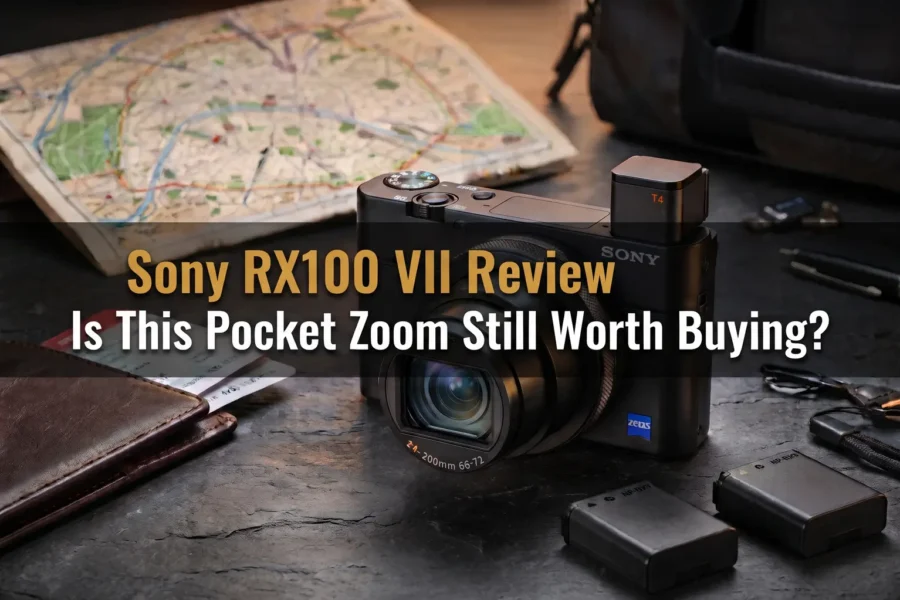
Few cameras in modern photography have defied the calendar quite like the Sony RX100 VII. Originally unveiled back in mid-2019, this 302-gram aluminum powerhouse refuses to fade into budget clearance bins—in fact, driven by persistent demand and limited compact camera supply, new retail prices in 2026 regularly hover between $1,498 and $1,699. Naturally, that raises a very fair question: does a seven-year-old 1-inch stacked sensor camera still deserve your money when flagship smartphones boast periscope zooms and larger APS-C compacts cost hundreds less?
Let’s be honest—on paper, paying mirrorless money for a pocket-sized point-and-shoot feels hard to justify at first glance. Yet the moment you slip this camera into a jacket pocket before boarding a flight or heading out for an afternoon street walk, you realize why no rival has managed to replace it. While we covered the Sony RX100 VII launch specs and original $1,198 pricing when it first arrived, its real-world value proposition today looks quite different. Here is how this legendary pocket zoom holds up after years of travel, street, and hybrid video testing.
Quick Verdict (Daisy Recommends — 8.8 / 10): If you want a genuinely pocketable camera that combines a 24–200mm optical zoom, flagship-grade Real-Time Eye AF, 20fps blackout-free bursts, and a pop-up OLED viewfinder, the Sony RX100 VII remains unmatched in 2026. Skip it only if you primarily shoot in dim indoor lighting, need an all-day battery without spares, or refuse to add an inexpensive stick-on grip.
Sony RX100 VII At a Glance: Core Specs & DCN Score Breakdown
Before diving into field performance, it helps to look at how Sony crammed flagship Alpha speed into a body smaller than a deck of playing cards. Rather than chasing higher megapixel counts, Sony engineered the RX100 VII around a fast-readout 20.1MP 1.0-type Exmor RS stacked CMOS sensor paired with a BIONZ X processor and front-end LSI.
- Sensor: 20.1MP 1-inch (13.2 × 8.8mm) Stacked Exmor RS CMOS
- Lens: ZEISS Vario-Sonnar T* 24–200mm equivalent, f/2.8–4.5 with Optical SteadyShot
- Autofocus System: 357 phase-detection + 425 contrast-detection points (0.02-sec acquisition, Real-Time Tracking & Eye AF)
- Continuous Shooting: Up to 20 fps blackout-free with full AF/AE tracking (plus 90 fps Single Burst mode)
- Viewfinder & Screen: Pop-up 2.36M-dot XGA OLED EVF (0.59x magnification) + 3.0-inch 180° tilting touchscreen
- Video Capabilities: Oversampled UHD 4K up to 30p (no pixel binning), Full HD up to 120p, S-Log2/S-Log3, 3.5mm mic jack
- Weight & Dimensions: 302g (10.7 oz) with battery and SD card | 101.6 × 58.1 × 42.8 mm
- Battery Life (CIPA): Approx. 260 shots (LCD) / 240 shots (EVF) via NP-BX1
| Feature Parameter | Sony RX100 VII Performance Details | DCN Score |
|---|---|---|
| Optics & Zoom Range | ZEISS 24–200mm equiv. f/2.8–4.5 retractable zoom with Optical SteadyShot | 9.1 / 10 |
| Autofocus & Burst Speed | Real-Time Eye AF, 357 PDAF points, 20fps blackout-free & 90fps Single Burst | 9.7 / 10 |
| Image Quality & Low Light | 20.1MP 1-inch stacked sensor; crisp daylight RAWs, grain rises past ISO 1600 | 8.2 / 10 |
| Video & Audio Integration | Oversampled 4K/30p (no pixel binning), S-Log3, 180° flip LCD & 3.5mm mic jack | 8.6 / 10 |
| Viewfinder & Portability | 302g pocket aluminum chassis with one-touch pop-up 2.36M-dot OLED EVF | 9.2 / 10 |
| Battery & Value (2026) | 260-shot NP-BX1 battery, Micro-USB port & steep $1,498–$1,699 street price | 7.8 / 10 |
| Overall Rating | Daisy Recommends: Benchmark Pocket Travel & Event Zoom | 8.8 / 10 |
Check Current Availability & Pricing: Sony Cyber-shot DSC-RX100 VII
Check Price on Amazon | Check Price at B&H Photo | Check Price at Adorama
24–200mm ZEISS Zoom Optics: Reach vs. Low-Light Trade-Offs
The defining engineering feat of the RX100 VII is its ZEISS Vario-Sonnar T* 24–200mm f/2.8–4.5 lens. When powered off, the barrel retracts completely flush into the slim aluminum chassis; switch it on, and you suddenly command an 8.3x optical zoom range that spans sweeping architectural wide angles all the way to tight 200mm telephoto compression. Across the center of the frame, sharpness is remarkably crisp from 24mm through 135mm, with only slight softness appearing wide open at the extreme 200mm telephoto end.
Of course, physics still demands a compromise to fit a 200mm-equivalent lens inside a shirt pocket. While the lens starts at a respectable f/2.8 at 24mm, the maximum aperture narrows quickly as you zoom—hitting f/4.0 around 40mm and settling at f/4.5 from roughly 70mm to 200mm. In bright daylight or golden hour sun, Optical SteadyShot stabilization keeps 200mm handheld shots tack-sharp. Once you step inside a dimly lit museum or evening restaurant, however, that variable aperture forces ISO sensitivity upward, where the 1-inch sensor begins showing grain past ISO 1600.
Autofocus & Speed: Pocket-Sized Sony Alpha Performance
If there is one area where the RX100 VII still embarrasses cameras twice its price in 2026, it is autofocus tenacity. Inheriting tracking algorithms directly from Sony’s full-frame sports flagships, the camera blankets 68% of the frame with 357 phase-detection points. Tap once on a subject on the rear LCD—whether a cyclist weaving through traffic, a toddler running across a park, or a dog mid-leap—and Sony’s Real-Time Tracking locks on like glue.
Even better, the stacked sensor’s ultra-fast readout enables 20 frames per second continuous shooting with zero viewfinder blackout. Because the display never flickers dark between exposures, following erratic motion at 200mm feels effortless. Sony also included a specialized Single Burst Shooting drive mode that fires seven frames in rapid succession at 30, 60, or 90 fps—ideal for freezing peak action like a tennis serve or splash without filling your SD card with hundreds of duplicate files.
Ergonomics, Viewfinder & Everyday Handling
Holding the RX100 VII brings an immediate mix of admiration and mild frustration. On the positive side, the spring-loaded pop-up 2.36M-dot OLED electronic viewfinder deploys with a single flick of a side switch and requires no secondary pull-out step. Having a sharp, high-contrast EVF on a sunny beach or snowy mountain ridge makes composing at 200mm infinitely steadier than squinting at a washed-out phone screen.
On the flip side, Sony’s minimalist slab-sided aluminum body offers virtually zero front grip, and the aging Micro-USB port alongside Sony’s older menu hierarchy reminds you this design predates modern USB-C bodies. If I were shooting with this camera every day, my very first purchase after unboxing would be Sony’s official AG-R2 stick-on attachment grip. That tiny $15 rubberized bump transforms one-handed security, especially when zooming out to 200mm.
Daisy’s Handling Reality Check: Treat the RX100 VII’s NP-BX1 battery like film rolls on a trip—never leave your hotel with just one. CIPA rates it at 260 shots, and heavy EVF or 4K video use drains a single cell in under two hours. Packing two spare batteries in a small pouch takes up almost zero space and eliminates battery anxiety completely.
4K Video & Vlogging Capabilities: Still Viable for Creators?
Unlike the earlier RX100 VI, the RX100 VII added a dedicated 3.5mm external microphone input—a crucial upgrade that turns this pocket camera into a surprisingly capable B-cam or travel video rig. Because it captures full-width, oversampled 4K/30p footage without pixel binning, detail is crisp and free of moiré, while S-Log2, S-Log3, and HLG profiles give colorists genuine grading flexibility.
Where it shows its age for solo vloggers is screen articulation and stabilization crop. The 3.0-inch touchscreen flips up 180 degrees over the top plate for self-framing, which works fine until you mount a shotgun microphone in a cold-shoe bracket—blocking your view of the screen unless you use a side-mounted extension plate. Furthermore, enabling Active SteadyShot in 4K crops into the 24mm wide end, making arm’s-length selfie framing noticeably tighter than dedicated vlog compacts like the Sony ZV-1 II.
How the Sony RX100 VII Compares to Top 2026 Alternatives
Because compact camera pricing has climbed across the board, buyers cross-shopping the RX100 VII usually weigh it against larger-sensor primes or vlogging-focused compacts. If you are still exploring other pocketable options across different sensor sizes, our roundup of the best compact cameras in 2026 breaks down the entire category side by side.
| Camera Model | Sensor & Lens | Autofocus | Low Light | EVF Included | Travel Versatility | 2026 Verdict |
|---|---|---|---|---|---|---|
| Sony RX100 VII | 1-inch | 24–200mm f/2.8–4.5 | ★★★★★ | ★★★☆☆ | ✅ Yes (Pop-up OLED) | ★★★★★ | ✅ Best All-in-One Zoom |
| Sony ZV-1 II | 1-inch | 18–50mm f/1.8–4.0 | ★★★★☆ | ★★★★☆ | ❌ No | ★★★☆☆ | ⚠️ Best for Wide Vlogging |
| Ricoh GR IIIx | APS-C | 40mm f/2.8 Prime | ★★☆☆☆ | ★★★★★ | ❌ No | ★★★☆☆ | ⚠️ Best for Street Stills |
| Canon PowerShot G7 X III | 1-inch | 24–100mm f/1.8–2.8 | ★★★☆☆ | ★★★★☆ | ❌ No | ★★★★☆ | ⚠️ Best Bright Mid-Zoom |
| Check Current Prices | — | RX100 VII | ZV-1 II | GR IIIx | G7 X Mark III | — |
The table highlights why the RX100 VII occupies an island of its own. The Ricoh GR IIIx delivers vastly cleaner high-ISO files from its APS-C sensor, but offers zero zoom and sluggish continuous autofocus. Meanwhile, the Sony ZV-1 II gives vloggers an 18mm ultra-wide lens and a fully articulating screen for hundreds less, yet sacrifices both the EVF and telephoto reach beyond 50mm. For a deeper look at how compact zooms stack up against interchangeable-lens kits on the road, see our guide to the best cameras for travel photography.
Pros & Cons: Should You Buy the Sony RX100 VII Today?
Every camera is a collection of deliberate design choices, and understanding where the RX100 VII excels—and where its 2019 bones show—makes your buying decision straightforward.
- Pros: Unmatched 24–200mm equivalent optical zoom in a 302g pocket body; class-leading Real-Time Eye AF and 20fps blackout-free bursts; crisp pop-up OLED viewfinder; oversampled 4K video with 3.5mm mic input; strong long-term resale value.
- Cons: Steep 2026 retail pricing for a 1-inch sensor; narrow f/4.5 aperture at telephoto focal lengths limits indoor low-light performance; short ~260-shot battery life; slippery front plate without an add-on grip; Micro-USB port instead of USB-C; no built-in ND filter or weather sealing.
Frequently Asked Questions
Is the Sony RX100 VII still worth buying over a flagship smartphone in 2026?
Yes, if you care about optical telephoto detail, fast-moving subjects, and natural photographic rendering. While modern smartphones rely on heavy computational sharpening and digital cropping between fixed lenses, the RX100 VII delivers true optical zoom across every focal length from 24mm to 200mm on a physically larger 1-inch sensor. Its 20fps blackout-free burst mode and Real-Time Eye AF freeze sports, pets, and candid street moments that still cause shutter lag or motion blur on phones. Plus, having a dedicated electronic viewfinder and physical control rings makes intentional photography far more enjoyable.
Why is the Sony RX100 VII so expensive in 2026?
Sony has never released an RX100 VIII, and almost every competing camera manufacturer abandoned the high-end pocket zoom market to focus on full-frame mirrorless bodies or vlogging compacts. Because Sony continues manufacturing the RX100 VII in smaller batches amid higher component and logistics costs, retail prices have risen from its original $1,198 launch figure to roughly $1,498–$1,699 new. Strong demand from travel photography enthusiasts and concertgoers keeps both new and used prices remarkably firm.
Does the Sony RX100 VII have a built-in ND filter like older RX100 models?
No, Sony removed the internal neutral density (ND) filter starting with the RX100 VI when it introduced the longer 24–200mm zoom lens assembly, and the RX100 VII does not include one either. For still photographers, the camera’s ultra-fast 1/32,000-second anti-distortion electronic shutter easily prevents overexposure in bright sunlight. However, if you plan to shoot outdoor 4K video at cinematic shutter speeds like 1/60s, you will want to attach a magnetic filter adapter ring—such as the Lensmate 52mm adapter—to use standard screw-in variable ND filters.
Should I buy the Sony RX100 VII new or look for a used unit?
Both routes make sense depending on your budget and usage habits. Buying new guarantees a fresh factory warranty, pristine lens barrel alignment, and zero dust inside the retractable zoom mechanism—important considerations for any fixed-lens zoom camera that cannot be disassembled easily. However, if you want to keep costs closer to $1,050–$1,200, purchasing a certified pre-owned unit from a reputable dealer with a return window is a smart way to capture over 90% of the value while leaving room in your budget for extra NP-BX1 batteries and a stick-on grip.
Final Verdict & Daisy’s Last Word
Great travel photography rarely comes from carrying the largest sensor in your closet—it comes from having a responsive camera in your hand when an unexpected moment unfolds across the street. That core principle explains why the Sony RX100 VII continues to earn its spot in working photographers’ bags years after its debut.
Once you build the simple practice of carrying two spare NP-BX1 batteries and adding a $15 front grip, the RX100 VII lets you progress seamlessly from wide street scenes to compressed 200mm portraits without ever breaking stride or swapping lenses. If you want to test how much versatility fits inside a single pocket, challenge yourself on your next weekend trip to leave your heavy camera bag at home and shoot exclusively with a compact zoom.
Daisy’s Advice: Before buying the RX100 VII, be honest about where you shoot most. If 80% of your photos happen outdoors, on vacations, or at daytime family events, its 24–200mm reach and autofocus speed are unbeatable. If you shoot mostly indoors after dark, put that budget toward an APS-C body like the Ricoh GR IIIx or Sony a6700 instead.
Daisy’s Last Word: Technology moves fast, yet truly cohesive camera designs age with remarkable grace. The Sony RX100 VII isn’t cheap, and its battery and Micro-USB port definitely show their birth year—but until someone builds another pocketable camera with a 200mm ZEISS zoom, an OLED viewfinder, and Alpha-grade tracking, it remains the undisputed benchmark of its class (earning an 8.8 / 10 DCN Score). Are you still rocking an RX100 series compact, or has your smartphone replaced your travel pocket camera? Share your thoughts in the comments below!

See More DCN on Google
Add Daily Camera News as a trusted source to see our latest camera reviews, deal alerts, and photography news first in Google Search.
Explore Recommended Gear
Looking for the best cameras, lenses, and accessories? Check out our curated, hand-picked gear lists on Amazon.






completely obsolete 20 mp lens,