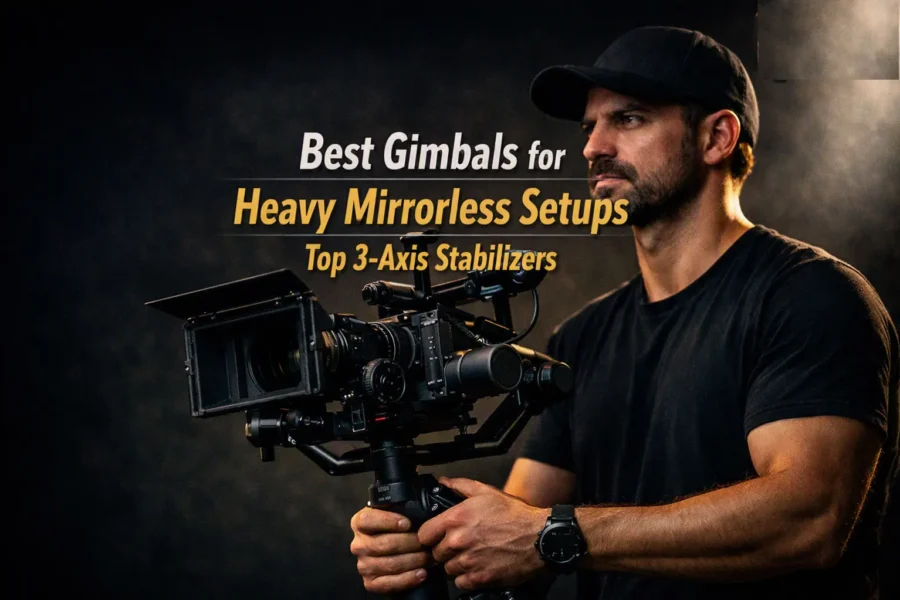
Mirrorless cameras have evolved into full-fledged filmmaking powerhouses, but high-end video production often requires more than just a bare camera body. Once you attach fast zoom lenses, matte boxes, follow focus motors, wireless video transmitters, and external monitors, a standard lightweight stabilizer quickly hits its payload limit.
In 2026, finding the best gimbal for a heavy mirrorless setup requires balancing raw motor torque, payload capacity, ease of balancing, and advanced tracking features. Whether you’re shooting demanding commercial work, event coverage, or indie films with fully rigged cameras, this buyer’s guide breaks down the top heavy-duty 3-axis stabilizers capable of handling demanding camera configurations seamlessly.
Daisy’s Take: Remember that a gimbal’s rated payload capacity is only half the equation! Physical clearance and balance leverage are equally critical when mounting heavy setups. A long lens or a tall cage setup can hit axis arms before reaching maximum weight capacity—always look for extended carbon fiber arms and auto-locking features when choosing a stabilizer for rigged cameras.
Quick Comparison: Best Heavy-Duty Mirrorless Gimbals
| Model | Best For | Max Payload | Key Feature |
|---|---|---|---|
| DJI RS 4 Pro | Best Overall Heavy Gimbal | 4.5 kg / 10 lbs | 2nd-Gen Automated Axis Locks & LiDAR Focus |
| Zhiyun Crane 4 | Best Ergonomics & Power | 6.0 kg / 13.2 lbs | Built-in Balance Indicator Lights & Wrist Rest |
| DJI RS 3 Pro | Best Value Pro Stabilizer | 4.5 kg / 10 lbs | Extended Carbon Fiber Arms & ActiveTrack Pro |
| FeiyuTech Scorp Pro | Best Dual-Handle Control | 4.8 kg / 10.5 lbs | Detachable Remote Control Handle & Dual Wheels |
| Zhiyun WEEBILL 3S | Best Compact Heavy-Hitter | 3.5 kg / 7.7 lbs | Sling Grip 2.5 & Built-in Fill Light |
1. Best Overall Heavy Gimbal: DJI RS 4 Pro
The DJI RS 4 Pro sets the modern industry benchmark for high-capacity mirrorless and compact cinema camera stabilization. Engineered specifically for demanding video productions, the RS 4 Pro features full carbon fiber axis arms, upgraded high-torque motors, and native vertical shooting capabilities without requiring extra brackets.
Key Specifications
- Max Payload: 4.5 kg (10 lbs)
- Weight: Approx. 1.6 kg (3.5 lbs)
- Arm Construction: Extended Carbon Fiber Arms
- Battery Life: Up to 13 hours (supports fast charging)
- Special Features: 2nd-Gen Automated Axis Locks, Teflon-coated balance plates, LiDAR autofocus integration
The RS 4 Pro handles heavy setups such as a Canon EOS C70, Sony FX6, or a full-rigged Sony A7S III with a 24-70mm f/2.8 lens with ease. Teflon coatings on the axis arms reduce friction for ultra-precise micro-adjustments, while the automated axis locks allow you to unfold and start shooting within seconds.
Check Prices & Availability
2. Best Ergonomics & Raw Torque: Zhiyun Crane 4
When maximum payload support and physical comfort during long shooting days are paramount, the Zhiyun Crane 4 delivers exceptional performance. Boasting a massive 6.0 kg payload capacity, it easily stabilizes full-frame mirrorless cameras equipped with heavy cinema glass or telephoto zooms.
Key Specifications
- Max Payload: 6.0 kg (13.2 lbs)
- Weight: Approx. 1.67 kg (3.68 lbs)
- Screen: 1.22-inch Color Touchscreen
- Ergonomics: Adjustable Sling Wrist Rest & Extendable Handle
- Unique Tech: Built-in balance indicator lights on each motor arm
Zhiyun introduced intelligent balance indicator lights on each motor arm of the Crane 4, providing immediate visual confirmation when precise balance is achieved. The inclusion of an ergonomic wrist rest and flexible sling grip significantly reduces fatigue when operating heavy camera rigs over extended shoot schedules.
Check Prices & Availability
3. Best Value Pro Stabilizer: DJI RS 3 Pro
Though succeeded by the RS 4 series, the DJI RS 3 Pro remains a powerhouse stabilizer that offers incredible value for high-end setups. Utilizing extended carbon fiber arms identical in strength to current flagships, it accommodates large camera bodies such as the RED Komodo or fully decked-out Panasonic S1H rigs.
Key Specifications
- Max Payload: 4.5 kg (10 lbs)
- Weight: 1.5 kg (3.3 lbs)
- Display: 1.8-inch OLED Touchscreen
- Tracking: ActiveTrack Pro via optional RavenEye / LiDAR
- Locks: 1st-Gen Automated Axis Locks
With high-torque motors and seamless compatibility with DJI’s ecosystem of LiDAR focus gear and wireless transmission units, the RS 3 Pro offers flagship performance at a competitive price point for serious creators.
Check Prices & Availability
4. Best Dual-Handle Gimbal: FeiyuTech Scorp Pro
The FeiyuTech Scorp Pro features a distinct dual-handle design engineered specifically for low-angle shots and heavy cinema-style mirrorless rigs. Its detachable wireless control handle allows operators to direct gimbal moves remotely or handle the rig comfortably with two hands.
Key Specifications
- Max Payload: 4.8 kg (10.5 lbs)
- Control: Detachable Wireless Joystick Handle with Touchscreen
- Design: Integrated Underslung Handle & Dual Multifunction Wheels
- Battery: Up to 12 hours operational battery life
The dual focus/zoom control wheels and custom axis lock switches make physical operations extremely intuitive, while the integrated underslung rear handle offers effortless transitions from eye-level to ground-skimming movements.
Check Prices & Availability
Key Factors to Consider for Heavy Mirrorless Gimbals
Selecting the right heavy-duty stabilizer requires evaluating more than just the payload number on the box:
- Motor Strength vs. Physical Clearance: A gimbal may support 4.5 kg, but if the rear roll arm hits your camera’s eyepiece or viewfinder when tilting straight up, the rig won’t operate correctly. Look for extended carbon arms or offset roll axes.
- Axis Locks: Manual thumb-screws can slip during transit. Automated or mechanical axis locks secure each motor during balancing or transportation, preventing gear damage.
- Follow Focus & Accessories Integration: Ensure the gimbal provides adequate USB-C power ports and NATO rails to mount focus motors, receivers, and top handles without cluttering the balance point.
Frequently Asked Questions (FAQ)
Frequently Asked Questions
Q: How much payload capacity do I need for a mirrorless camera setup?
A: For a standard mirrorless camera with a 24-70mm f/2.8 lens, a payload of 3 kg (6.6 lbs) is sufficient. However, if you add a cage, follow focus motor, matte box, microphone, and monitor, you should opt for a heavy-duty gimbal rated for at least 4.5 kg (10 lbs) to ensure smooth motor performance without overheating.
Q: Can I put a cinema camera on a heavy mirrorless gimbal?
A: Yes, high-capacity gimbals like the DJI RS 4 Pro or Zhiyun Crane 4 are built to handle compact cinema cameras like the Sony FX6, Canon EOS C70, and RED Komodo, provided the physical length of the body fits within the axis clearance.
Q: What happens if a gimbal payload is overloaded?
A: If a gimbal is overloaded or improperly balanced, the motors will vibrate, micro-shake, or enter auto-shutdown mode to prevent thermal damage. Operating an overloaded gimbal long-term leads to rapid battery drain and premature motor failure.