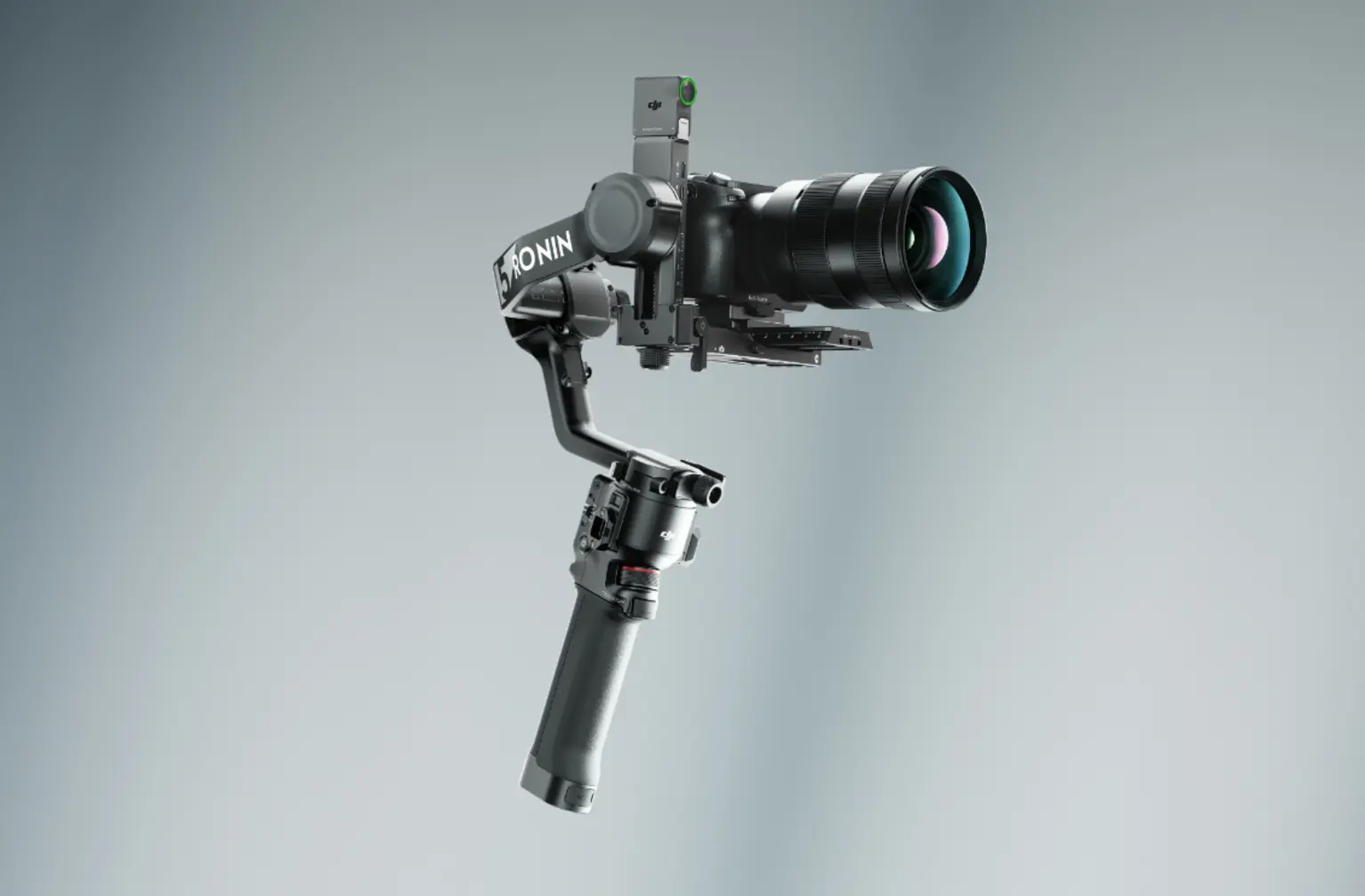
DJI has officially announced the RS 5 gimbal stabilizer, the latest addition to its professional handheld lineup. Launched in China with a starting price of 3,099 yuan (~$430 USD), the RS 5 builds on the foundation of the RS 4 with meaningful upgrades aimed at solo operators and small production teams.
Key Features
- Touchscreen subject tracking: A new Enhanced Intelligent Tracking Module attaches magnetically, streaming a live feed to the gimbal’s touchscreen. Users can tap directly on subjects—people, vehicles, or pets—to lock tracking at distances up to 10 meters.
- Payload capacity: Supports up to 3kg, accommodating a wide range of mirrorless and DSLR setups.
- Motor performance: 50% higher peak torque compared to RS 4, enabling smoother stabilization and better handling of heavier rigs.
- Improved ergonomics: Fine-tuning knobs, second-generation automated axis locks, and a redesigned briefcase handle for easier balancing and control.
- Battery life: Faster charging with extended runtime, offering up to 15% longer operation than the previous generation.
Comparison: DJI RS 4 vs DJI RS 5
| Feature | DJI RS 4 | DJI RS 5 |
|---|---|---|
| Payload Capacity | 2.5kg | 3kg |
| Peak Torque | Standard motors | 50% higher torque |
| Tracking | Requires external app | Touchscreen subject tracking module |
| Axis Locks | First-gen automated locks | Second-gen automated locks |
| Battery Runtime | Standard | 15% longer, faster charging |
Price and Availability
The DJI RS 5 is currently available in China at 3,099 yuan, which translates to approximately $430 USD. Global release details have not yet been confirmed, but given DJI’s track record, international availability is expected in the coming months. The RS 5 is positioned as a professional-grade stabilizer for filmmakers, content creators, and solo operators seeking smarter automation and stronger performance.
Editorial Perspective
The RS 5 is not a radical redesign but rather a thoughtful evolution of DJI’s gimbal technology. By focusing on intelligent subject tracking, higher torque motors, and ergonomic improvements, DJI has created a stabilizer that directly addresses the needs of modern creators. Compared to the RS 4, the RS 5 feels like a more polished tool—one that bridges the gap between professional demands and solo shooting convenience.