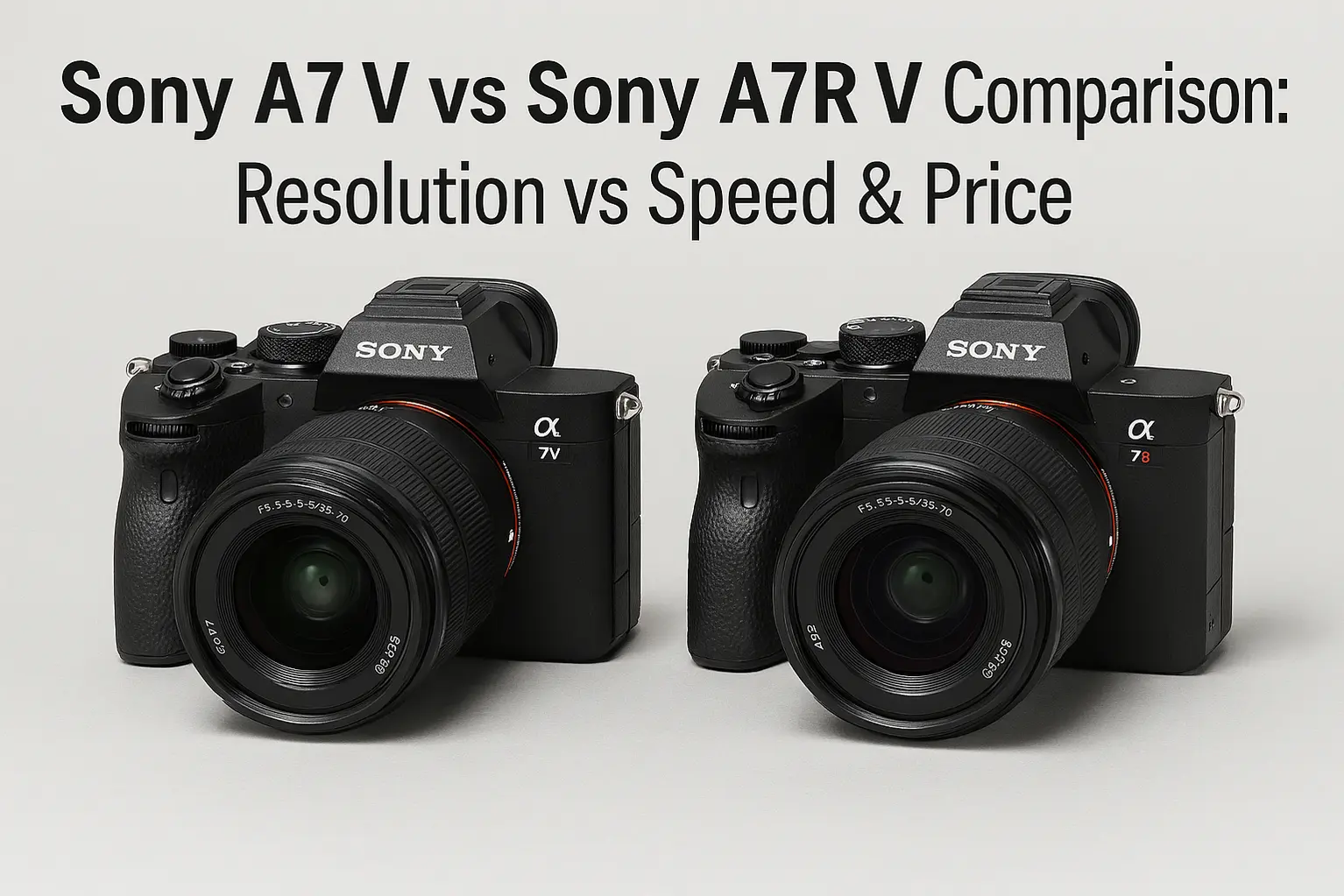
The Sony A7 V vs Sony A7R V comparison is one of the most searched full-frame mirrorless matchups among photographers today. In this guide, we compare price, specs, autofocus, video features, and the key resolution vs speed trade-off to help you decide which Sony full-frame mirrorless camera fits your shooting style. The Sony A7 V focuses on hybrid performance and speed, while the Sony A7R V is built for photographers who prioritize ultra-high resolution.
Sony A7 V vs Sony A7R V: Specs Comparison
| Specification | Sony A7 V | Sony A7R V |
|---|---|---|
| Sensor | 33MP full-frame BSI CMOS | 61MP full-frame BSI CMOS |
| Image Processor | BIONZ XR with dedicated AI Processing Unit | BIONZ XR with AI Processing Unit |
| Native ISO Range | ISO 100–51,200 (expandable to 50–204,800) | ISO 100–32,000 (expandable to 50–102,400) |
| Autofocus System | 759 phase-detection points, AI subject recognition | 693 phase-detection points, advanced AI subject recognition |
| Continuous Shooting | Up to 30 fps (electronic), 10 fps (mechanical) | Up to 10 fps (electronic & mechanical) |
| In-Body Image Stabilization | 5-axis IBIS, up to 7.5 stops | 5-axis IBIS, up to 8 stops |
| Video Recording | 4K up to 60p (oversampled), 4K 120p (Super 35 crop) | 8K 24p, 4K up to 60p |
| Viewfinder | 3.69M-dot OLED EVF | 9.44M-dot OLED EVF |
| Rear LCD | 3.2″ vari-angle touchscreen | 3.2″ 4-axis multi-angle touchscreen |
| Memory Card Slots | Dual: CFexpress Type A / SD (UHS-II) + SD (UHS-II) | Dual: CFexpress Type A / SD (UHS-II) + SD (UHS-II) |
| Battery | NP-FZ100 (approx. 750 shots, CIPA) | NP-FZ100 (approx. 530 shots, CIPA) |
| Body Weight (with battery & card) | Approx. 695 g | Approx. 723 g |
| Launch Price (Body Only) | Lower-priced hybrid full-frame option | Premium-priced high-resolution flagship |
Core Philosophy: Speed vs Resolution
Although the Sony A7 V and Sony A7R V share a similar full-frame mirrorless body and the same BIONZ XR processing platform, they are designed with very different priorities in mind. This is not a case of one camera replacing the other — instead, Sony positions them for distinct types of photographers.
The Sony A7 V is built around speed, balance, and hybrid performance. With a lower-resolution 33MP sensor, faster readout, deeper buffer, and higher burst rates, it targets photographers who shoot action, events, wildlife, travel, and mixed photo-video content.
By contrast, the Sony A7R V is all about maximum resolution and detail. Its 61MP full-frame sensor delivers extraordinary image quality, extreme cropping flexibility, and class-leading detail — ideal for landscape, studio, commercial, fashion, and fine-art photography, where speed matters less than absolute image fidelity.
Sensor & Image Quality
When comparing the Sony A7 V vs Sony A7R V, sensor resolution is the most obvious — and most important — difference. While both cameras use modern full-frame BSI CMOS sensors and Sony’s latest BIONZ XR processing, their image quality priorities diverge significantly.
The Sony A7 V features a 33MP full-frame sensor that strikes an excellent balance between resolution, dynamic range, and file size. This makes it highly versatile for everyday photography, fast-paced shooting, and hybrid workflows where storage efficiency and faster processing matter. Real-world results show strong dynamic range, clean high-ISO performance, and pleasing color output, as demonstrated in the Sony A7 V sample images gallery.
On the other hand, the Sony A7R V is built around a 61MP full-frame sensor designed for photographers who demand maximum detail. The sheer resolution allows for heavy cropping, large-format printing, and exceptional texture rendering, making it a favorite for landscape, architecture, studio, and commercial work. When paired with high-quality lenses, the A7R V delivers some of the most detailed images available in the full-frame mirrorless category.
In practice, the resolution vs speed trade-off becomes clear. The A7 V produces smaller, more manageable files and faster burst performance, while the A7R V rewards careful shooting with unparalleled detail — but at the cost of larger files and slower overall workflow. Choosing between them depends less on image quality alone, and more on how much resolution your photography actually requires.
Autofocus & Performance
Autofocus is one area where both the Sony A7 V and Sony A7R V excel, thanks to Sony’s advanced AI-driven subject recognition system. Both cameras feature dedicated AI processing units that enable highly reliable tracking of people, animals, birds, insects, and vehicles.
The Sony A7 V uses 759 phase-detection AF points covering most of the sensor area and benefits from faster sensor readout. This allows for more responsive tracking in continuous shooting, especially when photographing sports, wildlife, or fast-moving subjects. Combined with burst rates of up to 30 fps using the electronic shutter, the A7 V feels noticeably more agile in real-world action scenarios, as highlighted in our Sony A7 V hands-on coverage.
The Sony A7R V, while slightly slower overall, delivers extremely precise autofocus accuracy. Its AI-based subject detection is optimized for high-resolution capture, ensuring sharp focus even at pixel-level detail. This makes it particularly well suited for portrait, studio, wildlife-at-distance, and landscape photographers who prioritize accuracy over speed.
In terms of performance, the difference becomes clear under pressure. The A7 V’s faster burst rates, deeper buffer, and quicker file handling make it better suited for demanding, fast-paced shooting environments. The A7R V, by contrast, encourages a more deliberate shooting style, where focus precision and image detail take precedence over sheer speed.
Video Capabilities
The Sony A7 V is clearly positioned as a hybrid, creator-focused camera. It delivers oversampled 4K video with strong autofocus performance, improved rolling shutter control, and better thermal management for longer recording sessions. These strengths make it a more practical choice for YouTubers, filmmakers, and content creators who prioritize speed and reliability.
The Sony A7R V, while capable in video, is primarily designed for high-resolution photography. Its large sensor resolution can introduce heavier crop factors, increased rolling shutter, and more demanding processing in video modes. However, it still offers excellent detail and color depth for photographers who only shoot video occasionally.
In short, this is a classic creator vs photographer split: the A7 V favors flexibility and video performance, while the A7R V emphasizes resolution over speed.
For lens compatibility and video-oriented glass, explore the Sony E-Mount System Guide.
Handling, Ergonomics & Usability
Both the Sony A7 V and Sony A7R V share a similar full-frame mirrorless body design, offering a deep grip, solid weather sealing, and well-balanced handling even with larger lenses. The grip ergonomics are nearly identical, providing comfortable one-handed shooting during long sessions.
One notable difference appears in the electronic viewfinder. The A7R V features a higher-resolution EVF, which benefits photographers who rely heavily on precise framing and manual focusing. The A7 V’s EVF is still very capable, but clearly optimized for hybrid use rather than maximum detail.
Both cameras use a fully articulating vari-angle touchscreen, making them equally suitable for vlogging, low-angle shooting, and vertical content. Sony’s updated menu system is present on both models, offering improved customization, faster navigation, and better touch control compared to older Alpha cameras.
For recommended add-ons, see our Best Accessories for Sony A7 V and Best Memory Cards for Sony A7 V guides.
Battery Life & Connectivity
Both the Sony A7 V and A7R V use Sony’s high-capacity NP-FZ100 battery, which delivers reliable all-day performance for most hybrid shooters. In real-world use, photographers can expect strong endurance for stills, while video recording naturally drains the battery faster on both models.
The A7 V tends to offer slightly more efficient power management during video-heavy workflows, making it a better fit for creators who record frequently. The A7R V, with its high-resolution sensor and processing demands, may consume more power during extended shooting sessions.
Connectivity options are excellent on both cameras, including USB-C charging and data transfer, built-in Wi-Fi, Bluetooth, and reliable tethering support. These features make both models well suited for studio work, live streaming, and fast content delivery.
Who Should Buy Sony A7 V?
The Sony A7 V is designed for photographers and creators who need a fast, flexible, and modern full-frame mirrorless camera. Its balanced approach to resolution, speed, and video performance makes it one of the most versatile Alpha bodies to date.
- Hybrid shooters: If you regularly switch between photography and video, the A7 V offers an ideal balance of high-quality stills, advanced autofocus, and creator-friendly video tools.
- Travel & street photographers: With fast AF, strong low-light performance, and manageable file sizes, the A7 V is well suited for everyday shooting and on-the-go workflows.
- Action-leaning photographers: Sports, wildlife, and event shooters benefit from the A7 V’s speed-focused sensor, reliable subject tracking, and improved rolling shutter control.
- Content creators: Vloggers, YouTubers, and solo creators will appreciate the fully articulating screen, strong video features, and efficient battery performance.
To build the ideal kit, see our Best Lenses for Sony A7 V guide. You may also want to compare it directly with the previous generation in our Sony A7 V vs A7 IV comparison.
Who Should Buy Sony A7R V?
The Sony A7R V is aimed squarely at photographers who prioritize maximum image detail, resolution, and post-processing flexibility over speed and video-centric features.
- Landscape photographers: The high-resolution sensor captures extreme detail, making it ideal for large prints and highly textured scenes.
- Studio & fashion shooters: Controlled lighting environments allow the A7R V to fully exploit its resolution advantage for commercial-quality results.
- Commercial & fine art photographers: Clients who demand maximum image fidelity, color depth, and print-ready files will benefit from the A7R V’s sensor performance.
- Heavy cropping workflows: Wildlife, architectural, and editorial shooters who frequently crop images will appreciate the extra resolution headroom.
In short, the A7R V excels when detail matters more than speed, and when photography is the primary focus rather than hybrid creation.
Bottom Line: Sony A7 V vs Sony A7R V
Choosing between the Sony A7 V and Sony A7R V ultimately comes down to resolution vs speed. If you prioritize a versatile full-frame mirrorless camera for hybrid shooting, action, and video, the A7 V’s balanced sensor, faster burst rates, and improved autofocus make it a compelling choice. On the other hand, the A7R V shines for photographers who demand ultra-high resolution for landscape, studio, fashion, and commercial work, where detail retention and heavy cropping are critical.
Price positioning is also key: the A7R V commands a premium for its 61MP sensor and pro-level capabilities, while the A7 V offers excellent full-frame performance at a lower price, making it a solid value for most hybrid shooters.
Affiliate Disclosure: Some links above are affiliate links. We may earn a small commission if you purchase through these links at no extra cost to you. Thank you for supporting DailyCameraNews!