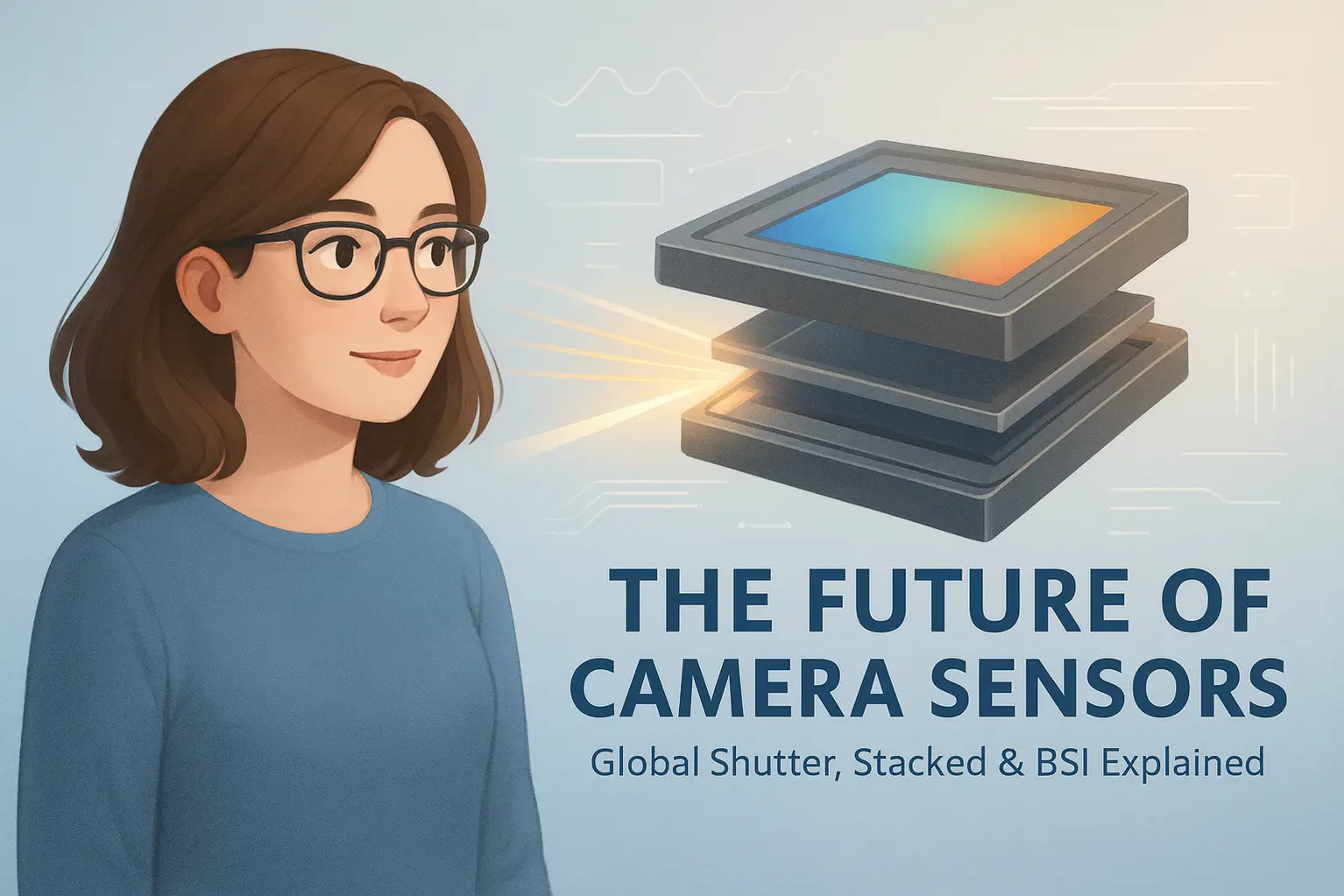
When we talk about the future of cameras, we usually talk about bodies. New models. New names. New specs.But here’s a quiet truth most photographers eventually discover: the real revolution doesn’t happen on the outside — it happens deep inside the camera, where light first turns into data.
Camera sensors are the invisible engines behind everything we care about today: autofocus speed, burst performance, dynamic range, rolling shutter, and even how natural motion looks in video.
In my last future-focused article, I looked at which mirrorless systems may matter most between 2026 and 2028. This time, I want to go one layer deeper — to the technology that will shape all of those systems, regardless of brand.
Global shutter sensors.
Stacked sensors.
Backside-illuminated (BSI) designs.
These aren’t just technical buzzwords. They quietly define how cameras feel to use — how fast they respond, how reliably they track motion, and how confidently they handle difficult light.
Let’s look ahead together and break down where camera sensor technology is heading, what’s already here, and what will truly matter for photographers and hybrid shooters in the years to come.
Why Camera Sensors Matter More Than Ever
Modern cameras are no longer limited by lenses alone. Today, what separates a good shooting experience from a great one often comes down to how fast, how clean, and how intelligently a camera sensor can read and process light.
Autofocus tracking, blackout-free bursts, rolling shutter control, video motion rendering, dynamic range — all of these depend less on marketing labels and more on what’s happening at the sensor level.
As photography and video continue to merge, sensor performance has become the common foundation for both worlds.
A sensor that struggles with readout speed or low-light performance will limit not only still images, but also slow-motion video, high frame rates, and computational features.
In short: lenses shape the look of an image, but sensors shape the limits of what a camera can do.
This is especially true for hybrid shooters. Features like real-time subject detection, high-speed bursts,
and clean 4K or 8K video aren’t separate technologies — they all lean on the same sensor capabilities.
That’s why conversations about the future of mirrorless cameras increasingly shift away from megapixels alone and toward sensor architectures designed for speed, efficiency, and smarter data handling. To understand where camera technology is heading next, we need to look at three sensor innovations that are already reshaping the industry: global shutter sensors, backside-illuminated designs, and stacked sensor architectures.
Global Shutter Sensors: The End of Rolling Shutter?
For decades, one of the most persistent technical limitations in digital cameras has been rolling shutter. It’s that subtle “jello” effect when panning quickly, or the skewed lines you see when shooting fast motion.
Enter the idea of a global shutter sensor — a sensor architecture that captures the entire frame at once, eliminating rolling shutter entirely. That’s a huge deal for both photographers and videographers alike.
Sony’s latest mirrorless flagship series has been one of the first to push global shutter concepts toward reality.
If you’ve been following advanced sensor development, you’ve likely seen cameras like the Sony A9 III featured in cutting-edge discussions.
- Rolling shutter reads sensor lines sequentially — which can distort fast motion.
- Global shutter reads the whole frame simultaneously — meaning smooth, distortion-free capture.
For sports, automotive shooting, action sequences, and high-speed video, that difference is huge. Instead of chasing workarounds (higher shutter speeds, electronic tricks, computational correction), a global shutter sensor natively solves the root issue.
dynamic range, and data throughput. They also demand more power and generate more heat — challenges that engineers are still refining.

BSI Sensors: Better Light, Better Color
While global shutter sensors represent the future of motion capture, backside-illuminated (BSI) sensors are already shaping the cameras many of us use today.
Traditional sensor designs place wiring and circuitry on top of the photodiodes, partially blocking incoming light. BSI sensors flip that structure, allowing light to reach the photosites more efficiently before it encounters any electronic layers.
The result is simple but powerful: better light gathering, improved signal-to-noise performance, and more consistent color — especially in challenging lighting conditions.
BSI sensors are especially valuable for:
- Low-light photography
- High-resolution sensors with smaller pixel sizes
- Hybrid shooters who need consistent stills and video quality
Unlike more experimental sensor technologies, BSI designs are now a mature and trusted solution.
They don’t generate headlines — but they form the backbone of many of today’s best-performing cameras.
Stacked Sensors: Speed Is the New Image Quality
If BSI sensors focus on capturing light more efficiently, stacked sensor architectures are all about one thing: speed.
A stacked sensor places multiple layers of circuitry directly behind the imaging sensor. This design dramatically increases data readout speed, allowing the camera to process information far more quickly than traditional layouts.
Why does that matter?
Because in modern cameras, speed affects almost everything — from autofocus accuracy to burst shooting, blackout behavior, and even how natural motion looks in video.
- Track fast-moving subjects more accurately
- Shoot higher frame rates with minimal blackout
- Reduce rolling shutter effects in electronic shutter modes
- Handle high-resolution video more smoothly
This is why stacked sensors are often found in cameras aimed at sports, wildlife, and professional hybrid shooters. They create a shooting experience that feels more responsive, more predictable, and more reliable under pressure.
There is, of course, a cost. Stacked sensors are more complex and expensive to produce, which is why they tend to appear first in flagship models before gradually filtering down to more affordable cameras.
What Comes Next? The Future of Camera Sensors (2026–2028)
So where does all of this lead?
Between global shutter breakthroughs, stacked architectures, and increasingly refined BSI designs, camera sensors are entering a phase where evolution feels less incremental — and more structural.
Between 2026 and 2028, we’re likely to see sensor technology move in three clear directions:
faster readout, smarter data handling, and tighter integration with computational imaging.
At the same time, stacked sensor designs will continue to trickle down. What feels like flagship-only performance today may become standard in mid-range mirrorless bodies within a few product cycles.
Another major shift will be the deeper fusion between sensors and computational processing. Rather than treating the sensor as a passive light collector, future cameras will increasingly use it as an active data source — optimizing exposure, autofocus, noise handling, and even subject recognition in real time.
The most exciting part?
Many of these changes won’t be loud or obvious. They’ll show up quietly — in cameras that simply feel faster, more confident, and more reliable the moment you pick them up.
Who Benefits Most From These Sensor Technologies?
Not every photographer needs the latest sensor innovation — but for certain shooting styles, these technologies can make a dramatic difference.
Photographers who regularly switch between stills and video benefit the most from faster readout speeds, reduced rolling shutter, and more consistent performance across shooting modes.
Stacked and global shutter sensors deliver faster bursts, more reliable autofocus tracking, and cleaner motion — all critical when timing is everything.
Faster sensors enable silent shooting with fewer distortions, making it easier to capture decisive moments without drawing attention.
Reduced rolling shutter, smoother motion rendering, and improved low-light performance translate directly into more professional-looking footage.
If you’re choosing a camera system with longevity in mind, understanding sensor technology helps you invest in bodies that will age more gracefully over time. Even if these technologies don’t change how you shoot today, they quietly influence how far your camera can grow with you tomorrow.
Daisy’s Final Thoughts: Sensors Shape the Future You’ll Actually Feel
It’s easy to get distracted by camera bodies, model names, and spec sheets that change every year. But if there’s one part of a camera that truly defines its future, it’s the sensor.
Global shutter designs promise a world without motion distortions. Stacked sensors redefine speed and responsiveness. BSI technology quietly improves every image you take.
These aren’t abstract ideas — they directly shape how confident, how fast, and how flexible your camera feels in real-world use.
If you’re thinking long-term, sensor literacy matters just as much as brand loyalty or lens selection. That’s why I always encourage photographers to look beyond individual models and understand the systems and technologies behind them.
To see how sensor innovation fits into the bigger picture, you may also want to explore our Ultimate Mirrorless Camera Guide, where we break down the modern mirrorless landscape from the ground up.
And if you’re following Daisy’s future-focused journey, this article pairs naturally with my earlier look at which mirrorless systems may matter most between 2026 and 2028.
The cameras of tomorrow won’t just be faster or sharper — they’ll feel smarter, more responsive, and more in tune with the way we actually shoot. And that future starts at the sensor.
Frequently Asked Questions About Camera Sensor Technology
What is a global shutter sensor, and why does it matter?
A global shutter sensor captures the entire image at once, eliminating rolling shutter distortion. This is especially important for fast motion, sports, wildlife, and video where motion accuracy matters.
Are global shutter cameras worth buying right now?
For most photographers, global shutter is still an emerging technology. It offers clear advantages, but current implementations tend to be expensive and aimed at professionals with specific needs.
What’s the difference between BSI and stacked sensors?
BSI sensors improve light efficiency and image quality, while stacked sensors focus on speed and fast data readout. Many modern cameras combine both technologies.
Do megapixels matter less than sensor technology?
Megapixels still matter, but sensor architecture often has a bigger impact on real-world performance — including autofocus reliability, burst speed, rolling shutter, and video quality.
Which photographers benefit most from advanced sensor designs?
Hybrid shooters, sports and wildlife photographers, content creators, and future-focused buyers benefit the most from newer sensor technologies.