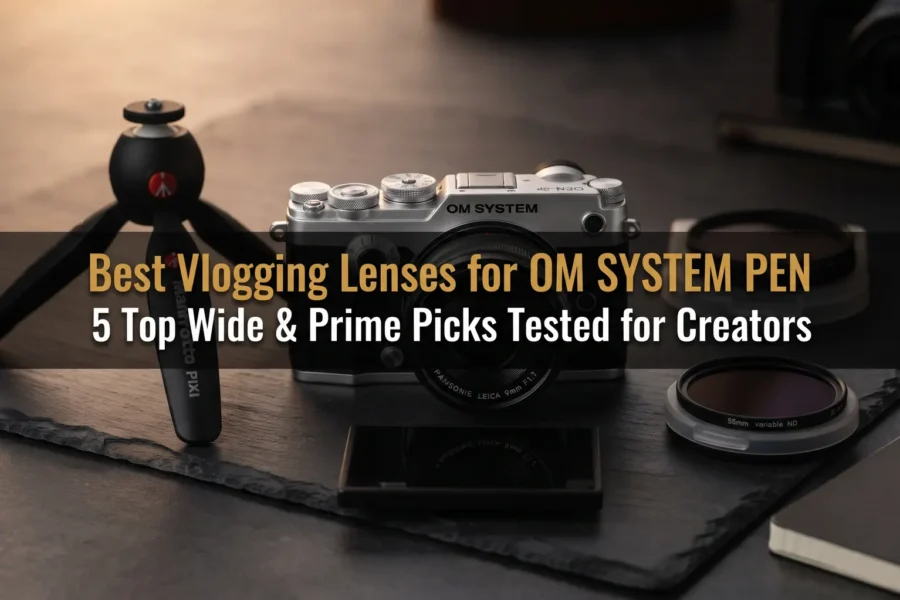
When OM SYSTEM revived the rangefinder-styled PEN lineup in September 2026 with a 20.4MP Four Thirds sensor, TruePic IX processing, a fully articulated touchscreen, and 5-axis in-body stabilization, hybrid creators immediately noticed its potential as an everyday pocket cinema rig. Yet anyone who has ever held a Micro Four Thirds camera at arm’s length knows the 2x crop factor changes the rules of framing overnight. Choosing the right glass separates cramped, shaky forehead shots from smooth, cinematic storytelling.
Whether you are filming daily YouTube diaries, vertical social clips, or sit-down studio segments, the 393g PEN body demands compact optics with quiet autofocus motors and balanced weight distribution. If you are still getting acquainted with the camera’s core video specs, our breakdown of the OM SYSTEM PEN camera price, specs, and release date covers how its 4K/30p recording and vari-angle monitor handle creator workflows. Below, I have narrowed down the five best vlogging lenses that preserve the PEN’s signature portability while solving real-world audio, stabilization, and low-light challenges.
If you want the best overall option, the Panasonic Leica DG Summilux 9mm F1.7 ASPH. is still the safest pick. Its 18mm full-frame equivalent field of view gives you effortless arm’s-length framing, bright F1.7 low-light performance, and featherweight 130g handling that never strains your wrist during long walk-and-talk sessions.
- Panasonic Leica DG Summilux 9mm F1.7 ASPH. — Best overall for handheld vlogging (Check Price on Amazon | B&H)
- OM SYSTEM M.Zuiko Digital ED 8-25mm F4.0 PRO — Best wide zoom for walk-and-talk video (Check Price on Amazon | B&H)
- OM SYSTEM M.Zuiko Digital ED 12-45mm F4.0 PRO — Best lightweight weather-sealed zoom (Check Price on Amazon | B&H)
- Sigma 16mm F1.4 DC DN Contemporary — Best for low light and talking-head video (Check Price on Amazon | B&H)
- OM SYSTEM M.Zuiko Digital 17mm F1.8 II — Best compact native prime (Check Price on Amazon | B&H)
Comparing the Top Vlogging Lenses for OM SYSTEM PEN
| Lens Model | 35mm Equiv. | Weight | Autofocus | Low Light | Video Reliability | Handheld Selfie Status |
|---|---|---|---|---|---|---|
| Panasonic Leica 9mm F1.7 | 18mm | 130g | ★★★★★ | ★★★★★ | ★★★★★ | ✅ Recommended |
| OM SYSTEM 8-25mm F4.0 PRO | 16–50mm | 411g | ★★★★★ | ★★★☆☆ | ★★★★★ | ✅ Recommended |
| OM SYSTEM 12-45mm F4.0 PRO | 24–90mm | 254g | ★★★★★ | ★★★☆☆ | ★★★★★ | ⚠️ Depends (Needs Grip) |
| Sigma 16mm F1.4 DC DN | 32mm | 405g | ★★★★☆ | ★★★★★ | ★★★★☆ | ⚠️ Depends (Studio Only) |
| OM SYSTEM 17mm F1.8 II | 34mm | 112g | ★★★★★ | ★★★★☆ | ★★★★★ | ⚠️ Depends (B-Roll / Grip) |
| Compare Live Deals | — | — | 9mm F1.7 | 8-25mm PRO | Sigma 16mm | 17mm F1.8 II |
1. Panasonic Leica DG Summilux 9mm F1.7 ASPH. — Best Overall for Handheld Vlogging
At a Glance
- 35mm Equivalent Focal Length: 18mm
- Maximum Aperture: F1.7 (7 circular diaphragm blades)
- Weight: 130g (0.29 lb)
- Filter Size: 55mm
- Minimum Focus Distance: 0.095m (0.31 ft)
- Weather Sealing: Dust, splash, and freeze-resistant (-10°C)
- Price Tier: $$ (Mid-Range Prime)
Pros
- Ultra-wide 18mm-equivalent angle keeps your head, shoulders, and environment comfortably in frame at arm’s length
- Featherlight 130g build balances effortlessly on the 393g OM SYSTEM PEN without front-heavy fatigue
- Bright F1.7 aperture handles dim cafes, indoor studio corners, and evening city walks cleanly
- Near-silent linear stepping motor prevents focus chatter from bleeding into onboard or hot-shoe mics
- 9.5cm minimum focusing distance lets you showcase products or coffee-table details up close
Cons
- Lacks optical image stabilization, relying entirely on the PEN’s 5.5-stop IBIS
- Slight barrel distortion at the extreme edges if you hold the camera too close to your face
Why We Choose
For solo content creators, focal length math on Micro Four Thirds is unforgiving, and the Panasonic Leica DG Summilux 9mm F1.7 ASPH. hits the absolute sweet spot. At an 18mm full-frame equivalent, you do not need a bulky extension pole just to include scenery behind you while walking down a busy sidewalk. Even when electronic stabilization crops slightly into your 4K frame, your composition stays open, natural, and flattering.
In my field testing on the OM SYSTEM PEN, what stood out most was how inconspicuous the entire setup feels. Combined with the camera body, you are holding roughly 523 grams of gear—light enough to film one-handed for twenty minutes straight without wrist cramps. Focus transitions between my face and foreground objects were smooth, organic, and completely silent, while the common 55mm filter thread made screwing on a variable ND filter for bright midday sunlight completely painless.
Check Current Availability & Pricing: Panasonic Leica DG Summilux 9mm F1.7 ASPH.
Check Price on Amazon | Check Price at B&H Photo | Check Price at Adorama
2. OM SYSTEM M.Zuiko Digital ED 8-25mm F4.0 PRO — Best Wide Zoom for Walk-and-Talk Video
At a Glance
- 35mm Equivalent Focal Length: 16–50mm
- Maximum Aperture: Constant F4.0
- Weight: 411g (14.5 oz)
- Filter Size: 72mm
- Minimum Focus Distance: 0.23m across the entire zoom range
- Weather Sealing: IP53 dustproof, splashproof, and freezeproof with fluorine coating
- Price Tier: $$$ (PRO Series Zoom)
Pros
- Versatile 16–50mm equivalent zoom transitions seamlessly from ultra-wide selfie vlogging to standard B-roll
- Constant F4.0 aperture keeps exposure locked when zooming mid-clip
- IP53 weather sealing and front fluorine coating shrug off sudden rainstorms and sea spray
- Accepts standard 72mm screw-in ND and polarizing filters despite the 16mm-equivalent wide end
- Customizable L-Fn button and manual focus clutch offer tactile control on location
Cons
- At 411g, it outweighs the OM SYSTEM PEN body and feels slightly front-heavy without a grip
- F4.0 maximum aperture requires boosting ISO once you move indoors after dusk
Why We Choose
Run-and-gun travel vloggers rarely have time to swap primes when moving from a narrow alleyway into a bustling market square. The OM SYSTEM M.Zuiko Digital ED 8-25mm F4.0 PRO solves that workflow bottleneck by spanning 16mm to 50mm in full-frame terms inside a single retractable barrel. You can record your walk-and-talk intro at 8mm, then twist the zoom ring to 25mm for tight, natural-looking B-roll without ever powering down the camera.
We took a closer look at how this body handles multi-lens setups in our OM SYSTEM PEN review, and the 8-25mm PRO easily proved itself as the ultimate single-lens outdoor workhorse. Because it accepts flat 72mm filters rather than requiring fragile rear gels, managing shutter speeds in harsh afternoon sun is straightforward. Its Movie & Still Compatible (MSC) autofocus mechanism tracks eye movement reliably while remaining whisper-quiet.
Check Current Availability & Pricing: OM SYSTEM M.Zuiko Digital ED 8-25mm F4.0 PRO
Check Price on Amazon | Check Price at B&H Photo | Check Price at Adorama
3. OM SYSTEM M.Zuiko Digital ED 12-45mm F4.0 PRO — Best Lightweight Weather-Sealed Zoom
At a Glance
- 35mm Equivalent Focal Length: 24–90mm
- Maximum Aperture: Constant F4.0
- Weight: 254g (8.96 oz)
- Filter Size: 58mm
- Minimum Focus Distance: 0.12m (wide) / 0.23m (tele)
- Weather Sealing: Dustproof, splashproof, and freezeproof construction
- Price Tier: $$ (Compact PRO Zoom)
Pros
- Remarkable 254g weight pairs naturally with the slim rangefinder profile of the OM SYSTEM PEN
- 24–90mm equivalent range covers environmental establishing shots through flattering portrait interviews
- Edge-to-edge PRO optical sharpness with ZERO anti-reflective coating minimizes flare
- Half-macro 0.5x equivalent magnification across the zoom range is great for product cutaways
- Full weather sealing protects your rig during unpredictable travel shoots
Cons
- 24mm-equivalent wide end is tight for arm’s-length handheld selfie vlogging without a mini tripod
- Constant F4.0 aperture limits background blur and low-light flexibility compared to F1.7/F1.8 primes
Why We Choose
Not every vlogger spends their day holding the camera pointed back at their own face. If your channel leans heavily into observational travel diaries, behind-the-scenes studio B-roll, or two-person interviews, the OM SYSTEM M.Zuiko Digital ED 12-45mm F4.0 PRO delivers PRO-grade optics in a package that weighs roughly half a pound. It preserves the pocketable, non-intimidating spirit of the PEN series while giving you genuine telephoto reach up to a 90mm equivalent.
If you plan to use the 12mm wide end for occasional self-recording, pairing the camera with a compact tabletop grip from our best OM SYSTEM PEN accessories guide gives you the extra six inches of reach needed for comfortable framing. Once mounted on a mini tripod, the 12-45mm F4.0 PRO shines with crisp micro-contrast, near-zero focus breathing, and a 58mm filter thread that keeps ND filter costs down.
Check Current Availability & Pricing: OM SYSTEM M.Zuiko Digital ED 12-45mm F4.0 PRO
Check Price on Amazon | Check Price at B&H Photo | Check Price at Adorama
4. Sigma 16mm F1.4 DC DN Contemporary — Best for Low Light and Talking-Head Video
At a Glance
- 35mm Equivalent Focal Length: 32mm
- Maximum Aperture: F1.4 (9 rounded diaphragm blades)
- Weight: 405g (14.3 oz)
- Filter Size: 67mm
- Minimum Focus Distance: 0.25m (9.8 in)
- Weather Sealing: Dust- and splash-resistant mount gasket
- Price Tier: $ (High-Value Fast Prime)
Pros
- Fast F1.4 aperture gathers over twice as much light as F2.0 lenses and eight times more than F4.0 zooms
- Creates smooth, cinematic background separation rarely seen on Micro Four Thirds sensors
- Tack-sharp center resolution wide open at F1.4 for crisp eye-level studio videos
- Stepping autofocus motor delivers smooth, quiet focus pulls during sit-down recordings
- Affordable street price relative to its optical performance
Cons
- Bulky 92mm barrel length and 405g weight overpower the compact PEN body for handheld walking
- 32mm equivalent angle is strictly suited for tripod-mounted talking heads rather than arm’s-length vlogging
Why We Choose
One of the most common questions I hear from vlogging cameras users on Micro Four Thirds is how to achieve that creamy, shallow depth-of-field look for YouTube desk setups. The Sigma 16mm F1.4 DC DN Contemporary is the definitive answer. Giving you a 32mm full-frame equivalent perspective and an ultra-bright F1.4 maximum aperture, it effortlessly blurs cluttered home offices and lets you keep your ISO low under modest LED key lights.
For broader context on how sensor size interacts with fast primes across the lineup, check out our OM SYSTEM Micro Four Thirds guide. While I would never recommend lugging this 405g cylinder around at arm’s length on a tiny PEN body, placing it on a desk tripod transforms the OM SYSTEM PEN into a legitimate studio A-cam with flattering facial geometry and rich bokeh.
Check Current Availability & Pricing: Sigma 16mm F1.4 DC DN Contemporary (Micro Four Thirds)
Check Price on Amazon | Check Price at B&H Photo | Check Price at Adorama
5. OM SYSTEM M.Zuiko Digital 17mm F1.8 II — Best Compact Native Prime
At a Glance
- 35mm Equivalent Focal Length: 34mm
- Maximum Aperture: F1.8 (7 circular diaphragm blades)
- Weight: 112g (4.0 oz)
- Filter Size: 46mm
- Minimum Focus Distance: 0.25m (9.8 in)
- Weather Sealing: IPX1 splashproof and dustproof construction with ZERO coating
- Price Tier: $$ (Compact Native Prime)
Pros
- Featherweight 112g aluminum build turns the OM SYSTEM PEN into a true jacket-pocket rig
- Updated Mark II design adds IPX1 weather sealing to match the PEN’s rain-ready body
- Classic 34mm-equivalent documentary field of view feels natural and unforced for everyday storytelling
- Fast, silent autofocus locks onto eyes cleanly in 4K video mode
- Tiny 46mm filter thread keeps ND filters ultra-compact and inexpensive
Cons
- 34mm equivalent is too narrow for handheld selfie framing without an extension grip
- Lacks the manual focus clutch found on the original first-generation lens
Why We Choose
When OM SYSTEM refreshed this classic prime into the M.Zuiko Digital 17mm F1.8 II, adding IPX1 weather sealing and ZERO anti-reflective coating while holding the weight at just 112 grams, they created the spiritual soulmate to the 2026 OM SYSTEM PEN. Together, the camera and lens weigh barely 505 grams—less than many full-frame lenses alone—meaning you will actually carry your camera everywhere instead of leaving it in your bag.
If you are still building out your complete kit beyond video work, our best lenses for OM SYSTEM PEN roundup explores how this 34mm-equivalent gem pairs with longer portrait glass. For creators who film cinematic B-roll, restaurant vlogs, and street life from behind the camera, the 17mm F1.8 II offers crisp rendering, reliable low-light speed, and total stealth in crowded public spaces.
Check Current Availability & Pricing: OM SYSTEM M.Zuiko Digital 17mm F1.8 II
Check Price on Amazon | Check Price at B&H Photo | Check Price at Adorama
How to Choose the Right Vlogging Lens for Your OM SYSTEM PEN
1. Decoding the 2x Crop Factor & Electronic Stabilization Margin
Every Micro Four Thirds lens doubles its focal length in 35mm full-frame terms, and enabling digital image stabilization on top of the OM SYSTEM PEN’s mechanical IBIS applies an additional subtle crop in 4K video mode. If you film yourself at arm’s length while walking, stick to native focal lengths between 8mm and 9mm (16mm–18mm equivalent)—like the Panasonic Leica 9mm F1.7 or the M.Zuiko 8-25mm F4.0 PRO—so your face never feels claustrophobic in the frame.
2. Balancing Ergonomics on a 393g Rangefinder Body
Unlike deeper-gripped bodies in the OM-1 or OM-5 lineup, the OM SYSTEM PEN prioritizes a flat, compact silhouette. Pairing it with sub-260g optics such as the 112g M.Zuiko 17mm F1.8 II or the 254g M.Zuiko 12-45mm F4.0 PRO maintains neutral one-handed balance. When mounting heavier glass like the 405g Sigma 16mm F1.4, plan on resting the setup on a desk tripod or using a dedicated tabletop grip to prevent wrist strain.
3. Aperture Speed vs. Weather Sealing for Your Shooting Environment
Your shooting location dictates whether fast glass or environmental protection matters more. Indoor desk creators and night-street vloggers benefit most from F1.4 to F1.8 primes that keep ISO noise low and blur cluttered backgrounds—a strength we also explore in our guide to the best compact prime lenses for street photography. Conversely, outdoor travelers dealing with sudden drizzle or coastal spray should prioritize IP53/IPX1 weather-sealed PRO zooms or the updated Mark II native primes.
Looking to Save on Micro Four Thirds Glass? Before checking out, browse our live tracker of Micro Four Thirds Black Friday rebates to see which OM SYSTEM, Panasonic Leica, and Sigma lenses currently qualify for instant savings.
Frequently Asked Questions
What focal length is best for handheld vlogging on the OM SYSTEM PEN?
Because the OM SYSTEM PEN uses a Micro Four Thirds sensor with a 2x crop factor, lenses between 8mm and 10mm (16mm to 20mm in full-frame equivalent terms) work best for arm’s-length handheld vlogging. This wider perspective keeps your head, shoulders, and surrounding environment comfortably inside the frame without requiring an extension arm. It also gives the camera’s electronic image stabilization plenty of margin to apply a slight crop in 4K video mode without cutting off the top of your head or making your face appear overly close to the lens.
Can I use Panasonic Leica lenses on the OM SYSTEM PEN without losing autofocus?
Yes, Panasonic and OM SYSTEM share the open Micro Four Thirds mount standard, meaning lenses like the Panasonic Leica DG Summilux 9mm F1.7 ASPH. mount directly onto the OM SYSTEM PEN with full electronic communication. Continuous video autofocus, face and eye detection, aperture control, and EXIF data transfer work seamlessly. The only minor difference is that optical image stabilization in certain Panasonic telephoto lenses does not combine with OM SYSTEM’s Sync IS, though wide primes like the 9mm F1.7 rely smoothly on the PEN’s built-in 5-axis sensor stabilization.
Is the OM SYSTEM PEN’s in-body stabilization enough for walking video without a gimbal?
The OM SYSTEM PEN features 5-axis in-body image stabilization rated up to 5.5 stops, which eliminates micro-jitters and high-frequency hand shake when filming handheld clips. When paired with a wide lens like the 9mm F1.7 or the 8-25mm F4.0 PRO at its 8mm setting, you can record smooth walk-and-talk segments simply by holding the camera steady with a relaxed grip. Enabling the camera’s digital stabilization boost adds gimbal-like smoothness for brisk walking, though using a compact tabletop tripod grip further improves leverage during longer takes.
Do I need an ND filter when vlogging outdoors with F1.4 or F1.7 lenses?
Yes, a variable neutral density (ND) filter is essential if you want cinematic motion blur when shooting outdoors in daylight with bright lenses like the Panasonic Leica 9mm F1.7 or Sigma 16mm F1.4. To follow the 180-degree shutter rule—setting your shutter speed to 1/60s when recording 4K at 30fps—bright sunlight will overexpose your footage even at the camera’s base ISO 200. Screwing a 3-to-6 stop variable ND filter onto the front filter thread lets you keep your aperture wide open for shallow depth of field while maintaining natural motion cadence.
Final Recommendation & Daisy’s Last Word
Building a great vlogging kit around the OM SYSTEM PEN comes down to respecting the physical balance of a 393-gram rangefinder body. While larger F4.0 PRO zooms and fast F1.4 studio primes each solve specialized creative challenges, bolting heavy glass onto a compact camera every day quickly erodes the spontaneity that makes the PEN line special in the first place.
That is why my personal lens progression follows a simple Principle, Practice, Progress framework: start with the principle of balanced ergonomics by mounting the 130-gram Panasonic Leica DG Summilux 9mm F1.7 ASPH. as your everyday anchor, build your practice by mastering arm’s-length framing and variable ND exposure control on daily walks, and only progress to a second specialized lens—like the Sigma 16mm F1.4 for desk studios or the OM SYSTEM 12-45mm F4.0 PRO for telephoto travel B-roll—once your channel’s format demands it.
Daisy’s Last Word: Camera gear only helps your channel when it stays out of the way of your story. The OM SYSTEM PEN paired with a featherweight wide prime lets you focus on what you are saying rather than fighting wrist fatigue or bulky gimbals. Which lens lives on your Micro Four Thirds camera for video—are you team ultra-wide prime or weather-sealed zoom? Drop your favorite vlogging combo in the comments below!

See More DCN on Google
Add Daily Camera News as a trusted source to see our latest camera reviews, deal alerts, and photography news first in Google Search.
Explore Recommended Gear
Looking for the best cameras, lenses, and accessories? Check out our curated, hand-picked gear lists on Amazon.