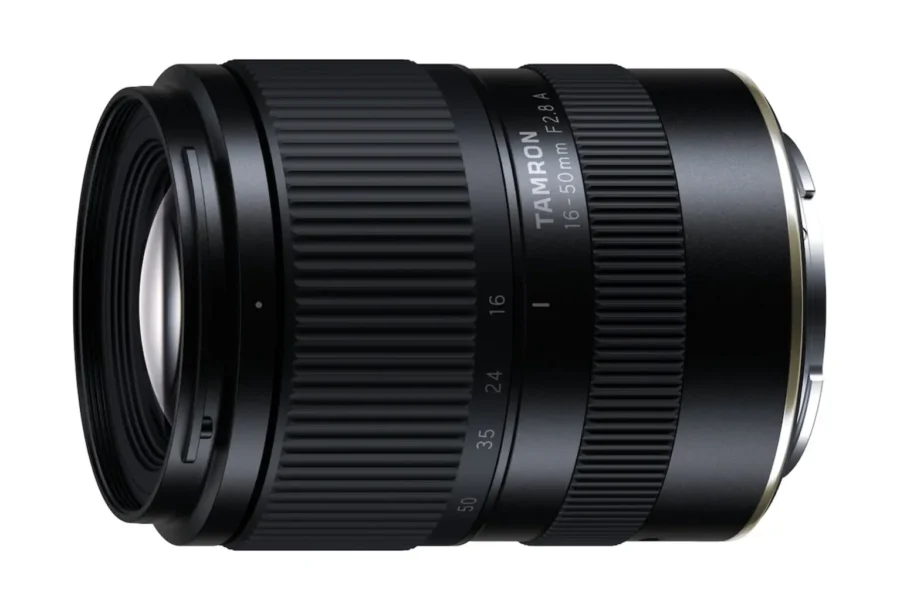
Crop-sensor photographers looking to upgrade beyond slow, variable-aperture kit zooms (such as standard 16-50mm f/3.5-5.6 or 18-45mm f/4.5-6.3 lenses) have historically faced a difficult trade-off. First-party constant f/2.8 zooms often command premium prices well near $1,000 to $1,700, while existing third-party options starting at 17mm or 18mm cut away that crucial wide-angle field of view. Tamron has officially addressed this gap with the press release launch of the Tamron 16-50mm f/2.8 A.
Offering a 24-75mm full-frame equivalent focal range on Sony E, Nikon Z, and Fujifilm X bodies (and a 25.6-80mm equivalent range on Canon RF crop-sensor cameras), this optic maintains a bright constant f/2.8 maximum aperture throughout its entire zoom extension. Weighing just 305g (10.8 oz) in its Sony, Canon, and Fujifilm builds (and 315g on Nikon Z), it pairs a silent VXD linear autofocus motor with a close-focus distance of just 0.15m (5.9 inches). Below is our complete technical breakdown of Tamron’s new APS-C zoom champion. To explore the wider optical ecosystem, visit our master directory for mirrorless camera lenses, check out our full coverage of third-party lenses, and follow all dedicated releases on our Tamron lens hub.
Quick Summary: Key Specifications & Staggered Mount Schedule
Here is a comprehensive breakdown of the official technical specifications and staggered regional release dates for the Tamron 16-50mm f/2.8 A:
| Specification Parameter | Tamron 16-50mm f/2.8 A (Model B091) Details |
|---|---|
| Focal Length Range | 16-50mm (24-75mm equiv. on Sony/Nikon/Fuji | 25.6-80mm on Canon RF) |
| Maximum Aperture | Constant f/2.8 across the entire zoom range |
| Minimum Aperture | f/16 |
| Optical Construction | 14 elements in 10 groups (1 LD, 2 Glass Molded Aspherical, 2 Hybrid Aspherical) |
| Diaphragm Blades | 7-blade rounded circular diaphragm |
| Autofocus Motor | VXD (Voice-coil eXtreme-torque Drive) Linear Motor Drive |
| Minimum Focus Distance | 0.15m (5.9 in) at 16mm | 0.29m (11.5 in) at 50mm |
| Maximum Magnification Ratio | 1:4.5 (at 16mm wide) | 1:4.8 (at 50mm tele) |
| Filter Thread Diameter | Compact 55mm filter size |
| Dimensions & Weight | 64.4mm x 79.6mm (Sony E) | Weight: 305g – 315g (Nikon Z version is slightly longer) |
| Mount Availability & Price | • Sony E: Oct 29, 2026 ($529 USD) • Canon RF: Oct 29, 2026 ($549 USD) • Nikon Z: Nov 19, 2026 ($549 USD) • Fujifilm X: Dec 17, 2026 ($529 USD) |
1. True 24mm Wide-Angle Start & Lightweight Ergonomics
The primary advantage of the Tamron 16-50mm f/2.8 A lies in its starting focal length. Most standard kit upgrade zooms begin at 17mm or 18mm (yielding a 25.5mm or 27mm equivalent reach). By starting at 16mm, Tamron gives landscape photographers, interior shooters, and handheld vloggers a true 24mm equivalent perspective right out of the box, offering crucial extra field-of-view margin when standing in tight spaces or holding a camera at arm’s length.
Despite housing a constant f/2.8 optical formula throughout the entire zoom range, the physical footprint remains remarkably small. Measuring under 80mm in length and weighing just 305 grams in its Sony E, Canon RF, and Fujifilm X iterations (and 315g in its slightly elongated Nikon Z mount build), it balances effortlessly on compact APS-C mirrorless camera bodies such as the Sony A6700, Canon EOS R100/R50/R10, Nikon Z50 II, and Fujifilm X-S20.
Search Tamron 16-50mm f/2.8 A Across Mounts
Check live pre-order listings, stock availability, and retailer pricing:
Check Price on Amazon
Pre-Order at B&H Photo
Filter Tip: This compact zoom features a 55mm front filter thread, keeping replacement polarizers and Variable ND filters lightweight and affordable!
2. Advanced Optical Construction & Close-Up Performance
To control optical aberrations and maintain high resolution across crop sensors, Tamron engineered the internal formula with 14 elements arranged in 10 groups. The design incorporates one Low Dispersion (LD) glass element, two Glass Molded Aspherical elements, and two Hybrid Aspherical elements to suppress chromatic fringing, distortion, and corner softness.
Beyond landscape and environmental shooting, the lens serves as a capable close-up tool. At the 16mm wide-angle setting, the minimum focus distance drops down to just 0.15 meters (5.9 inches), achieving a maximum magnification ratio of 1:4.5. This allows creators to capture dramatic close-up shots of food, products, or travel details with blurred background context.
Explore Fast APS-C Mirrorless Camera Bodies
Pair the Tamron 16-50mm f/2.8 A with compact crop-sensor camera bodies:
3. Rapid VXD Autofocus Drive & Weather-Resistant Build
Autofocus execution is driven by Tamron’s high-speed VXD (Voice-coil eXtreme-torque Drive) linear motor drive. The VXD motor provides fast, near-silent, and precise subject tracking, keeping up effortlessly with moving subjects like pets, children, or fast street action in both stills and video recording modes.
Built for outdoor versatility, the lens housing incorporates a Moisture-Resistant Construction with protective rubber seals located at the lens mount bayonet and key barrel joints. Additionally, the front glass element is treated with a protective Fluorine Coating that repels water droplets, oil smudges, and dirt, making field maintenance straightforward.
4. Market Positioning & Unbeatable Value
By positioning the lens at $529 (Sony E / Fuji X) and $549 (Canon RF / Nikon Z), Tamron offers a high-value alternative to first-party constant f/2.8 optics. It provides an accessible entry point for photographers transitioning away from basic kit lenses into professional-grade f/2.8 imaging performance without breaking the bank.
Compare authorized pricing, bundle options, and stock availability across top camera retailers:
Search Tamron Optics on Amazon | Shop Tamron at B&H Photo | Browse Optics at Adorama
Frequently Asked Questions (FAQ)
Frequently Asked Questions About the Tamron 16-50mm f/2.8 A
Q: What does the “A” in the Tamron 16-50mm f/2.8 A name stand for?
A: The “A” designation signifies Tamron’s dedicated line of optics engineered specifically for crop-sensor (APS-C / Di III-A) mirrorless camera systems.
Q: Does the Tamron 16-50mm f/2.8 A feature built-in optical image stabilization (VC)?
A: No, the lens omits internal Optical Stabilization (VC) to keep the weight down to a featherweight 305g. Stabilization relies on the camera body’s sensor-shift IBIS or digital stabilization.
Q: When will the different camera mount versions become available?
A: The Sony E and Canon RF versions ship first on October 29, 2026. The Nikon Z version follows on November 19, 2026, and the Fujifilm X version arrives on December 17, 2026.