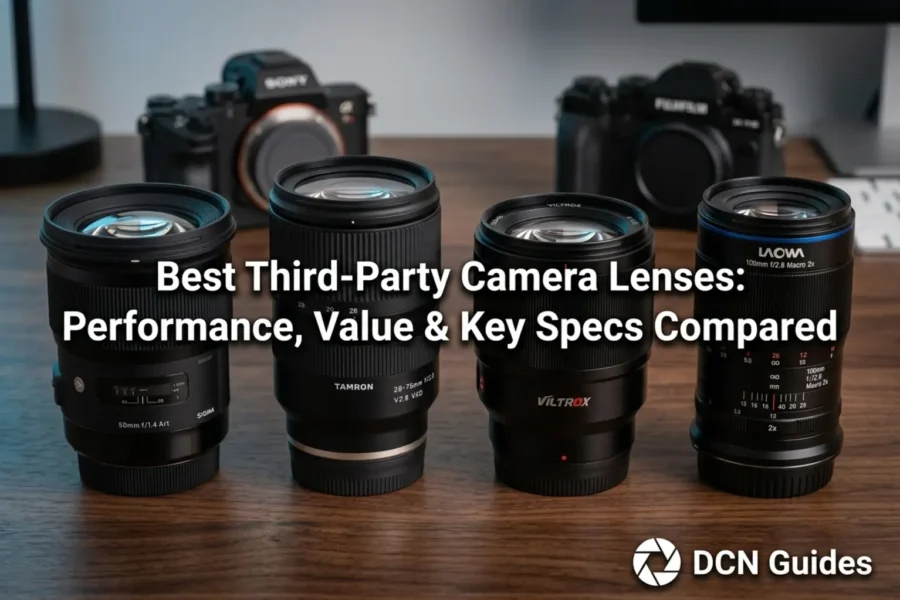
Selecting the ideal camera lens was once a straightforward decision: if you shot with a Sony, Canon, or Nikon body, purchasing first-party native glass was considered the only pathway to achieving professional edge-to-edge sharpness, fast autofocus tracking, and long-term durability. However, modern third-party manufacturers have rewritten industry rules. By leveraging advanced optical design algorithms, high-torque linear autofocus motors, and open or licensed mirrorless protocols, independent lens makers produce some of the most dynamic glass on the market.
Whether you need a fast f/2.8 standard zoom for commercial event coverage, an ultra-fast portrait prime with creamy bokeh, a high-magnification macro lens for product details, or a light super-telephoto zoom for wildlife, third-party options deliver immense value. In this comprehensive buying guide, we analyze the standout third-party optics across major categories, highlighting real-world optical performance, autofocus reliability, build quality, and system value.
Quick Comparison: Top Third-Party Lenses Ranked
Here is an overview comparing key specifications and DCN editorial ratings for our recommended third-party lenses:
| Lens Model | Key Optical Highlight | Autofocus Drive | Best Application | DCN Rating |
|---|---|---|---|---|
| Sigma 24-70mm f/2.8 DG DN II Art | Clinical Edge Sharpness & Compact Body | HLA (High-response Linear Actuator) | Workhorse Events & Weddings | 9.6 / 10 |
| Tamron 35-150mm f/2-2.8 Di III VXD | Ultra-Fast f/2-2.8 All-in-One Zoom | VXD Linear Motor | Portraits, Travel & Events | 9.5 / 10 |
| Viltrox AF 16mm f/1.8 FE/Z | Ultra-Wide f/1.8 with On-Body LCD Screen | STM Stepping Motor | Astrophotography & Architecture | 9.2 / 10 |
| Tamron 70-180mm f/2.8 Di III VC VXD G2 | Lightweight Tele-Zoom with VC Stabilization | VXD Linear Motor | Handheld Portraits & Sports | 9.3 / 10 |
| Laowa 90mm f/2.8 2x Ultra Macro APO | 2:1 Macro Magnification & Apochromatic Design | Manual Precision Focus | Macro, Insects & Fine Details | 9.1 / 10 |
| Sigma 85mm f/1.4 DG DN Art | Creamy Bokeh & Ultra-Compact Prime Body | Stepping Motor (Optimized) | Fine Art Portraiture | 9.5 / 10 |
1. The Workhorse Standard Zooms: Sigma vs. Tamron
Standard f/2.8 zoom lenses (covering roughly 24mm to 70mm) serve as the foundation for working wedding videographers, photojournalists, and commercial shooters. First-party native equivalents often carry premium price tags, making third-party alternatives the most popular upgrades in this category.
The Sigma 24-70mm f/2.8 DG DN II Art stands out as a triumph in optical design. Smaller, lighter, and noticeably sharper wide-open than its predecessor, it incorporates dual HLA linear actuators for whisper-quiet autofocus tracking. It matches native 24-70mm f/2.8 optics in center resolution while offering physical aperture rings and weather-sealed construction at a fraction of the cost.
For photographers prioritizing portability and extended telephoto reach over ultra-wide framing, the Tamron 28-75mm f/2.8 Di III VXD G2 and the revolutionary Tamron 35-150mm f/2-2.8 Di III VXD represent incredible options. The 35-150mm in particular replaces two traditional zoom lenses in a camera bag, allowing portrait and event shooters to seamless transition from environmental 35mm wide shots to isolated 150mm f/2.8 headshots without swapping lenses.
Search Top-Rated Third-Party Lenses & Deals
Check live stock availability, promotional pricing, and kit bundles across authorized photo retailers:
Check Prices on Amazon
Shop Lenses at B&H Photo
Filter Tip: Many popular third-party lenses (especially within Tamron’s mirrorless line) standardize on a 67mm front filter thread, making it cost-effective to share ND filters and polarizers across your kit!
2. Fast Prime Specialists: The Rise of Viltrox & Sigma Art
While third-party manufacturers built their early reputations on affordable zoom lenses, their fast prime lineups now set industry benchmarks for low-light speed and background bokeh rendering.
The Sigma 85mm f/1.4 DG DN Art redesigned what a professional portrait prime could be, shrinking the physical barrel size while rendering clinical edge-to-edge sharpness at f/1.4. Meanwhile, Chinese optical innovator Viltrox has made massive strides in autofocus prime development. The Viltrox AF 16mm f/1.8 features a built-in color LCD display panel on the lens barrel to indicate exact focus distance and depth-of-field, offering astrophotographers and landscape shooters incredible optical sharpness at an accessible price point.
Explore Fast Prime Lenses for Portraiture & Astro
Compare fast f/1.4 and f/1.8 prime lens options across camera mounts:
3. Macro & Specialty Optics: Venus Optics Laowa
When native lens manufacturers overlook specialized optical niches, third-party brands lead the way with innovative designs. Venus Optics (Laowa) has carved out a dominant position in macro and extreme wide-angle photography.
The Laowa 90mm f/2.8 2x Ultra Macro APO offers 2:1 magnification—allowing macro photographers to fill the frame with life-sized detail twice as large as standard 1:1 native macro lenses. Featuring an Apochromatic (APO) optical formula that virtually eliminates longitudinal chromatic aberration and purple fringing, it delivers pristine contrast for macro product details, insect photography, and scientific documentation.
4. Key Factors to Consider When Buying Third-Party Lenses
Before adding a third-party lens to your camera bag, evaluate these essential factors:
- Autofocus Compatibility & Burst Limits: While third-party autofocus tracking is fast, certain camera manufacturers impose artificial software burst-rate caps (such as limiting continuous tracking to 15fps) when non-native lenses are attached to flagship bodies.
- Weather Sealing & Build Quality: High-end lines (like Sigma Art and Tamron VC G2 series) feature full rubber gaskets and fluorine front coatings. Budget-tier lenses may only feature mount sealing.
- In-Body Image Stabilization Synchronization: Ensure the lens features built-in optical stabilization (like Tamron’s VC or Sigma’s OS) if you shoot handheld with non-IBIS camera bodies or at long telephoto focal lengths.
Compare authorized pricing, manufacturer warranties, and live stock across top camera retailers:
Search Mirrorless Optics on Amazon | Shop Lenses at B&H Photo | Browse Store Deals at Adorama
The Verdict: Are Third-Party Lenses Worth It?
The modern third-party camera lens market offers exceptional quality. Brands like Sigma, Tamron, Viltrox, and Venus Optics produce optics that rival or surpass native manufacturer equivalents in resolution, feature set, and handling while offering immense savings. By investing in top-tier third-party glass, photographers can build a versatile, professional gear setup without compromising optical performance.
To explore specific brand lineups in detail, check out our dedicated hubs for Sigma lenses, browse our extensive coverage of Tamron optics, discover affordable performance inside our Viltrox lens directory, inspect specialty macro and ultra-wide optics in our Venus Optics Laowa guide, or visit our master index covering all third-party camera lenses.
Frequently Asked Questions (FAQ)
Frequently Asked Questions About Third-Party Camera Lenses
Q: Are third-party lenses as sharp as native Sony, Canon, and Nikon lenses?
A: Yes! Modern high-end lines—such as Sigma Art, Tamron G2, and Viltrox Pro series—frequently match or exceed native optical resolution in laboratory MTF tests.
Q: Will my camera’s eye-autofocus and subject tracking work with third-party lenses?
A: Absolutely. Modern autofocus third-party lenses fully support native eye-AF, face detection, subject tracking algorithms, and in-camera lens correction profiles.
Q: How do I update the firmware on a third-party lens?
A: Depending on the brand, firmware updates are installed via built-in USB-C ports on the barrel (Viltrox/Tamron), through USB lens docks (Sigma), or directly through the camera body menu.