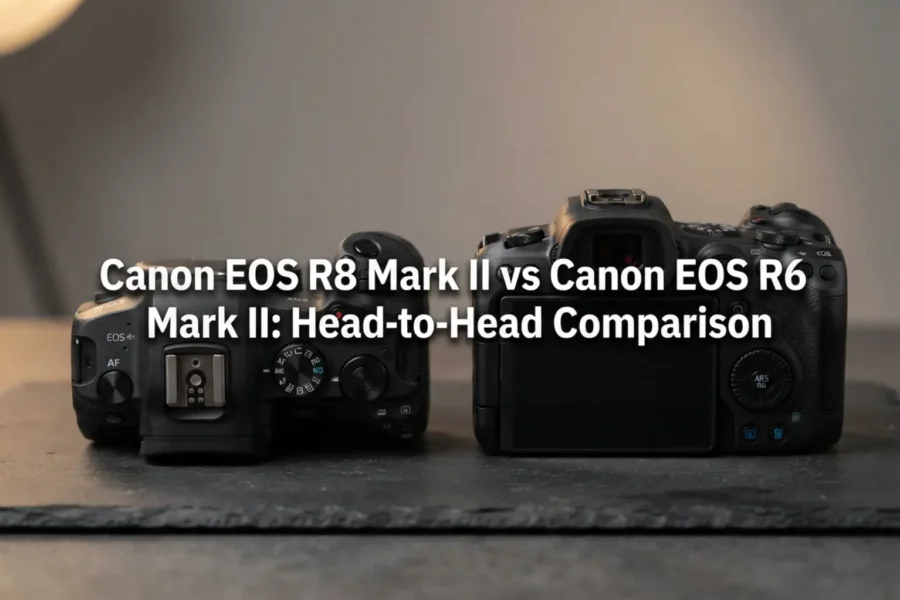
Canon’s full-frame mirrorless ecosystem offers options for every shooting style and budget. However, with the release of the updated Canon EOS R8 Mark II, choosing between Canon’s lightweight full-frame line and its enthusiast workhorse series has become far more complex.
The original EOS R8 was often viewed as a stripped-down companion to the Canon EOS R6 Mark II—lacking In-Body Image Stabilization (IBIS), a physical AF joystick, and side memory card access. But the EOS R8 Mark II changes that dynamic dramatically by adding 7.5-stop 5-axis IBIS, a rear AF multi-controller joystick, and a dedicated side SD card door into a light 546g body at a launch price of $1,899.
Meanwhile, the Canon EOS R6 Mark II remains a legendary full-frame workhorse priced around $2,299 (MSRP) – Currently $1,999 with $300.00 saving – , offering dual UHS-II SD card slots, a massive LP-E6NH battery, weather sealing, and a high-resolution 3.69M-dot EVF. In this detailed comparison, we break down every key spec difference to help you decide which camera deserves a spot in your bag.
For complete launch details, pricing setups, and regional package availability on the newer lightweight model, check out our full breakdown of the Canon EOS R8 Mark II Official Specs & Price.
Daisy’s Take: Canon made the choice much tougher this time around! On paper, the R8 Mark II gets nearly all of the R6 Mark II’s headline features—including 24.2MP resolution, 40fps electronic bursts, deep-learning AF tracking, and 7.5-stop IBIS. The decision now comes down to practical workflow choices: do you need dual card slots and a larger battery, or do you prefer saving $600 and carrying a lighter rig on travel shoots?
Quick Comparison: Key Specifications at a Glance
| Specification / Feature | Canon EOS R8 Mark II | Canon EOS R6 Mark II |
|---|---|---|
| Launch Price (MSRP) | $1,899 (Body Only) | $2,299 (Body Only)
Currently $1,999 with $300.00 saving.
|
| Sensor Resolution | 24.2MP Full-Frame CMOS | 24.2MP Full-Frame CMOS |
| Image Stabilization (IBIS) | 5-Axis IBIS (Up to 7.5 Stops) | 5-Axis IBIS (Up to 8.0 Stops) |
| Autofocus System | Dual Pixel CMOS AF II + Register People | Dual Pixel CMOS AF II |
| Memory Card Slots | 1x UHS-II SD Card Slot (Side Access) | Dual UHS-II SD Card Slots |
| Battery Type & Rating | LP-E17 (~290–370 shots CIPA) | LP-E6NH (~580 shots CIPA) |
| Electronic Viewfinder (EVF) | 0.39-inch 2.36M-dot OLED (0.70x) | 0.50-inch 3.69M-dot OLED (0.76x) |
| Continuous Burst Speeds | 40 fps (Electronic) / Pre-Burst | 40 fps (Electronic) / 12 fps (Mechanical) |
| Shutter Design | Electronic Shutter Only | Mechanical & Electronic Shutter |
| Video Recording | 4K 60p Oversampled (Uncropped), C-Log 3 | 4K 60p Oversampled (Uncropped), C-Log 3, 6K RAW Out |
| Body Weight | 546g (With Battery & Card) | 670g (With Battery & Card) |
In-Depth Feature Analysis
1. Sensor Performance & Autofocus Capabilities
Both cameras feature a 24.2-megapixel full-frame CMOS sensor paired with Canon’s DIGIC X processing platform. Image quality, dynamic range, high-ISO noise control up to ISO 25,600, and Canon’s color science are virtually identical across both bodies.
Likewise, both utilize the advanced Dual Pixel CMOS AF II system with deep-learning subject detection for humans, animals, and vehicles. However, the EOS R8 Mark II includes the updated Register People Priority AF feature, which allows event photographers to pre-register specific faces into internal memory so the focus system prioritizes them in crowded environments.
To see how the R8 Mark II compares directly against its first-generation counterpart, take a look at our Canon EOS R8 Mark II vs Canon EOS R8 Comparison.
2. Memory Card Redundancy: Single vs. Dual UHS-II Slots
This is one of the clearest dividing lines between these two bodies for working professionals:
- Canon EOS R6 Mark II: Equipped with Dual UHS-II SD card slots housed behind a weather-sealed side door. This allows real-time backup recording (writing RAW files simultaneously to both cards), overflow storage, or separating RAW photos from JPEG/video files.
- Canon EOS R8 Mark II: Relies on a single UHS-II SD card slot. While Canon moved the card slot out of the battery compartment and into its own dedicated side door, the lack of a second card slot remains a consideration for paid wedding or commercial shoots where instant backup is required.
3. Battery Life & Power Stamina
Power management is another key point of differentiation:
- The EOS R6 Mark II uses the larger Canon LP-E6NH battery, rated for roughly 580 shots per charge (CIPA). In real-world burst photography, it easily delivers 1,200+ images on a single pack, making it ideal for full-day event shooting.
- The EOS R8 Mark II uses the compact Canon LP-E17 battery to maintain its slim, 546g frame. CIPA-rated for approximately 290 to 370 shots per charge, carrying two or three spare batteries or utilizing a USB-C Power Delivery bank is recommended for long days in the field.
4. EVF, Shutter Mechanics & IBIS Performance
When framing through the viewfinder, the EOS R6 Mark II offers a superior viewing experience thanks to its larger 0.50-inch 3.69M-dot OLED EVF with 0.76x magnification. The EOS R8 Mark II features a 0.39-inch 2.36M-dot OLED EVF with 0.70x magnification, which is clear and responsive at 120fps but visually smaller.
Regarding stabilization, both cameras excel. The R6 Mark II provides up to 8.0 stops of Coordinated Control IS, while the R8 Mark II delivers up to 7.5 stops. In real-world handheld testing, both cameras allow sharp handheld exposures at shutter speeds as slow as 1 to 1.5 seconds.
For a detailed hands-on evaluation of real-world IBIS performance, EVF usability, and thermal handling, read our full Canon EOS R8 Mark II Review.
Daisy’s Pro Tip: If you shoot primarily with fast RF prime lenses (such as the RF 35mm f/1.8 IS or RF 85mm f/2 Macro), both cameras unlock massive stabilization benefits! However, if you shoot under severe, flickering artificial lighting at indoor sports arenas, the mechanical shutter option on the R6 Mark II provides an added layer of flicker protection over electronic-only shutter designs.
Video Capabilities Comparison
Both models are hybrid video powerhouses capable of capturing uncropped, oversampled 4K video up to 60p in 10-bit 4:2:2 C-Log 3 and HDR-PQ modes, alongside high-speed Full HD recording up to 180p for slow-motion clips.
Video Feature Distinctions
- External RAW Video: The EOS R6 Mark II supports 6K 12-bit RAW video output over HDMI to Atomos external recorders. The R8 Mark II focuses on internal 10-bit recording modes.
- Front Tally Lamp: The R8 Mark II includes a front-facing red tally light for solo vloggers, which illuminates when recording is active.
- Thermal Management: Both cameras handle heat well during continuous 4K 30p/60p recording, though the larger magnesium alloy chassis of the R6 Mark II dissipates thermal energy slightly faster during extended multi-hour takes.
To dial in your camera for video or stills work, check out our step-by-step Best Settings for Canon EOS R8 Mark II Setup Guide.
To select the best lenses for either body across landscapes, portraits, and travel photography, browse our recommendations in the Best Lenses for Canon EOS R8 Mark II Guide.
If you want to see where both bodies fit within Canon’s broader camera lineup, check out our comprehensive Canon EOS R System Guide.
Which Camera Should You Buy?
Buy the Canon EOS R8 Mark II If:
- You Want the Best Full-Frame Value Under $2,000: At $1,899, it delivers 90% of the R6 Mark II’s performance—including 7.5-stop IBIS, 40fps bursts, and an AF joystick—while saving you $600.
- Portability & Travel Weight Matter: At 546g, it is significantly lighter and more compact for street shooting, hiking, and daily travel carry.
- You Are a Solo Vlogger / Content Creator: The front tally lamp, vari-angle LCD touchscreen, and lighter weight make handheld self-recording far easier.
Buy the Canon EOS R6 Mark II If:
- You Are a Working Pro Shooting Paid Events: Dual UHS-II SD card slots provide real-time backup, protecting your files against card failure during unrepeatable weddings or commercial jobs.
- You Need Maximum All-Day Battery Stamina: The LP-E6NH battery provides nearly double the shot capacity per charge compared to the LP-E17.
- You Prefer a Larger EVF & Full Mechanical Shutter: The 3.69M-dot EVF offers a larger, clearer view, while the mechanical shutter adds versatility under tough indoor lighting.
Shop Canon Cameras & Lenses
Check Canon EOS R8 Mark II PricesBuy Canon EOS R8 Mark II
View Canon EOS R8 Mark II Listings
Tip: Compare the current EOS R8 with the expected EOS R8 Mark II to decide your upgrade path.
For continuity, see our previous R8 Mark II coverage, the Canon EOS R8 II archive and stay tuned to our Canon News and Canon Rumors hub for updates.
Join the Canon Camera Users Group to share your Canon photography. Ask and answer questions that arise and help each others!
Frequently Asked Questions (FAQ)
Frequently Asked Questions
Q: Does the Canon EOS R8 Mark II have IBIS like the R6 Mark II?
A: Yes! The EOS R8 Mark II features 5-axis IBIS providing up to 7.5 stops of stabilization, bringing it remarkably close to the 8.0 stops offered by the R6 Mark II.
Q: What is the main advantage of the EOS R6 Mark II for professional photographers?
A: Dual UHS-II SD card slots for instant file backup, longer battery life with the LP-E6NH battery, a larger 3.69M-dot EVF, and robust weather sealing.
Q: Is the video quality identical between the R8 Mark II and R6 Mark II?
A: Yes, both record uncropped 4K 60p video oversampled from 6K data in 10-bit 4:2:2 C-Log 3. However, the R6 Mark II also supports external 6K RAW recording over HDMI.
Final Verdict
The Canon EOS R8 Mark II narrowing the performance gap between Canon’s entry and enthusiast tiers is fantastic news for photographers. By including 7.5-stop IBIS, a rear AF joystick, and a side SD door, the R8 Mark II delivers top-tier full-frame performance at an accessible $1,899 price point.
For working professionals who demand dual card slots, longer battery life, and a larger EVF, the Canon EOS R6 Mark II remains the definitive full-frame workhorse. However, for travel shooters, hybrid creators, and budget-conscious photographers, the EOS R8 Mark II stands as one of the best value full-frame cameras available today!