Mirrorless cameras have reshaped modern photography. From beginners picking up their first interchangeable-lens body to professionals shooting weddings, wildlife, cinema, and commercial work—mirrorless systems now dominate the market. This guide breaks down everything you need to know: how mirrorless cameras work, system advantages, lens compatibility, brand ecosystems, and which models are worth buying today. Think of this as your all-in-one hub for understanding every major mirrorless camera system in 2025.
This ultimate hub brings together every major mirrorless system — Canon RF, Nikon Z, Sony E, Fujifilm X/GFX, Panasonic/Leica L-Mount, and OM System. You’ll find pros & cons, sensor-size breakdowns, lens compatibility guides, and buyer recommendations for every type of photographer.
And if you like future predictions, don’t miss Daisy’s trend article:
👉 Read also: Daisy Looks Ahead: The Future of Mirrorless Cameras & Computational Imaging
What Are Mirrorless Cameras?
Mirrorless cameras are digital interchangeable-lens cameras that remove the traditional DSLR mirror mechanism. Instead of bouncing light into an optical viewfinder, mirrorless bodies send light directly to the image sensor, allowing for real-time electronic previews. This design reduces size, improves autofocus speed, and enables features that simply aren’t possible with optical systems—like live exposure simulation, advanced eye-tracking autofocus, and silent shooting for weddings and wildlife.
The lack of a mirror also gives engineers more freedom. Mounts can sit closer to the sensor thanks to shorter flange distances, which improves lens design efficiency. This is why mirrorless systems often feature smaller, faster, and optically superior lenses. Whether you’re new to photography or upgrading from a DSLR, mirrorless technology provides a cleaner, more modern shooting experience with fewer mechanical limitations.
👉 See also: Best Mirrorless Cameras for Beginners
Today, virtually every major brand—including Canon, Nikon, Sony, Fujifilm, Panasonic, Leica, and OM System—has fully transitioned to mirrorless development. DSLRs are no longer the cutting edge; mirrorless is the standard.
Mirrorless vs DSLR: Key Differences
The debate between mirrorless and DSLR systems has largely ended—but understanding the differences helps new buyers make informed decisions. DSLRs rely on an internal mirror and optical pentaprism to show a real-time view through the lens. This design was revolutionary for decades, but it introduces bulk, noise, vibration, and mechanical wear. Mirrorless cameras eliminate those moving parts, resulting in lighter bodies, quieter operation, faster burst rates, and simplified design.
Autofocus is another major factor. DSLRs use separate phase-detect AF modules, which can suffer from focus calibration issues. Mirrorless bodies use on-sensor phase and contrast detection, ensuring pin-point accuracy across the entire frame. This is especially beneficial for fast-moving subjects, portrait eye tracking, and video work. Additionally, electronic viewfinders offer exposure previews, focus peaking, zebras, real-time highlight warnings, and instant playback without removing your eye from the viewfinder.
While DSLRs still have loyal fans—especially for battery life and optical clarity—the overall direction of the industry is unmistakable. Mirrorless technology offers more innovation and continues to expand with every new model.
Pros & Cons of Mirrorless Systems
Pros
- Smaller and lighter systems, ideal for travel and everyday use
- Advanced autofocus with eye, face, animal, vehicle, and subject tracking
- Silent or electronic shutters for discreet shooting
- Better video capabilities, including 4K/6K/8K with advanced codecs
- More modern lens designs due to short flange distances
- Live exposure, histogram, and preview through the EVF
Cons
- Shorter battery life compared to DSLRs (though improving each generation)
- High-end bodies and lenses can be expensive
- Electronic viewfinders may feel unnatural to traditional shooters
- Fast lenses sometimes run hotter or consume more power
👉 See also: Best Mirrorless Cameras 2025
Despite these trade-offs, the benefits overwhelmingly outweigh the drawbacks for most photographers. The mirrorless ecosystem continues to evolve rapidly, making it the most future-proof investment in 2025 and beyond.
Full-Frame vs APS-C vs Micro Four Thirds
The sensor format you choose influences image quality, depth of field, size, and cost. Full-frame sensors offer the highest dynamic range and low-light performance, making them ideal for professionals shooting weddings, portraits, landscapes, or night scenes. However, full-frame bodies and lenses tend to be heavier and pricier.
APS-C strikes a balance between portability and performance. Popular with enthusiasts and travel photographers, APS-C mirrorless cameras deliver excellent sharpness and speed while keeping costs reasonable. Systems like Fujifilm X and Sony E APS-C have extensive lens ecosystems designed specifically for smaller sensors.
Micro Four Thirds (MFT) prioritizes compactness. While smaller sensors produce more depth-of-field naturally and have slightly less low-light capability, the system is unmatched for travel, hiking, and long telephoto reach. Wildlife photographers appreciate that a 300mm lens becomes a 600mm equivalent without extra weight.
Each sensor size has strengths; the key is choosing based on the type of photography you plan to do—not simply the largest sensor available.
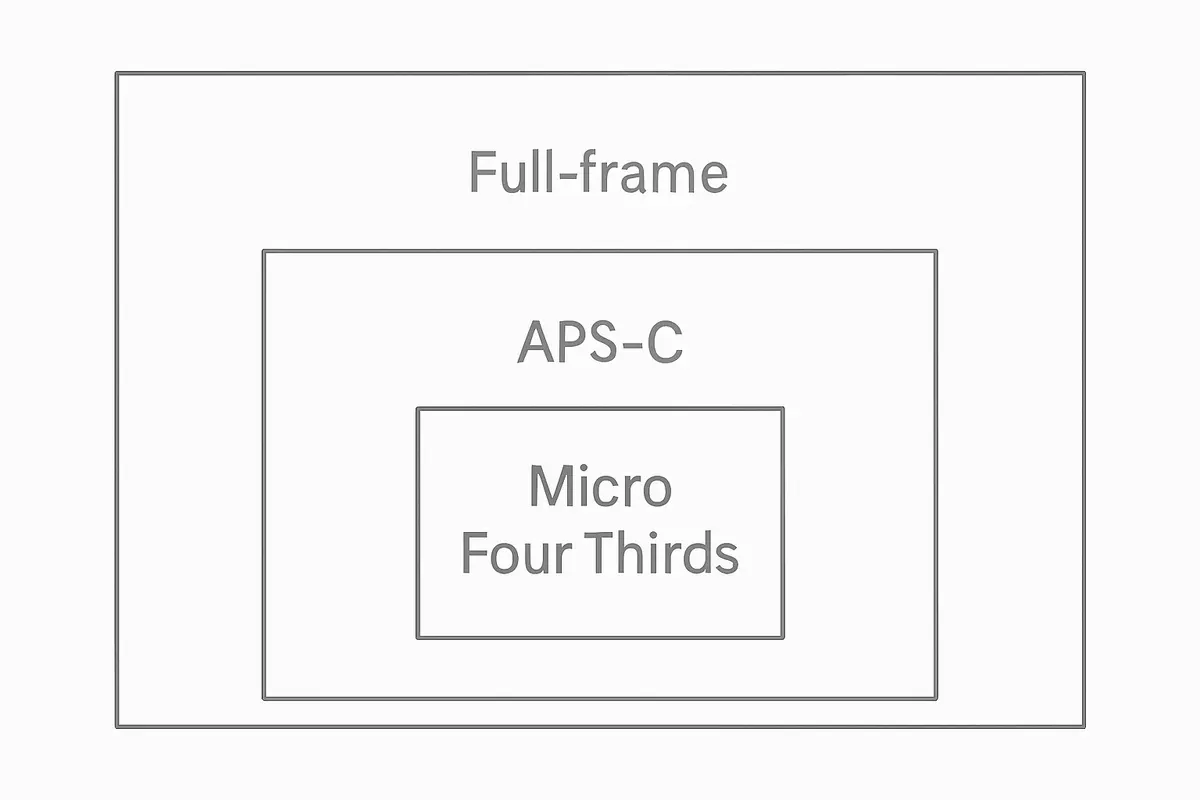
Full-Frame (Canon RF, Nikon Z, Sony FE, Panasonic/Leica L)
Ideal for: Professionals, portrait shooters, weddings, low-light work
Strengths:
-
Best dynamic range
-
Best background blur
-
Superior high-ISO performance
Trade-offs: -
Lenses are larger & pricier
APS-C (Sony E, Fujifilm X, Canon RF-S, Nikon Z DX)
Ideal for: Beginners, vloggers, travel, budget shooters
Strengths:
-
Smaller lenses
-
More reach for wildlife
-
Cheaper bodies
Trade-offs: -
Less bokeh & slightly lower ISO performance
Micro Four Thirds (OM System, Panasonic MFT)
Ideal for: Travelers, wildlife, documentary, handheld video
Strengths:
-
Ultra-compact lenses
-
Best IBIS on the market
-
Deep depth of field (sharp, predictable)
Trade-offs: -
Smaller sensor → reduced low-light performance
Lens Compatibility Across Major Mirrorless Mounts
One of the biggest challenges for new buyers is understanding lens compatibility. Unlike DSLRs, where lenses lasted across decades, mirrorless mounts differ in design, flange distance, and communications. Below is a simplified breakdown of today’s major systems.
Canon RF
Canon’s RF mount is designed exclusively for mirrorless bodies like the EOS R5, R6 II, R7, and R8. RF lenses emphasize optical quality, fast communication, and advanced stabilization. Canon EF DSLR lenses can be adapted flawlessly with Canon’s official EF-to-RF adapters. RF-S lenses support APS-C bodies but can also mount on full-frame cameras in crop mode.
-
Supports RF (native) and RF-S (APS-C) lenses
-
Cannot use EF-M lenses
-
Can adapt EF lenses flawlessly
Nikon Z
The Nikon Z mount supports both full-frame (FX) and APS-C (DX) bodies. Z mount lenses are known for excellent corner-to-corner sharpness thanks to a wide 55mm throat diameter. Like Canon, Nikon F DSLR lenses adapt cleanly using the FTZ II adapter, preserving autofocus and stabilization features in most cases.
-
Universal mount for both full-frame (FX) and APS-C (DX)
-
FTZ II adapter supports F-mount lenses
-
Wide range of third-party AF lenses (Tamron, Viltrox, Sigma upcoming)
Sony E
Sony’s E-mount is the longest-running mirrorless system, supporting both APS-C and full-frame FE lenses. Compatibility is straightforward: FE lenses work on all Sony bodies; APS-C lenses crop on full-frame cameras. Sony’s massive third-party ecosystem (Sigma, Tamron, Viltrox, Zeiss) is unmatched, giving buyers more lens options than any other mount.
-
The most mature mirrorless ecosystem
-
FE lenses (FF)
-
E lenses (APS-C)
-
Strongest 3rd-party support: Sigma, Tamron, Samyang, Viltrox
Fujifilm X
Fujifilm’s X mount is APS-C only (except the separate GFX medium-format line). The system is beloved for its color science, retro ergonomics, and outstanding prime lenses like the 23mm f/1.4 and 56mm f/1.2. Fuji does not support full-frame, which simplifies lens design and keeps bodies compact.
-
Unique APS-C ecosystem
-
Best color science for JPEG shooters
-
Dedicated film simulations
-
Limited full-frame options → Only GFX medium format
Leica / Panasonic / Sigma L-Mount
The L-Mount Alliance combines Leica, Panasonic, and Sigma into a shared ecosystem. Full-frame and APS-C cameras use the same mount. Panasonic’s L-mount bodies focus heavily on hybrid shooting, while Sigma provides affordable, sharp lenses. Leica contributes high-end optics for premium users.
-
Shared mount across brands
-
Broad coverage: photo, cinema, hybrid
-
Sigma lineup extremely strong for value
OM System Micro Four Thirds
Micro Four Thirds (OM System and Panasonic MFT) is the most mature compact mirrorless mount. All MFT lenses work across all MFT cameras, which creates the largest cross-brand lens compatibility in the industry. The system is ideal for travel, wildlife, macro, and video shooters.
-
Shared ecosystem (OM + Panasonic MFT)
-
Exceptional lightweight telephotos
-
Best-in-class stabilization
Brand-by-Brand Breakdown (Mini Guides)
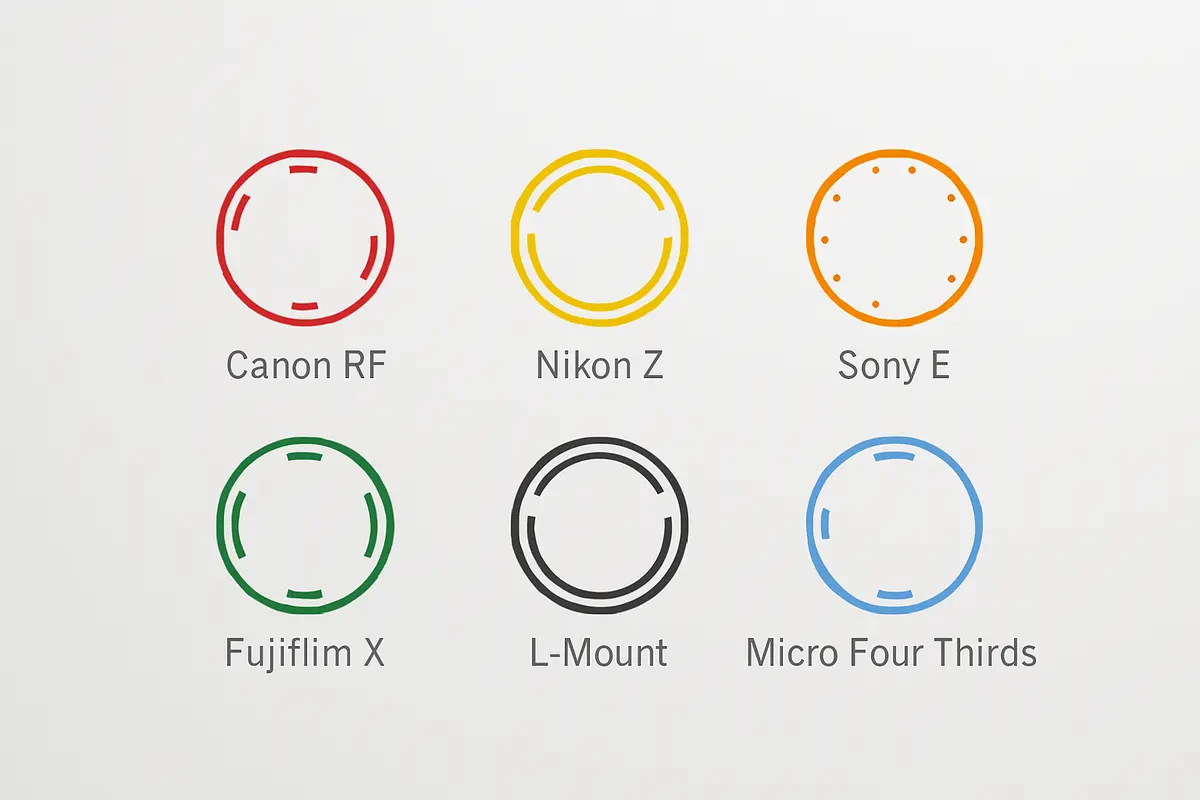
Canon EOS R System
The Canon EOS R ecosystem has rapidly matured into one of the most balanced and forward-looking mirrorless platforms. Canon’s legendary color science remains a major draw for portrait, wedding, and lifestyle photographers who want skin tones that look great straight out of the camera. The RF lens lineup includes some of the sharpest modern primes and zooms ever produced, and Canon’s Dual Pixel AF II still ranks among the most intuitive autofocus systems for beginners and professionals. At the same time, the system’s compatibility with EF lenses through Canon’s highly reliable adapters offers thousands of legacy options, making the transition from DSLR both smooth and budget-friendly. Despite the strengths, Canon’s RF ecosystem remains limited in affordable third-party autofocus lenses, which slightly restricts budget users.
- Strengths
- Excellent color science
- Strong RF primes
- Brilliant AF
- EF lens compatibility
- Weaknesses
- Limited budget RF lenses
- No third-party AF (yet)
- Who It’s For
- Portrait, weddings, hybrid shooters.
Nikon Z System
Nikon’s Z system stands out with outstanding ergonomics, intuitive handling, and some of the best low-light sensors ever deployed in mirrorless cameras. From the compact Z5 to the flagship Z8, Nikon offers remarkable value at nearly every price point. The lens lineup has matured into one of the most optically consistent collections on the market, including exceptional S-Line primes and zooms. Wildlife and landscape shooters gravitate toward Nikon thanks to excellent dynamic range and long-lens performance. Although the APS-C range is smaller and third-party lenses are still expanding, the Z mount remains one of the most future-proof systems on the market.
- Strengths
- Best ergonomics
- Superb low-light sensors
- Highly balanced lens lineup
- Excellent value in Z5/Z6 II/Z6 III/Z8
- Weaknesses
- Fewer APS-C bodies
- Third-party lens ecosystem growing slowly
- Who It’s For
- Travelers, landscape, wildlife, enthusiasts.
Sony E-Mount (FE + E)
Sony’s E-mount remains the most complete and flexible mirrorless system, with the largest native and third-party lens ecosystem available today. Professionals love Sony’s reliable subject tracking, outstanding video autofocus, and hybrid-focused bodies like the A7 IV and A7C II. Meanwhile, APS-C is experiencing a strong resurgence with creator-focused models and compact prime lenses. Although Sony’s menus can feel complex to newcomers and some bodies emphasize compactness over deep handling, the system’s versatility and innovation make it an excellent long-term investment for nearly any visual creator.
- Strengths
- Largest lens ecosystem in mirrorless
- Best video autofocus
- Strong APS-C lineup returning
- Excellent third-party lens support
- Weaknesses
- Menus (improved but still complex)
- Some bodies feel less ergonomic
- Who It’s For
- Hybrid creators, videographers, pros.
Fujifilm X & GFX
Fujifilm’s X Series has become the gold standard for enthusiasts who value tactile controls, beautiful color science, and compact prime lenses. Its APS-C sensors deliver class-leading results, while film simulations give creators a distinctive aesthetic with minimal editing. Meanwhile, the GFX lineup makes medium format photography surprisingly accessible, offering huge dynamic range and stunning detail for commercial and fine-art photographers. While Fuji lacks long telephoto options and does not offer full-frame, it compensates with a uniquely artistic and highly optimized system.
- Strengths (X)
- Best APS-C primes
- Film simulations
- Stylish, tactile bodies
- Strengths (GFX)
- Medium format at accessible pricing
- Stunning dynamic range
- Weaknesses
- Limited long telephotos
- No full-frame option
- Who It’s For
- Street, travel, portrait, color lovers.
Panasonic L-Mount (and Leica/Sigma)
The L-Mount alliance—Panasonic, Leica, and Sigma—offers one of the most versatile ecosystems in modern mirrorless photography. Panasonic’s full-frame bodies, especially the S5 II and S5 II X, deliver exceptional video performance with professional-level codecs, internal stabilization, and strong heat management. Sigma’s Art lenses provide premium optical performance at reasonable prices, giving the system a uniquely strong value proposition. While L-Mount has historically lagged behind in autofocus and is less popular for wildlife, its rapid improvement and open nature make it a compelling choice for filmmakers and hybrid creators.
- Strengths
- Incredible video features
- Open ecosystem
- Sigma Art lenses → unbeatable value
- Weaknesses
- Autofocus used to be weaker (greatly improved)
- Not as popular for wildlife
- Who It’s For
- Videographers, creators, filmmakers.
OM System Micro Four Thirds
OM System’s Micro Four Thirds platform is engineered for mobility, speed, and extreme versatility in challenging shooting environments. Its industry-leading image stabilization and weather sealing allow handheld shooting in conditions that would challenge most full-frame cameras. Wildlife photographers appreciate the reach advantage of Micro Four Thirds lenses, especially the lightweight super-telephotos. While the smaller sensor can limit high-ISO performance, the system remains an outstanding choice for adventurers, macro specialists, and travelers who want professional results without heavy gear.
- Strengths
- Lightest long lenses
- Best stabilization
- Weather-sealed bodies
- Weaknesses
- Small sensor limits ISO
- Shallow DOF harder to achieve
- Who It’s For
- Wildlife, macro, travel, handheld shooters.
Who Should Buy a Mirrorless Camera?
Modern mirrorless cameras appeal to a wide range of photographers and creators thanks to their compact size, advanced autofocus systems, excellent video performance, and growing lens ecosystems. Whether you’re entering photography for the first time or looking to upgrade to a professional setup, mirrorless bodies provide a flexible and future-proof platform. Below, you’ll find detailed guidance for different types of users, including what features to prioritize and which cameras deliver the best balance of performance and value within each category.
Beginners
Beginners benefit most from cameras that are easy to set up, intuitive to use, and capable of delivering great results without complex menus. Mirrorless systems offer features like subject tracking, touchscreen controls, and lightweight bodies that make learning photography smoother. Choose a camera with a strong kit lens option and reliable autofocus to grow your skills confidently.
- Look for:
- Affordable kits
- Simple menus
- Good autofocus
- Recommended: Nikon Z50, Canon R10, Sony A6100
Vloggers
For vloggers and online creators, a mirrorless camera should combine excellent video quality with user-friendly features like a flip-out screen and dependable autofocus. Lightweight designs make it easier to shoot handheld content for long periods, while microphone and headphone ports allow better control over audio. Compact APS-C systems often provide the best value and portability.
- Look for:
- Flip screen
- Great video AF
- Light body
- Recommended: Sony ZV-E10 II, Canon R50, Panasonic G100 II
👉 See also: Best Cameras for Vlogging
Travel & Street
Travel and street photographers require a blend of portability, discretion, and responsiveness. Lightweight mirrorless bodies paired with fast compact primes allow creators to capture spontaneous moments while moving through crowded environments. Reliable stabilization and strong battery life help maintain performance during long days on the road or in urban settings.
- Look for:
- Compact size
- Good primes
- Reliable IBIS
- Recommended: Fujifilm X-S20, OM-5, Sony A7C II
👉 See also: Best Cameras for Travel Photography in 2025: Capture the World in Style
Wildlife / Sports
Wildlife and sports photography demand fast autofocus, long telephoto reach, and bodies capable of shooting at high burst rates with deep buffers. Mirrorless cameras excel here thanks to advanced subject detection algorithms and electronic shutters that make silent shooting possible in delicate environments. A reliable telephoto lens ecosystem is essential for capturing distant subjects.
- Look for:
- Fast burst
- Deep buffer
- Strong telephoto lenses
- Recommended: Nikon Z8, Sony A9 III, OM-1 Mark II
👉 See also: Best Cameras for Wildlife Photography in 2025 – Top Picks for Every Budget
Portrait & Weddings
Portrait and wedding photographers need consistent skin tones, beautiful depth of field, and cameras that perform flawlessly in both natural and artificial lighting. Full-frame mirrorless systems excel in dynamic range and low-light performance, while fast prime lenses deliver creamy bokeh ideal for professional portrait work. Dual card slots and dependable autofocus are musts for capturing once-in-a-lifetime moments.
- Look for:
- Full-frame
- Beautiful color & dynamic range
- Fast primes
- Recommended: Canon R6 Mark II, Sony A7 IV, Nikon Z6 III
Cinematographers
Cinematographers and hybrid filmmakers rely on advanced codecs, color profiles, and stabilization systems to achieve cinematic results. Mirrorless cameras increasingly offer features once reserved for cinema bodies, including log profiles, 10-bit recording, high frame rates, and powerful heat management. Systems like Panasonic’s S5 II X and Sony’s FX series deliver exceptional video performance with strong ecosystem support.
- Look for:
- Advanced codecs
- 4:2:2 10-bit
- Unlimited recording
- Recommended: Panasonic S5 II X, Sony FX3
Future Trends: What’s Coming Next?
Mirrorless technology is evolving rapidly. Sensor & Imaging Technology, Key innovations on the horizon:
-
Global Shutter Sensors
-
AI-driven Autofocus with emotion/facial expression detection
-
Computational Exposure Blending
-
Hybrid Optical + Digital Viewfinders
-
Next-gen heat management and fanless 8K video
👉 For a deeper look, read Daisy’s article:
“DAISY LOOKS AHEAD — Mirrorless Cameras in 2026–2028: AI, Global Shutters & What’s Next”
Best Mirrorless Cameras: Starter Recommendations
Below are reliable, high-value cameras for beginners, travelers, vloggers, and hybrid creators. Each model includes links to Amazon, B&H Photo, and Adorama.
Beginner Favorites
- Nikon Z50 — compact, great AF, and a strong starter lens lineup.
(Buy on Amazon | Check latest price at B&H | See deals on Adorama) - Canon EOS R10 — excellent entry APS-C hybrid for photo & video.
(Buy on Amazon | Check latest price at B&H | See deals on Adorama) - Sony A6100 — reliable AF, compact, and good for learners.
(Buy on Amazon | Check latest price at B&H | See deals on Adorama) - Sony ZV-E10 II — vlogger-focused APS-C with strong video features.
(Buy on Amazon | Check latest price at B&H | See deals on Adorama)
Best Value Full-Frame
- Sony A7 IV — hybrid powerhouse for photo & video.
(Buy on Amazon | Check latest price at B&H | See deals on Adorama) - Canon R6 Mark II — excellent autofocus and low-light performance.
(Buy on Amazon | Check latest price at B&H | See deals on Adorama) - Nikon Z6 III — balanced specs for photo and video at a competitive price.
(Buy on Amazon | Check latest price at B&H | See deals on Adorama)
High-Performance & Pro Picks
- Nikon Z8 — sports & wildlife workhorse with pro features.
(Buy on Amazon | Check latest price at B&H | See deals on Adorama) - Sony A9 III — ultimate speed for sports and action.
(Buy on Amazon | Check latest price at B&H | See deals on Adorama) - Sony A7R V — highest resolution for commercial and studio work.
(Buy on Amazon | Check latest price at B&H | See deals on Adorama) - Panasonic S5 II X — cinema features packed into a stills-video hybrid.
(Buy on Amazon | Check latest price at B&H | See deals on Adorama)
Medium Format
- Fujifilm GFX 50S II
(Buy on Amazon | Check latest price at B&H | See deals on Adorama) - Fujifilm GFX 100S II
(Buy on Amazon | Check latest price at B&H | See deals on Adorama)
Compact / Travel
- Fujifilm X-S20 — a travel-friendly APS-C hybrid with great color profiles.
(Buy on Amazon | Check latest price at B&H | See deals on Adorama) - OM System OM-5 — ultra-portable with strong stabilization and weather sealing.
(Buy on Amazon | Check latest price at B&H | See deals on Adorama) - Sony A7C II — compact full-frame for travel photographers who want small size without compromising sensor size.
(Buy on Amazon | Check latest price at B&H | See deals on Adorama)
Tip: For any camera above, click the marketplace search links to compare kit and body-only prices, check bundled lenses, and find verified used options.
Best Mirrorless Cameras in 2025 (Updated Picks)
Looking for the best mirrorless cameras you can buy right now? Our updated guide covers the top 12 mirrorless cameras in 2025, from beginner-friendly APS-C models to professional full-frame hybrids.
🎀 Read: Best Mirrorless Cameras in 2025 (Updated Guide)
Final Thoughts: Choosing the Right Mirrorless Camera
Whether you’re stepping into photography for the first time or upgrading from an older DSLR, the mirrorless ecosystem in 2025 offers more flexibility, performance, and creative potential than ever before. This guide has covered the fundamentals—from sensor formats to lens mounts, autofocus technology, brand ecosystems, and our top beginner camera picks. Use this mirrorless camera guide as your long-term reference when comparing systems or evaluating which camera fits your creative goals.
The most important thing is matching a camera to your needs, not chasing specs. Think about your shooting style, preferred subjects, travel habits, and budget. With so many excellent mirrorless options available today, there has never been a better time to start creating. If you’re ready to explore deeper, check out our dedicated gear reviews, lens guides, and future-trend predictions through our Daisy Looks Ahead series.
Happy shooting—and welcome to the world of mirrorless.