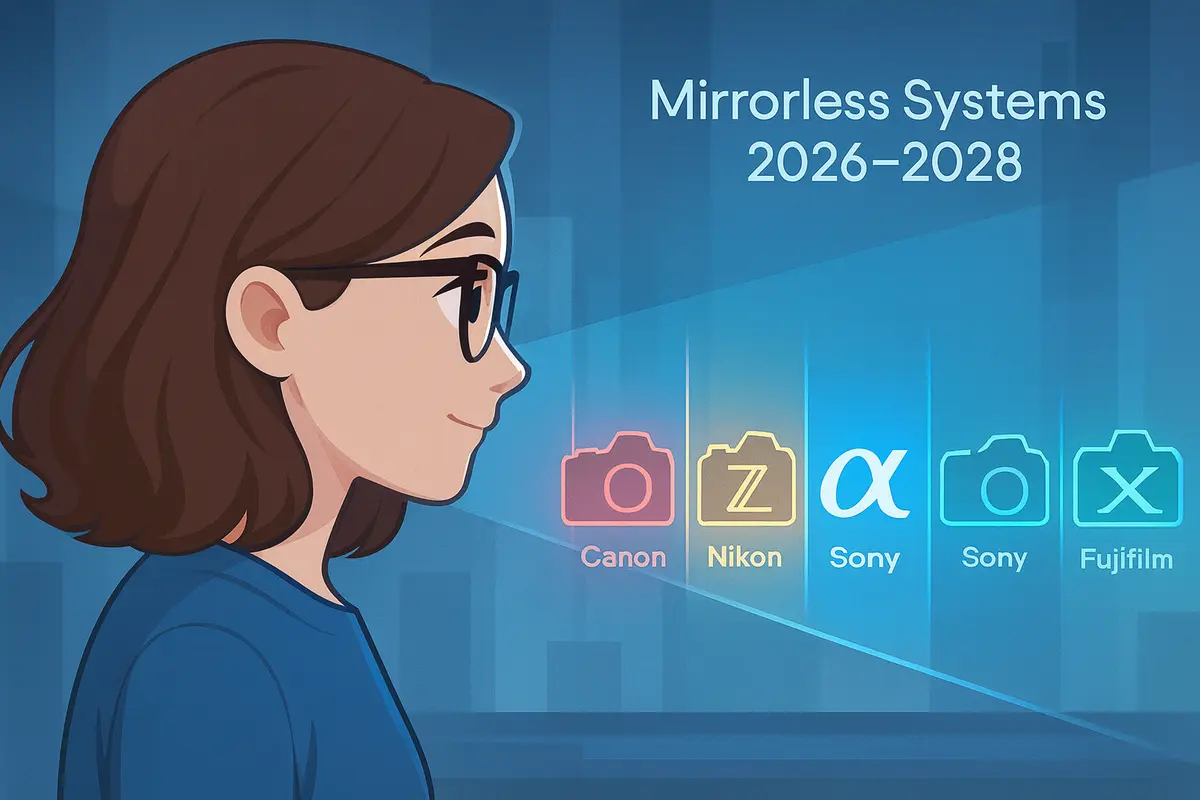
Buying a mirrorless camera today isn’t just about megapixels or video specs anymore. It’s about choosing a system that will still make sense three years from now — when new sensors arrive, AI features mature, and lens ecosystems quietly decide who stays relevant.
In the past, photographers could jump between brands without thinking twice. Today, mirrorless systems are deeper, more interconnected, and more expensive to switch. Lenses, mounts, autofocus ecosystems, firmware philosophy, and even video pipelines matter more than ever.
We’ll look closely at the four systems that dominate the mirrorless world today — Canon EOS R, Nikon Z, Sony E-mount, and Fujifilm X — not through spec sheets, but through ecosystem strength, long-term investment value, and the direction each brand is heading.
Let’s take a step back, look beyond marketing promises, and ask the real question:
Which mirrorless systems will truly matter in the next three years?
Why Mirrorless Systems Matter More Than Camera Bodies
For years, camera buyers focused almost entirely on the body in front of them — the latest sensor, the highest frame rate, or the newest video spec. But in the mirrorless era, that mindset no longer tells the full story.
A camera body will be replaced in three or four years. A system decision can follow you for a decade.
Mirrorless systems today are built around long-term commitments: lens mounts designed for future optical formulas, firmware platforms that evolve over time, autofocus technologies powered by AI, and video pipelines that increasingly mirror professional cinema workflows.
Lenses are the clearest example. While camera bodies rapidly improve, high-quality lenses often stay in a photographer’s kit for 10 years or more. Choosing a mirrorless system means choosing a lens ecosystem, a third-party support policy, and a roadmap you may not fully see yet.
Beyond lenses, systems differ in how they age. Some brands extend camera lifespans with meaningful firmware updates. Others move faster, offering rapid hardware cycles but shorter support windows. Neither approach is wrong — but they appeal to very different kinds of photographers.
This is why, in this guide, we’re stepping back from individual models and focusing on the systems themselves — starting with the four ecosystems that currently shape the mirrorless market.
For a broader overview of how modern mirrorless ecosystems are structured, you can also explore our
Ultimate Mirrorless Camera Guide.
Canon EOS R System: Strong Today, Stronger Tomorrow?
Canon entered the full-frame mirrorless market later than some of its rivals, but it didn’t enter unprepared. With the EOS R system, Canon made a clear long-term bet: control the mount, protect optical quality, and build a tightly integrated ecosystem around native RF lenses.
Lens Ecosystem & RF Mount Strategy
The RF mount is the foundation of Canon’s mirrorless future. Its wide diameter and short flange distance allow Canon to design lenses that simply weren’t possible in the DSLR era — fast primes, compact zooms, and optically ambitious designs aimed at professionals.
Today, the RF lens lineup is one of the strongest native ecosystems in the mirrorless world, especially at the high end. From L-series zooms to unique primes, Canon has clearly prioritized image quality and consistency over sheer volume.
The trade-off, of course, is third-party support. While this may frustrate budget-conscious buyers today, it also signals Canon’s confidence in its own roadmap. Whether that strategy remains sustainable through 2028 will depend on how accessible the system becomes at lower price points.
Video, Autofocus & Computational Direction
Canon’s Dual Pixel autofocus remains one of the most trusted AF systems in the industry. Its evolution toward subject recognition and AI-assisted tracking suggests a future where reliability matters more than headline features.
On the video side, Canon has clearly separated product lines, protecting its cinema range while gradually pushing EOS R cameras toward more serious hybrid roles. Thermal management, rolling shutter control, and color science have all improved steadily across recent generations.
Long-Term Investment Outlook (2026–2028)
Looking ahead, Canon’s EOS R system feels positioned for stability rather than disruption. Its lens roadmap is mature, its autofocus philosophy is proven, and its brand loyalty remains strong among professionals and enthusiasts alike.
For a deeper dive into Canon’s mirrorless ecosystem, lens options, and current bodies, see our full Canon EOS R System Guide.
Nikon Z System: Quietly Catching Up — or Still Behind?
Nikon’s transition into mirrorless has been anything but smooth. Compared to Canon and Sony, the Z system entered the market later and, at times, felt hesitant — a reality that still shapes how many photographers perceive Nikon’s mirrorless ambitions today.

For years, critics argued that Nikon was playing catch-up: fewer bodies, a smaller lens lineup, and a mirrorless strategy that seemed cautious rather than confident. Some of those criticisms were fair — especially in the early days.
Z Mount Potential vs. Real-World Execution
On paper, the Z mount is one of the most advanced lens mounts in the industry. Its large diameter and extremely short flange distance offer enormous optical potential, theoretically allowing Nikon to design lenses with exceptional sharpness and edge-to-edge consistency.
In practice, however, that potential took time to materialize. Early Z lenses were excellent optically, but the ecosystem lacked depth and variety — reinforcing the idea that Nikon was lagging behind more established mirrorless players.
Firmware, Bodies & the Pace of Innovation
Where Nikon has been more conservative is in its product cadence. Firmware updates tend to be meaningful, but slower. New bodies arrive less frequently, often prioritizing refinement over headline-grabbing features.
This approach has frustrated some users who equate progress with speed. Yet it has also resulted in cameras that feel mature, durable, and thoughtfully updated — rather than rushed to market.
Will Nikon Z Still Matter in 2026–2028?
Despite early stumbles, the Z system today looks far more complete than it did just a few years ago. The lens lineup has expanded significantly, third-party support is improving, and Nikon’s commitment to long-term firmware support remains one of its quiet strengths.
Still, Nikon faces a clear challenge moving forward: it must convince photographers that the Z system is not just “good enough,” but strategically competitive in a market defined by rapid innovation and aggressive marketing.
For a detailed breakdown of Nikon’s mirrorless bodies, lenses, and current roadmap, visit our Nikon Z System Guide.
Sony E-Mount: Still the Benchmark for Hybrid Innovation?
If there is one brand that has consistently defined what a modern mirrorless system looks like, it’s Sony. The E-mount ecosystem didn’t just arrive early — it set expectations for autofocus, sensor performance, and hybrid photo-video workflows that others are still responding to.
Yet being the benchmark comes with its own challenges. As the mirrorless market matures, Sony’s biggest question is no longer whether it can innovate — but whether it can maintain clarity while doing so.
Lens Diversity & Third-Party Freedom
Sony’s greatest long-term advantage remains its openness. The E-mount ecosystem offers unmatched lens diversity, with strong native options alongside extensive third-party support from Sigma, Tamron, Samyang, and others.
This freedom has made Sony uniquely attractive to hybrid shooters and creators who want flexibility without being locked into a single pricing tier or optical philosophy.
Sensor Leadership, AI & the Hybrid Future
Sony’s influence extends beyond cameras. As a leader in sensor manufacturing, the company effectively shapes the technological direction of the entire industry — from stacked sensors to AI-assisted autofocus and rolling shutter control.
Recent cameras show Sony leaning harder into computational photography and subject recognition, pushing hybrid performance rather than separating photo and video into distinct product lines.
The Sony A7 V as a System Signal
The Sony A7 V represents more than a generational update. It signals where Sony believes hybrid mirrorless cameras are heading: smarter autofocus, deeper AI integration, and bodies designed to handle both stills and video without compromise.
Rather than chasing extreme specs in isolation, Sony appears to be refining how those specs work together — a critical shift as mirrorless innovation slows and usability becomes the real differentiator.
For full details on Sony’s latest hybrid flagship and what it tells us about the future of the E-mount system, see our in-depth coverage: Sony A7 V Officially Announced.
Is Sony’s Strength Also Its Risk?
Sony’s rapid innovation cycle can sometimes feel overwhelming. Frequent releases, overlapping models, and subtle differences between bodies may confuse buyers — especially those entering the system for the first time.
Still, when viewed through a 2026–2028 lens, Sony’s strategy looks less risky and more intentional: iterate quickly, let users choose their balance, and evolve the ecosystem continuously rather than in large leaps.
For a complete overview of Sony’s bodies, lenses, and ecosystem philosophy, visit our Sony E-Mount System Guide.
Fujifilm X System: Can APS-C (and Medium Format) Still Hold Its Ground?
Fujifilm has always played a different game in the mirrorless world. While others competed fiercely in full-frame dominance, Fujifilm chose a split identity: APS-C for speed, portability, and creativity — and medium format for ultimate image quality.
For years, this strategy has worked. The X system built a loyal following among photographers who value compact bodies, tactile controls, and Fujifilm’s distinctive color science. But as we look toward 2026–2028, the question becomes unavoidable: can Fujifilm’s approach continue to hold its ground without a full-frame system?
APS-C as a Philosophy, Not a Compromise
Unlike brands that treat APS-C as an entry-level step toward full-frame, Fujifilm has positioned the X system as a complete, intentional platform. High-quality lenses, professional bodies, and advanced video features reinforce the idea that APS-C can be a long-term choice — not a temporary one.
In practice, this philosophy resonates with photographers who prioritize size, speed, and creative output over pure sensor real estate. For them, the X system remains both relevant and refreshingly focused.
The Medium Format Factor: GFX as a Strategic Counterbalance
Fujifilm’s medium format GFX system plays a crucial role in this ecosystem. Instead of chasing full-frame parity, Fujifilm leapfrogged it — offering medium format bodies that are relatively accessible and increasingly versatile.
This creates a unique ladder within Fujifilm’s lineup: APS-C for everyday work and portability, medium format for maximum image quality. No other major brand currently offers this kind of internal progression.
The Full-Frame Question: Will Fujifilm Ever Go There?
Rumors of a Fujifilm full-frame camera surface regularly — and have for years. Yet despite persistent speculation, Fujifilm has consistently resisted entering the full-frame mirrorless market.
From a strategic perspective, this reluctance makes sense. A full-frame system would overlap uncomfortably with both X and GFX, potentially weakening the clarity that defines Fujifilm’s current lineup.
Will Fujifilm’s Strategy Still Work in 2026–2028?
Looking ahead, Fujifilm’s challenge is not relevance — it’s perception. As competitors push computational photography, AI autofocus, and increasingly video-centric designs, Fujifilm must continue evolving without losing its identity.
So far, the brand has shown that it can modernize while staying distinctive. Whether that balance holds through 2028 will depend on how well Fujifilm adapts its APS-C and GFX platforms to the next wave of hybrid creators.
For a complete look at Fujifilm’s mirrorless bodies, lenses, and system philosophy, see our Fujifilm X System Guide.
Comparing the Systems: What Really Decides the Future?
After looking at each ecosystem individually, one thing becomes clear: the future of mirrorless systems won’t be decided by a single breakthrough or headline feature. It will be shaped by a handful of long-term factors that quietly define how systems age.
- Lens Ecosystem Stability
Sony leads in sheer variety and third-party freedom. Canon prioritizes native optical quality. Nikon is catching up steadily, while Fujifilm remains focused and intentional. - Firmware Longevity
Nikon and Fujifilm tend to extend camera lifespans with meaningful updates. Sony moves faster with hardware cycles, while Canon favors structured, predictable upgrades. - Hybrid Photo–Video Balance
Sony sets the benchmark for hybrid performance. Canon carefully balances stills and video across product lines. Fujifilm evolves creatively, while Nikon focuses on refinement over spectacle. - System Clarity
Fujifilm offers the clearest identity. Canon maintains strong segmentation. Sony provides maximum choice — sometimes at the cost of simplicity. Nikon continues to redefine its mirrorless voice. - Long-Term Investment Confidence
Canon and Sony feel safest for heavy system investment. Nikon rewards patience. Fujifilm rewards commitment to a philosophy rather than sensor size.
Daisy’s Final Verdict: Which Systems Will Matter Most?
The mirrorless market is no longer about catching up. It’s about direction. Brands that understand who they’re building for — and stick to that vision — are the ones that will still matter three years from now.
Canon EOS R feels built for longevity. Its ecosystem rewards patience and long-term investment, especially for photographers who value optical excellence and consistency over rapid change.
Sony E-mount remains the innovation engine. If the future of hybrid mirrorless cameras is defined by AI, computational photography, and flexible workflows, Sony is likely to keep pushing the boundaries — even when that pace feels relentless.
Nikon Z sits in a quieter place. It may not dominate headlines, but it continues to refine its system deliberately. For photographers willing to look past perception and focus on substance, Nikon’s mirrorless future is more stable than it appears.
Fujifilm X proves that full-frame isn’t the only path forward. By committing to APS-C and medium format, Fujifilm has built an ecosystem defined by creativity and identity — a strategy that will resonate as long as photographers value more than specs.
That’s the real future-proofing question. And the answer depends less on technology — and more on how well a system fits the photographer you’re becoming.
Explore Mirrorless Systems:
- Canon EOS R Cameras Search on Amazon | Search on B&H Photo | Search on Adorama
- Nikon Z Cameras Search on Amazon | Search on B&H Photo | Search on Adorama
- Sony E-Mount Cameras Search on Amazon | Search on B&H Photo | Search on Adorama
- Fujifilm X Cameras Search on Amazon | Search on B&H Photo | Search on Adorama