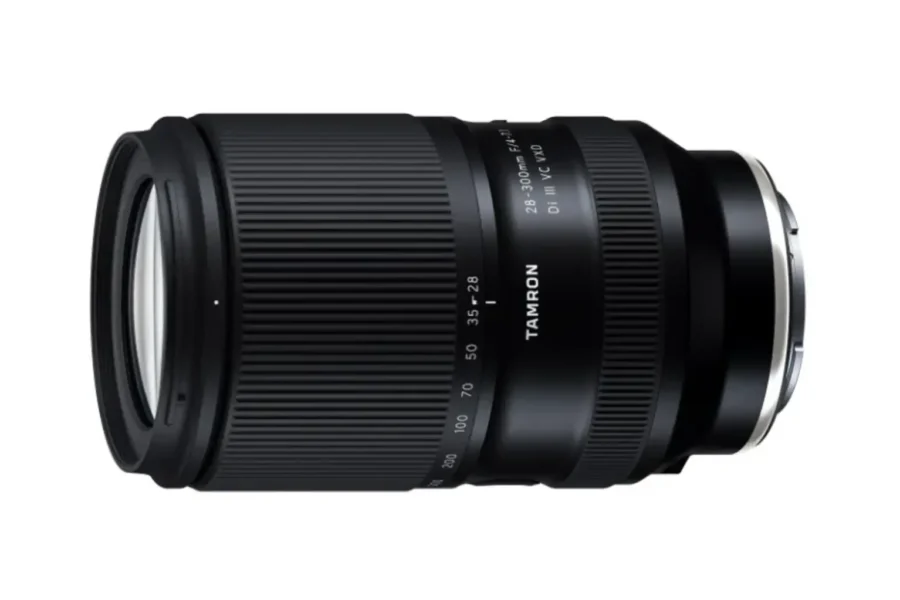
For travel photographers, outdoor enthusiasts, and everyday creators, the ultimate dream is often a single lens that can capture wide streetscapes, candid portraits, and distant wildlife without requiring a lens swap in dusty or wet environments. However, traditional superzoom lenses have historically earned a reputation for compromise: sacrificing edge-to-edge optical sharpness, autofocus tracking speed, and low-light performance in order to achieve an extreme focal range.
Tamron set out to rewrite that narrative with the release of the Tamron 28-300mm f/4-7.1 Di III VC VXD. Designed specifically for modern full-frame mirrorless sensors, this lens packs an expansive 10.7x zoom sweep into a body that weighs just 610 grams. By incorporating high-speed Voice-coil eXtreme-torque Drive (VXD) autofocus, built-in Vibration Compensation (VC), weather-resistant sealing, and compatibility with the Tamron Lens Utility software, it aims to redefine what an all-in-one zoom can accomplish. In this detailed hands-on review, we evaluate real-world image resolution, stabilization performance, autofocus speed, and physical handling limitations. To explore more third-party developments, visit our dedicated Tamron lens hub or browse our master directory covering all mirrorless camera lenses.
Quick Summary: Key Specifications & Review Score
Here is an overview of the core technical parameters and our DCN editorial rating for the Tamron 28-300mm f/4-7.1 Di III VC VXD:
| Feature Parameter | Tamron 28-300mm f/4-7.1 Di III VC VXD Details | DCN Score |
|---|---|---|
| Focal Range & Zoom Ratio | 28-300mm (10.7x Optical Zoom) | 9.5 / 10 |
| Maximum Aperture | f/4 (at 28mm) – f/7.1 (at 300mm) | 7.5 / 10 |
| Autofocus System | VXD (Voice-coil eXtreme-torque Drive) Linear Motor | 9.0 / 10 |
| Image Stabilization | Tamron VC (Vibration Compensation) System | 9.0 / 10 |
| Close-Up Capability | 0.19m (7.5 in) MOD at 28mm | 1:2.8 Max Magnification | 9.2 / 10 |
| Dimensions & Weight | 77mm x 126mm | 610 grams (21.5 oz) | 67mm Filter Thread | 9.5 / 10 |
| Overall Rating | Editor’s Choice: Ultimate Full-Frame Travel Zoom | 8.9 / 10 |
1. Optical Sharpness & Image Quality Across 28-300mm
When testing a superzoom with a 10.7x range, the most critical evaluation is how well the optical formula holds up across the focal sweep. Tamron constructed the lens using 20 elements in 13 groups, including XLD (eXtra Low Dispersion) and LD (Low Dispersion) elements alongside specialized aspherical optics to suppress chromatic aberration and geometric distortion.
At the 28mm wide end, center sharpness is crisp wide open at f/4, rendering sharp details in architectural landscapes and street snapshots. Stopping down slightly to f/5.6 brings up corner resolution significantly. As you zoom through the mid-range (50mm to 150mm), contrast remains strong. At the 300mm telephoto extension, image clarity is surprisingly detailed in the center frame—ideal for isolating wildlife, distant architectural details, or sports action—though micro-contrast drops slightly compared to specialized telephoto primes. Overall, color rendering is warm and accurate, with ghosting and flare well-controlled under direct sunlight by Tamron’s BBAR-G2 multi-coatings.
Search Tamron 28-300mm f/4-7.1 Di III VC VXD Deals
Check live pricing, stock availability, and retailer deals across authorized camera stores:
Check Price on Amazon
Shop Lens at B&H Photo
Filter Tip: Like most of Tamron’s mirrorless zoom series, this lens utilizes a standard 67mm filter thread, making it easy to share circular polarizers and ND filters across your setup!
2. VXD Autofocus Drive & VC Image Stabilization
Autofocus tracking speed on modern mirrorless bodies demands rapid motor response. Tamron equipped the 28-300mm with its flagship VXD (Voice-coil eXtreme-torque Drive) linear motor. During real-world testing—tracking moving vehicles, walking pets, and flying birds—the VXD motor delivered fast, accurate, and near-silent focus acquisition. It fully supports native camera eye-AF, subject detection algorithms, and real-time tracking in both stills and video modes.
At the 300mm telephoto reach, camera shake is naturally magnified. The inclusion of Tamron’s proprietary VC (Vibration Compensation) mechanism is vital when shooting handheld in dim ambient light. The VC system counteracts micro-tremors effectively, allowing photographers to capture sharp handheld stills at shutter speeds several stops slower than the traditional reciprocal rule would dictate.
Search High-Speed Full-Frame Camera Bodies
Explore deals on full-frame mirrorless camera bodies ideal for travel superzooms:
3. Macro Close-Up Reach & Physical Ergonomics
Beyond landscape and telephoto photography, the Tamron 28-300mm f/4-7.1 acts as a surprisingly versatile macro-style lens. At the 28mm wide end, the Minimum Object Distance (MOD) drops down to just 0.19 meters (7.5 inches), yielding an impressive maximum magnification ratio of 1:2.8. This allows creators to get close to foreground subjects—such as flowers, food, or travel textures—while preserving dynamic wide-angle background context.
Physically, the lens is engineered for comfort during long shooting days. Measuring 126mm in length when retracted and weighing 610 grams, it balances naturally on full-frame camera bodies. The exterior chassis features a sleek matte finish with improved grip rings, a moisture-resistant construction with rubber sealing gaskets along the mount bayonet, and a protective Fluorine coating on the front element that repels water smudges and oil.
4. Real-World Limitations to Consider
While the Tamron 28-300mm f/4-7.1 VC VXD is an outstanding single-lens travel solution, buyers should be aware of a few optical trade-offs inherent to its design:
- Slow Variable Aperture (f/7.1 at 300mm): The aperture dims to f/5.6 by ~100mm and reaches f/7.1 at the long end. When shooting sports or wildlife at dusk, you will need to increase your camera’s ISO setting to maintain high shutter speeds.
- Vignetting at Extreme Ends: Uncorrected RAW files show noticeable vignetting at 28mm f/4 and 300mm f/7.1. Enabling in-camera lens corrections or applying automatic profile corrections in Lightroom resolves this instantly.
- No Dedicated VC On/Off Switch: Image stabilization controls and custom ring behaviors are managed electronically via camera menus or customized using the Tamron Lens Utility software connected via the built-in USB-C port.
Compare authorized pricing, bundle options, and live stock across top camera retailers:
Search Tamron Optics on Amazon | Shop Tamron at B&H Photo | Browse Store Deals at Adorama
The Verdict: Is the Tamron 28-300mm f/4-7.1 Worth Buying?
The Tamron 28-300mm f/4-7.1 Di III VC VXD proves that modern optical engineering can make a 10.7x superzoom perform at a level that satisfies demanding full-frame photographers. By combining reliable sharpness across most of its focal range with fast VXD autofocus, robust VC image stabilization, close-up macro capability, and a lightweight 610g chassis, it is an outstanding companion for travel, hiking, and daily walkaround shooting.
If you want to travel light without sacrificing the reach needed for distant subjects, this lens earns our high recommendation as an essential all-in-one full-frame zoom.
Frequently Asked Questions (FAQ)
Frequently Asked Questions About the Tamron 28-300mm f/4-7.1
Q: What filter thread size does the Tamron 28-300mm VC VXD use?
A: The lens utilizes a standard 67mm front filter thread, which matches many other Tamron mirrorless lenses.
Q: Is the Tamron 28-300mm f/4-7.1 weather-sealed?
A: Yes, it features a Moisture-Resistant Construction with leak-resistant rubber seals at the bayonet mount and key barrel joints, alongside a protective Fluorine front coating.
Q: How do I update the firmware on this Tamron lens?
A: The lens features a built-in USB-C Connector Port on the barrel. You can connect it directly to a computer running the Tamron Lens Utility software to update firmware and customize focus ring functions.