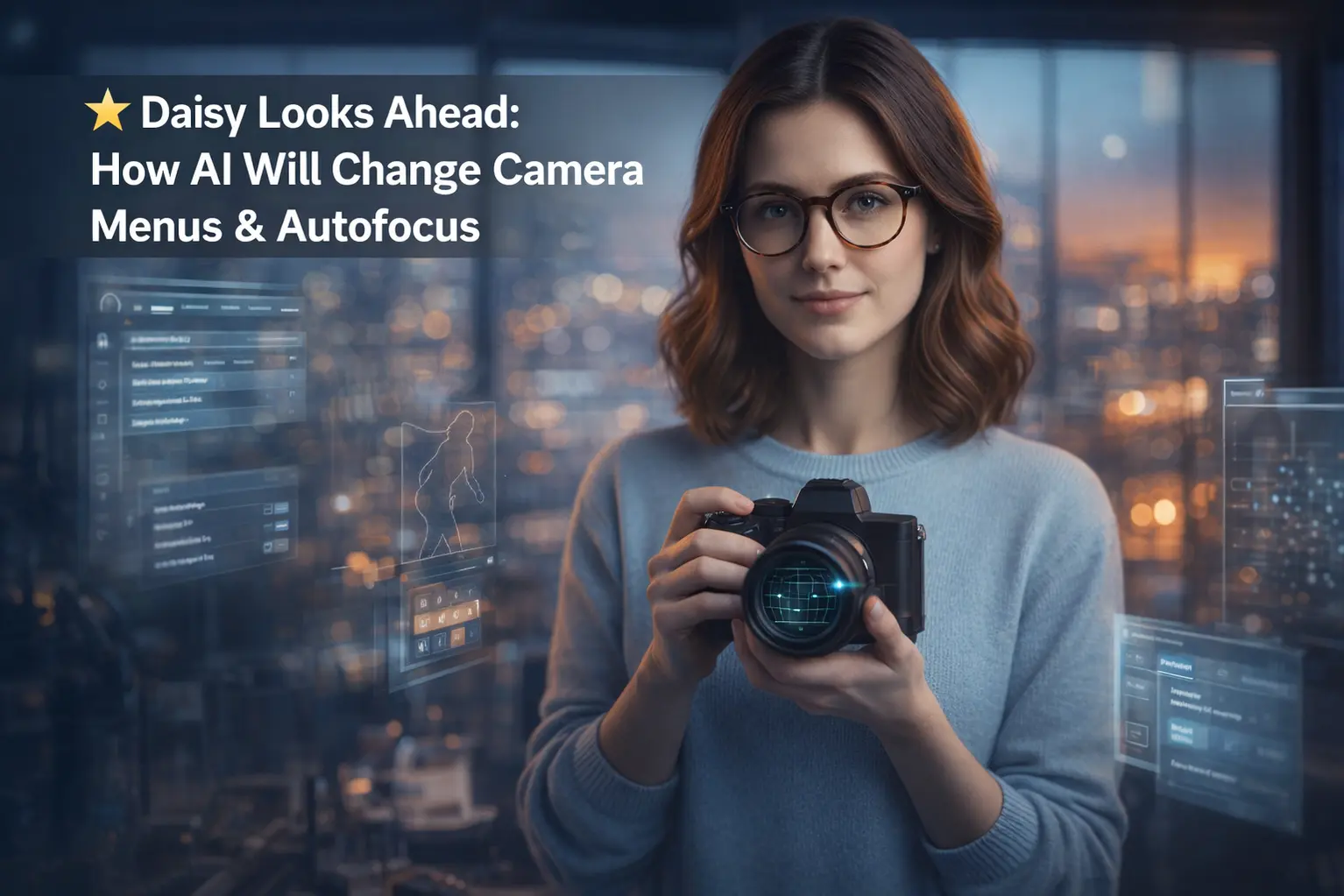
AI isn’t just improving cameras anymore — it’s redesigning how they think.
For years, artificial intelligence in mirrorless systems meant better subject detection and faster autofocus. Eye AF got smarter. Animal detection got more reliable. Tracking became sticky. But between 2026 and 2028, something bigger is happening.
AI is moving beyond autofocus performance. It’s starting to reshape camera menus, interface logic, and the way we interact with our gear.
If you’ve been following our Daisy Looks Ahead series — from the broader Mirrorless Camera Trends 2026–2028 overview to our deep dive into AI in Photography — you already know the shift isn’t subtle. Cameras are no longer just reactive tools. They’re becoming predictive systems.
And that changes everything.
Autofocus won’t simply detect subjects — it will anticipate intent. Menus won’t just list settings — they will adapt based on how you shoot. Firmware won’t only fix bugs — it will evolve behavior.
This isn’t speculation. It’s the logical next step after what we explored in Future #1: Mirrorless Systems 2026–2028.
In this article, I’ll walk you through how AI will transform camera menus and autofocus systems over the next three years — what it means for hybrid shooters, content creators, and photographers who still believe control matters.
Because the real question isn’t whether AI will change cameras.
It’s whether your next camera will still feel like a tool… or start feeling like a collaborator.
AI Is Moving From Autofocus to Interface Design
For nearly a decade, AI in cameras meant one thing: autofocus performance.
Manufacturers competed on eye detection accuracy, animal recognition, vehicle tracking, and burst precision. And yes — those improvements were real. Modern mirrorless camera technology now locks focus in situations that were nearly impossible just five years ago.
But here’s the shift happening quietly in 2026:
AI is no longer confined to autofocus algorithms. It’s starting to redesign the entire camera interface.
Why?
Because menus have become the biggest friction point in modern cameras.
Today’s high-end mirrorless bodies ship with hundreds of settings. Deep menu trees. Custom pages. Sub-categories inside sub-categories. For power users, that flexibility is powerful — but it’s also overwhelming.
Between 2026 and 2028, we’ll see AI-driven menu systems that:
- Surface the most-used settings dynamically
- Prioritize controls based on shooting mode
- Reduce visual clutter automatically
- Adapt layout depending on whether you’re shooting photo or video
Instead of scrolling through static lists, cameras will begin to interpret context.
If you switch to vertical video, the interface shifts.
If you mount a telephoto lens, stabilization options become more prominent.
If you frequently adjust white balance manually, that control floats higher in your quick menu.
This is where AI in cameras becomes truly transformative. Not because it replaces photographers — but because it removes friction between intent and execution.
And once menus become adaptive, autofocus systems won’t just detect subjects.
They’ll start predicting behavior.
Predictive Autofocus: Cameras That Anticipate, Not React
Autofocus used to be reactive.
The subject moves. The camera responds.
Eye detected. Face tracked. Servo engaged.
But the next evolution of AI in cameras goes beyond detection. It moves into prediction.
Between 2026 and 2028, mirrorless camera technology will shift from “subject tracking” to what I call intent modeling.
Imagine photographing a soccer match.
Today’s cameras recognize players and track eyes. That’s impressive.
But predictive autofocus will begin analyzing:
- Body orientation
- Acceleration patterns
- Ball trajectory
- Previous motion behavior
Instead of reacting to movement, the system estimates where the subject will be at the moment of exposure.
For wildlife shooters, this means better capture rates during takeoff sequences.
For wedding photographers, it means sharper frames during unpredictable movement.
For sports creators, it means fewer missed peak-action moments.
And here’s where it becomes even more interesting.
Predictive systems won’t just evaluate motion. They’ll learn your behavior.
If you tend to recompose after locking focus, the camera adapts.
If you prioritize foreground subjects, tracking logic adjusts.
If you frequently shoot through obstacles (branches, crowds), occlusion tolerance changes.
This is where future autofocus systems stop being tools — and start feeling collaborative.
AI in mirrorless cameras will evolve from “assistive” to “context-aware.”
And once context awareness enters the system, static interfaces can’t survive.
The Death of Static Menus
Let’s be honest.
Modern camera menus are powerful — but they are not intelligent.
They are static trees built for engineers, not fluid systems built for creators.
In the next generation of mirrorless cameras, static menus will quietly disappear.
Here’s what that looks like:
- Contextual surfacing: Frequently used settings rise automatically.
- Mode-aware layouts: Switching from photo to video reshapes the interface.
- Lens-aware prioritization: Mount a macro lens? Focus stacking controls surface instantly.
- Usage learning: The system tracks patterns and adjusts shortcuts over time.
Instead of memorizing menu paths, you interact with a living interface.
This matters because mirrorless camera technology has reached complexity saturation.
The hardware is extraordinary — but usability is now the bottleneck.
Touch-first controls, simplified layouts, and AI-assisted navigation will reduce friction dramatically.
And here’s the bigger shift:
As computational photography grows stronger, cameras must expose fewer technical barriers to creators. Simplicity becomes competitive advantage.
Because the real innovation in 2026–2028 won’t always be visible in spec sheets.
It will be felt in how effortlessly you move from vision to capture.
Personalized Cameras: Firmware That Learns You
For decades, cameras have been configurable — but not personal.
You could customize buttons. Save presets. Build custom shooting banks.
But every adjustment was manual.
That’s about to change.
The next phase of AI in mirrorless cameras won’t just optimize autofocus or menus. It will optimize around you.
Between 2026 and 2028, we’ll begin seeing cameras that:
- Track frequently used exposure combinations
- Recognize preferred focus modes in specific lighting
- Detect how often you switch between photo and video
- Automatically recall lens-specific adjustments
Instead of building static “Custom 1 / Custom 2” banks, the camera will generate dynamic shooting profiles based on real-world usage.
For example:
- If you consistently increase shutter speed for backlit scenes, the system adapts.
- If you favor shallow depth of field in portraits, aperture suggestions prioritize accordingly.
- If you disable certain features repeatedly, they become less prominent.
This is where mirrorless camera technology shifts from tool to assistant.
The result? Less setup time. Fewer missed moments. A camera that feels increasingly familiar the more you use it.
And once firmware starts learning you, interface control itself becomes the next frontier.
Voice, Gesture & Context-Aware Controls
If AI redesigns menus and personalizes firmware, the next logical step is control evolution.
We are entering the early stages of a UX revolution in dedicated cameras.
Voice input, subtle gestures, and context-aware automation are no longer experimental concepts — they are inevitable extensions of computational photography.
Here’s what that could look like:
- Voice commands: “Switch to 4K 60p,” “Enable animal eye AF,” or “Activate silent shutter.”
- Gesture shortcuts: Simple swipe gestures near the EVF to toggle overlays.
- Context detection: Tripod detected? IBIS behavior changes automatically.
- Orientation awareness: Vertical framing instantly optimizes UI layout.
Smartphones normalized this interaction model. Mirrorless systems will adapt it — but in a more refined, professional way.
Of course, physical dials won’t disappear. Tactile control remains essential for many photographers.
But hybrid interaction — touch, voice, intelligent automation — will reduce friction dramatically, especially for hybrid shooters switching between stills and video.
This isn’t about turning cameras into smartphones.
It’s about removing unnecessary complexity so creativity moves faster than configuration.
What This Means for Real Photographers
All of this sounds futuristic — predictive autofocus, adaptive menus, personalized firmware.
But what does it actually mean for real photographers?
It means fewer missed shots.
It means less time buried in menus.
It means more attention on light, timing, and storytelling.
Here’s the practical impact between now and 2028:
- Higher keeper rates thanks to predictive autofocus
- Faster setup times through adaptive interfaces
- Reduced cognitive load during hybrid shooting
- More consistent output across changing environments
For professionals, this means reliability under pressure.
For enthusiasts, it means less intimidation and more confidence.
For content creators, it means speed — without sacrificing control.
And here’s my take.
Daisy’s Final Take:
The future of camera menus and autofocus isn’t about automation taking over.
It’s about intelligence quietly supporting your decisions.
The photographers who thrive in the next three years won’t be the ones who chase specs.
They’ll be the ones who understand how to collaborate with AI-driven tools.
Cameras are not becoming less professional.
They are becoming more intuitive.
And that shift? It favors creators who value speed, clarity, and adaptability.
The future camera technology wave is not flashy. It’s focused.
And for real photographers, that’s exactly what matters.
FAQ: AI, Camera Menus & Autofocus in 2026–2028
Will AI replace manual camera control?
No. Manual control will remain essential. AI systems are designed to assist, predict, and reduce friction — not eliminate creative decision-making.
What is predictive autofocus?
Predictive autofocus analyzes motion patterns and scene behavior to estimate where a subject will be at the moment of capture, rather than simply reacting to movement.
Are camera menus really going to change?
Yes. Static menu systems are likely to evolve into adaptive, context-aware interfaces that reorganize based on shooting mode, lens choice, and user behavior.
Will voice control become standard in mirrorless cameras?
Voice and gesture controls are expected to expand gradually, especially in hybrid and video-focused systems, though physical dials will remain important.
Should photographers wait for AI-driven cameras before upgrading?
Not necessarily. Current mirrorless cameras are already powerful. The upcoming evolution focuses more on usability and intelligence rather than dramatic hardware shifts.