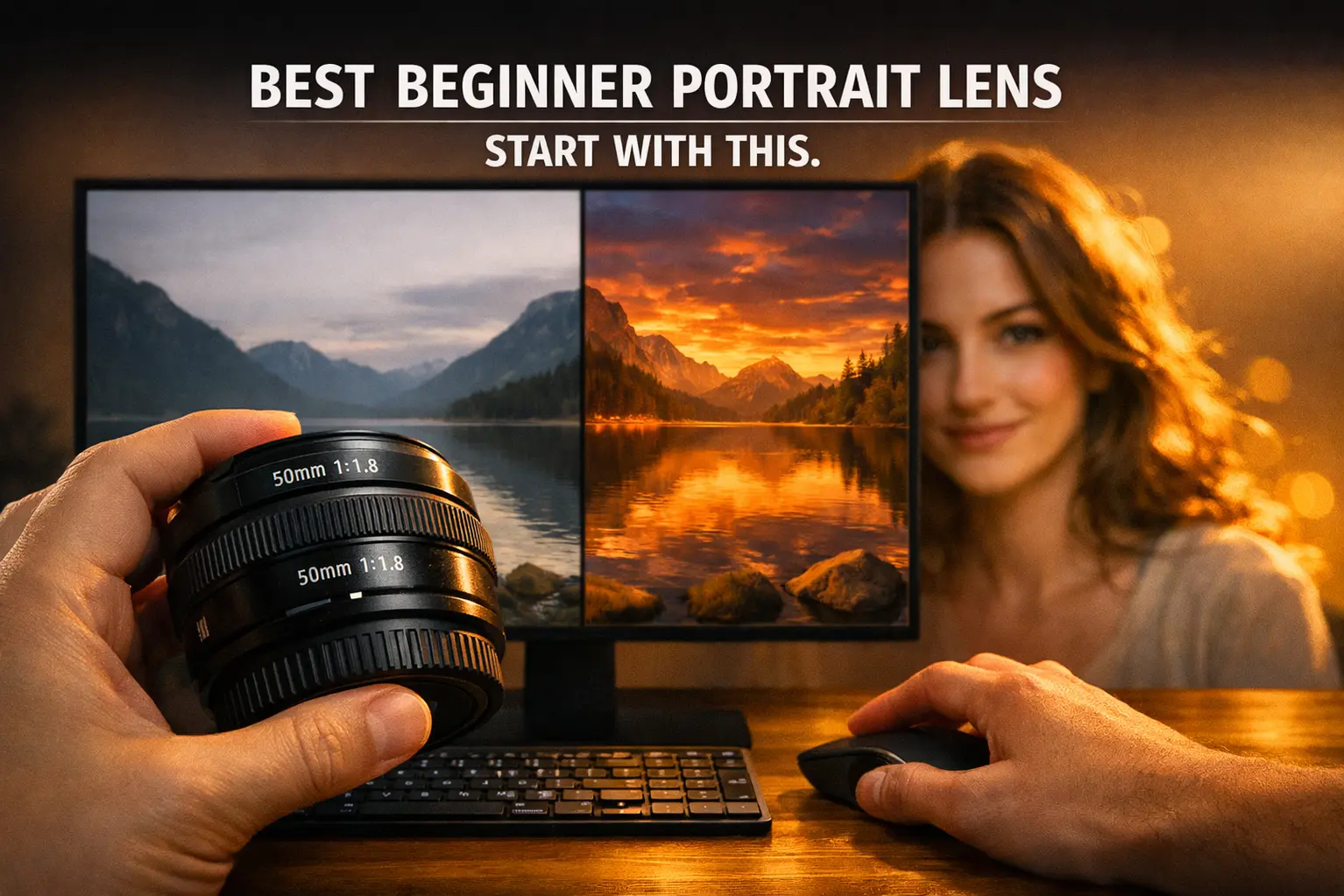
If you’re searching for the best beginner portrait lens in 2026, you’re not alone. One of the biggest upgrades new photographers make is moving from a basic kit zoom to a fast prime lens that delivers real background blur, sharper results, and that professional portrait look.
The problem? There’s too much conflicting advice. Some say start with 85mm. Others insist on 50mm. Then you hear about APS-C crop factors, full-frame compression, and f/1.4 vs f/1.8 debates — and suddenly choosing the best portrait lens for beginners feels more complicated than actually taking portraits.
This guide simplifies everything. We’ll help you choose the best beginner portrait lens based on your camera system — Canon RF, Sony E, Nikon Z, Fujifilm X, or Micro Four Thirds — and your real-world shooting needs. No pro-only recommendations. No unnecessary spending. Just lenses that are affordable, reliable, and designed to help you grow.
Quick Insight: If you want the safest and most affordable starting point, a 50mm f/1.8 (or its APS-C equivalent) is still the smartest first portrait lens in 2026.
We’ll also explain how focal length affects portraits in simple terms. If you’re still unsure about framing differences, you may want to read our breakdown of 35mm vs 50mm for portraits before deciding.
And if you’re completely new to portrait work, our Portrait Photography Essentials guide covers the fundamentals you should understand before investing in new gear.
Who Is This Guide For?
This article is for photographers who want clarity and confidence before buying their first serious portrait lens. Whether you’re upgrading or starting fresh, this guide focuses on the best portrait lens for beginners — not the most expensive one.
First-Time Prime Lens Buyers
If you’ve never owned a prime lens and are wondering which focal length to choose, this section is for you. The right beginner portrait photography lens should be sharp, easy to focus, lightweight, and forgiving while you’re still mastering exposure and subject positioning.
Photographers Upgrading from a Kit Lens
Kit lenses are versatile, but they struggle with low-light performance and strong background separation. If your portraits lack depth or creamy bokeh, upgrading to a fast aperture prime is the single most noticeable improvement you can make. We’ll focus on lenses that offer the best balance of price and performance.
APS-C vs Full Frame Beginners
You don’t need a full-frame camera to get beautiful portraits. APS-C systems like Fujifilm X and many Canon, Sony, and Nikon entry-level bodies are excellent for portrait photography. A 35mm lens on APS-C delivers a similar field of view to a 50mm lens on full-frame, while lenses like 56mm behave closer to the classic 85mm portrait look.
If camera settings still feel confusing, especially when shooting wide open at f/1.8, you may also find our guide on portrait camera settings for natural light helpful before choosing your lens.
Daisy’s Advice: Your first portrait lens should make photography simpler, not more intimidating. Prioritize reliable autofocus, manageable size, and an f/1.8 aperture over chasing ultra-fast f/1.2 lenses that are heavier and far more expensive.
Quick Answer (If You Just Want One Safe Pick)
If you don’t want to overthink it and just want the best beginner portrait lens that works in almost every situation, the safest choice in 2026 is still a 50mm f/1.8 (or its APS-C equivalent).
Why? Because it delivers flattering perspective, strong background blur, excellent low-light performance, and it’s affordable across every major mirrorless system. For most new photographers, it offers the best balance of image quality, ease of use, and long-term value.
The Safe Pick Rule: Full-frame shooters → 50mm f/1.8. APS-C shooters → 35mm f/1.8 (or 33mm/35mm equivalent). Micro Four Thirds shooters → 25mm f/1.8.
Here are the safest beginner portrait lens picks for each major system:
Canon RF Mount
Canon RF 50mm f/1.8 STM is the most affordable and beginner-friendly portrait lens in the RF lineup. It’s lightweight, sharp, and produces pleasing background separation without overwhelming new shooters.
Check Canon RF 50mm f/1.8 Prices
Buy at B&H Photo
View at Adorama
Tip: The most cost-effective way to dramatically improve your portrait look on Canon RF bodies.
Sony E Mount (Full Frame)
Sony FE 50mm f/1.8 remains one of the most affordable entry points into portrait photography for Sony full-frame users, offering classic framing and strong subject isolation.
Check Sony FE 50mm Prices
Buy at B&H Photo
View at Adorama
Tip: Ideal first portrait lens if you’re building a Sony full-frame kit.
Nikon Z Mount
Nikon Z 50mm f/1.8 S is optically superior for its class and delivers beautiful skin tones, smooth bokeh, and professional-level sharpness while remaining beginner-friendly.
Check Nikon Z 50mm Prices
Buy at B&H Photo
View at Adorama
Tip: A slightly bigger investment, but extremely sharp and future-proof for Nikon Z users.
Fujifilm X Mount (APS-C)
Fujifilm XF 35mm f/1.4 R or XF 33mm f/1.4 R LM WR both deliver a classic portrait field of view on APS-C, making them ideal equivalents to a 50mm full-frame look.
Check Fujifilm 35mm Prices
Buy at B&H Photo
View at Adorama
Tip: The perfect first portrait lens for Fujifilm APS-C users.
Micro Four Thirds
Olympus M.Zuiko 25mm f/1.8 or Panasonic 25mm f/1.7 provide the classic 50mm-equivalent perspective and strong subject separation for MFT users starting portrait photography.
Check Olympus 25mm Prices
Buy at B&H Photo
View at Adorama
Tip: Compact, lightweight, and perfect for beginners using Micro Four Thirds cameras.
Daisy’s Bottom Line: If you’re unsure, don’t overcomplicate it. Start with a 50mm-equivalent lens on your system, master composition and lighting, and upgrade later only if your style demands it.
Best Beginner Portrait Lenses (Top Picks for 2026)
Best Overall Beginner Portrait Lens
Canon RF 50mm f/1.8 STM, Sony FE 50mm f/1.8, Nikon Z 50mm f/1.8 S, or equivalent – These 50mm f/1.8 lenses are the best all-around portrait primes for beginners because they combine flattering perspective, strong subject isolation, lightweight handling, and excellent value. They work well for headshots, half-body portraits, and even environmental portraiture without getting too restrictive in tighter spaces. If you want one lens to start your portrait journey, this is it.
Check 50mm f/1.8 Lens Prices
Buy via B&H Photo
View at Adorama
Tip: This pick is perfect if you want a go-to lens that feels right for most beginner portrait shoots.
Best Budget Option
Viltrox or Meike 50mm/56mm f/1.8 lenses – If you want a portrait lens that’s extremely beginner-friendly but lighter on your budget, third-party f/1.8 lenses like Viltrox or Meike deliver great image quality for the price. They may not have quite the refinement of OEM glass, but they’re ideal for hobbyists, beginners on a budget, and anyone who wants strong results without spending much.
Check Budget Portrait Lens Prices
Buy via B&H Photo
View at Adorama
Tip: Best for beginners who want value-first picks without sacrificing everyday portrait quality.
Best Upgrade Choice
85mm f/1.8 lenses – Once you’ve learned the basics and want more flattering compression and background separation, an 85mm f/1.8 is the classic portrait upgrade. It’s ideal for tighter headshots, better subject isolation, and outdoor portraits with creamy bokeh. This choice suits beginners who are ready to invest a bit more for more professional results.
Check 85mm f/1.8 Lens Prices
Buy via B&H Photo
View at Adorama
Tip: Ideal for crisp headshots and outdoor portraits with strong background blur.
Best for APS-C Cameras
35mm f/1.8 lenses for Fujifilm X, Sony E APS-C, Nikon APS-C – On APS-C bodies, a 35mm f/1.8 lens gives you a classic 50mm equivalent field of view, making it one of the most versatile portrait primes for crop-sensor shooters. It’s lightweight, affordable, and perfect for beginners who want natural perspective and strong subject separation.
Check APS-C Portrait Lens Prices
Buy via B&H Photo
View at Adorama
Tip: Perfect for crop-sensor users who want a classic portrait look without full-frame costs.
Best for Natural Light Portraits
Lenses with f/1.4 apertures – If you frequently shoot portraits in natural light and want maximum background blur and low-light capability, f/1.4 lenses are the ideal choice. They’re a bit more expensive and heavier than f/1.8 options, but deliver creamier bokeh and more separation — perfect for outdoor sessions and artistic portrait work.
Check f/1.4 Portrait Lens Prices
Buy via B&H Photo
View at Adorama
Tip: Best for natural light sessions where dreamy, creamy background blur matters most.
Comparison Table (Decision Based)
If you’re still deciding between focal lengths and aperture options, this quick comparison table simplifies the buying decision. Instead of specs, we focus on real-world beginner use cases.
| Use Case | 50mm f/1.8 | 85mm f/1.8 | 35mm f/1.8 (APS-C) |
|---|---|---|---|
| Background Blur | ★★★★☆ Strong subject separation |
★★★★★ Maximum compression & creamy bokeh |
★★★★☆ Natural blur, slightly wider look |
| Ease of Use | ★★★★★ Very beginner friendly |
★★★☆☆ Needs more working distance |
★★★★★ Flexible and forgiving |
| Indoor Shooting | ★★★★☆ Works well in small spaces |
★★☆☆☆ Often too tight indoors |
★★★★★ Best for tight environments |
| Outdoor Portraits | ★★★★☆ Great balance of framing |
★★★★★ Ideal for headshots outdoors |
★★★★☆ Good for environmental portraits |
| Price to Performance | ★★★★★ Best value overall |
★★★★☆ Higher cost, strong results |
★★★★★ Excellent APS-C value |
| Beginner Friendliness | ★★★★★ Safest first lens |
★★★☆☆ More specialized |
★★★★★ Great starting point for crop users |
| Long Term Investment | ★★★★☆ Will stay useful for years |
★★★★★ Classic portrait staple |
★★★★☆ System-dependent longevity |
| Best For | Most beginners starting portrait photography | Outdoor headshots & advanced subject isolation | APS-C users wanting 50mm-equivalent look |
50mm vs 85mm: Which Should You Start With?
For most new photographers, the 50mm f/1.8 is the smarter starting point. It’s easier to use indoors, more flexible in small spaces, and far more forgiving while you’re learning posing and composition.
The 85mm f/1.8, on the other hand, creates stronger background compression and more dramatic subject isolation. It’s excellent for outdoor headshots but requires more working distance and can feel restrictive in tight indoor environments.
If you’re still unsure how focal length changes framing and perspective, read our detailed breakdown of 35mm vs 50mm for portraits. Understanding perspective will make this decision much easier.
Simple Rule: If this is your first portrait lens, start with 50mm. Move to 85mm once you know you want tighter framing and stronger compression.
Should Beginners Buy f/1.4 or f/1.8?
For most beginners, f/1.8 is the smarter and more practical choice. It offers excellent background blur, better affordability, lighter weight, and easier focusing performance compared to f/1.4 lenses.
While f/1.4 lenses produce slightly creamier bokeh and allow more light in extremely low-light situations, they are heavier, more expensive, and less forgiving with shallow depth of field — especially for beginners still mastering focus accuracy.
If you’re still learning exposure and aperture control, our guide on best camera settings for portrait photography will help you understand how aperture impacts your portraits before investing in faster glass.
Daisy’s Final Advice: Start with f/1.8, master light and composition, and only upgrade to f/1.4 if your shooting style truly demands it.
Final Recommendation (Clear & Honest)
If you’ve read this far and still feel unsure, here’s the simplest possible answer: for most beginners, the best beginner portrait lens is still a 50mm f/1.8. It’s affordable, easy to use, flattering, and flexible enough to grow with you.
If you’re buying just one lens → Get a 50mm f/1.8.
If you mainly shoot outdoors and want stronger background compression with tighter headshots, then an 85mm f/1.8 will give you that classic, creamy portrait look — just make sure you have enough working distance.
If you want more compression and shoot mostly outdoors → Choose 85mm f/1.8.
If you’re using an APS-C camera like Fujifilm X, Sony APS-C, or Nikon DX, a 35mm f/1.8 (or 33mm/35mm equivalent) gives you the most natural and beginner-friendly field of view for portraits.
If you shoot APS-C → Start with 35mm f/1.8.
And if you’re still hesitating and don’t want to risk making the wrong choice, go back to the safest rule: choose the 50mm-equivalent lens for your system. It’s the most balanced starting point and the smartest long-term investment for learning portrait photography.
No overthinking. No gear anxiety. Start with 50mm, master light and composition, and upgrade only when your style clearly demands it.
Frequently Asked Questions About Beginner Portrait Lenses
If you’re still deciding on the best beginner portrait lens, these quick answers address the most common questions new photographers ask before buying.
- What is the best focal length for beginner portrait photography?
- For most beginners, a 50mm lens on full-frame or a 35mm lens on APS-C is the best starting point. These focal lengths offer natural perspective, strong background blur, and flexible framing without requiring too much working distance.
- Is 85mm too much for beginners?
- Not necessarily, but 85mm lenses require more shooting distance and are less flexible indoors. They are excellent for outdoor headshots and strong background compression, but most beginners find 50mm easier to use as a first portrait lens.
- Do I need a full-frame camera for portrait photography?
- No. APS-C and Micro Four Thirds cameras can produce beautiful portraits. The key factor is lens choice and aperture. A fast prime lens like f/1.8 makes a much bigger difference than sensor size alone.
- Is f/1.4 better than f/1.8 for portraits?
- f/1.4 lenses offer slightly more background blur and better low-light performance, but they are heavier and more expensive. For beginners, f/1.8 lenses provide the best balance of image quality, price, and usability.
- Can I shoot portraits with a kit lens?
- Yes, but kit lenses usually have smaller maximum apertures, which limits background blur and low-light capability. Upgrading to a fast prime lens like a 50mm f/1.8 will dramatically improve portrait results.
- What is the cheapest good portrait lens for beginners?
- Budget-friendly third-party lenses from brands like Viltrox or Meike, as well as entry-level 50mm f/1.8 lenses from major manufacturers, are often the most affordable and reliable starting options.