Street photography is fast, unpredictable, and often unforgiving. You don’t get second chances, you don’t ask people to repeat moments, and the light rarely waits for you to be ready. That’s why camera settings matter more in street photography than in almost any other genre.
If your settings slow you down, distract you, or force you to constantly adjust dials, you’ll miss the shot — not because you lack skill, but because your camera wasn’t prepared for the street.
This guide focuses on one simple goal: helping you build reliable, practical camera settings for street photography, both during the day and at night. Not theoretical setups. Not brand-specific menus. Just real-world settings that let you react quickly, stay discreet, and focus on what matters — the scene unfolding in front of you.
Daytime street photography is about balancing context, depth, and motion. Night street photography is about managing limited light without sacrificing timing or atmosphere. The settings that work in bright streets often fail after sunset, and that’s where many photographers struggle.
Understanding how aperture, shutter speed, and ISO work together is essential for street photography, especially if you want to react quickly in changing light — something we explain in detail in our Exposure Triangle guide.
Below, we’ll start with the core foundation settings that apply to almost all street situations. Once those are solid, adjusting for day or night becomes simple and intuitive.
Core Street Photography Settings (The Foundation)
Before separating day and night setups, it’s important to understand the base settings that most street photographers rely on. These choices prioritize speed, consistency, and flexibility — three things street photography demands constantly.
Shooting Mode: Aperture Priority vs Manual
For most street photography situations, Aperture Priority (A / Av) is the most practical choice. It allows you to control depth of field — which affects how much of the scene stays in focus — while the camera automatically adjusts shutter speed as light changes.
This is especially useful on the street, where you might move from open sunlight to shade, reflections, or narrow alleys within seconds. Aperture Priority keeps exposure changes fast without forcing you to stop and think.
Manual mode can work well in stable lighting conditions, such as consistent daylight or well-lit night streets. Some photographers prefer it for full control, but it requires more attention and experience. If you’re still building confidence, Aperture Priority is the safer and more forgiving option.
File Format: RAW or JPEG?
Street photography values speed, but flexibility still matters. Shooting in RAW gives you more room to adjust exposure, highlights, and shadows later — especially helpful in high-contrast street scenes.
However, many experienced street photographers choose RAW + JPEG or even JPEG-only for simplicity and faster workflows. If your exposure is close and your style is consistent, JPEG can be enough.
With these foundation settings in place, adjusting for daylight or nighttime street photography becomes far more intuitive — which is exactly what we’ll explore next.
Best Camera Settings for Daytime Street Photography
Daytime street photography gives you one major advantage: light. But that doesn’t mean it’s easy. Bright conditions often come with strong contrast, fast-moving subjects, and constantly changing scenes. The goal isn’t technical perfection — it’s creating images that feel alive, layered, and intentional.
The settings below focus on balancing clarity, depth, and responsiveness, so you can react quickly without overthinking every shot.
Aperture: Depth vs Context
In daytime street photography, apertures between f/5.6 and f/8 are popular for a reason. These values provide enough depth of field to keep both your subject and surrounding context sharp, which is often essential for storytelling.
Unlike portraits, street photography isn’t just about isolating a subject. The environment — signs, architecture, shadows, other people — often plays a crucial role in the narrative. A slightly deeper depth of field helps preserve those visual clues.
At f/5.6–f/8, you also gain a practical advantage: focus tolerance. Minor focusing errors become less noticeable, which is especially helpful when reacting quickly or using techniques like zone focusing.
Shutter Speed: Freezing the Moment
Street photography is full of motion: people walking, gestures, bikes passing by, expressions that last a fraction of a second. To capture these moments cleanly, a shutter speed between 1/250 and 1/500 is a reliable starting point.
At 1/250, you can freeze most walking subjects while maintaining flexibility in lower light. Moving up to 1/500 is helpful for faster action, sudden gestures, or shooting from a moving position.
Using a faster shutter speed also reduces the risk of camera shake, especially when shooting one-handed or reacting quickly. Sharpness in street photography often comes down to timing — and shutter speed protects that timing.
If you’re still unsure how shutter speed affects motion, our shutter speed tutorials break it down with clear, real-world examples.
ISO: Keep It Clean, Stay Flexible
During the day, ISO is usually the least demanding setting — but it still deserves attention. Instead of locking ISO manually, many street photographers rely on Auto ISO to maintain consistent exposure as lighting changes.
Auto ISO works especially well when paired with Aperture Priority. You control depth of field, the camera manages shutter speed, and ISO quietly adjusts in the background to keep everything balanced.
A common recommendation is to set an upper ISO limit between ISO 800 and ISO 1600 for daytime shooting. This keeps noise under control while allowing enough flexibility when light drops unexpectedly.
With these daytime settings dialed in, your camera becomes predictable and fast — exactly what street photography demands. Once the sun goes down, the priorities shift, and the settings need to adapt. That’s where night street photography tells a very different story.
Best Camera Settings for Night Street Photography
Night street photography is where technical decisions matter most — and where many photographers hesitate unnecessarily.
Low light doesn’t mean low quality. With the right settings, nighttime streets can be rich, cinematic, and full of atmosphere.
Aperture: Letting Light In
At night, aperture becomes your primary light source. This is where fast lenses truly earn their reputation.
f/1.8 – f/2.8 is the sweet spot for most night street scenes. These apertures allow enough light to keep shutter speeds usable while avoiding extreme ISO values.
While shooting wide open sounds tempting, going to the absolute maximum aperture (like f/1.4) isn’t always necessary. Many lenses perform best one stop down, offering improved sharpness and more reliable focus.
The goal isn’t just brightness — it’s balance.
If ISO still feels intimidating, it helps to understand how modern cameras handle noise — especially when shooting street scenes in low light, as explained in our ISO basics series.
Bokeh vs Sharpness Balance
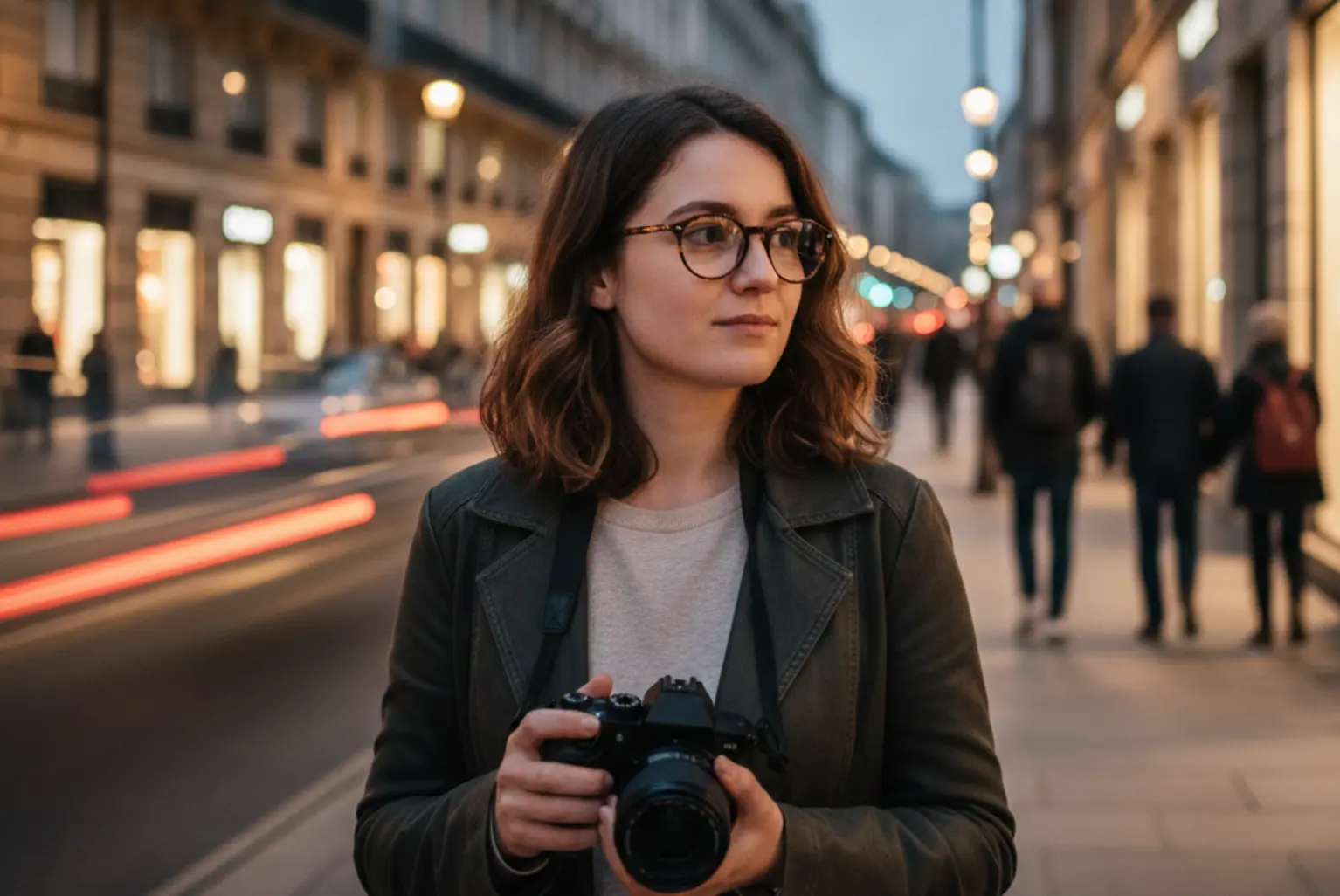
Wide apertures naturally produce background blur, which can be powerful in night street photography. Neon signs, street lamps, and car headlights transform into soft light shapes that add mood and depth.
However, context still matters. If the background tells part of the story — a street sign, a café window, or urban texture — stopping down slightly to f/2.2 or f/2.8 can preserve atmosphere without losing clarity.
Night street photography works best when subject isolation supports the scene rather than erasing it.
Shutter Speed: Motion vs Blur
Low light forces a creative decision: freeze the scene, or let motion speak.
A practical working range is 1/60 – 1/125. At these speeds, most walking subjects remain acceptably sharp, especially if your timing is good.
Dropping below 1/60 increases the chance of motion blur — but that isn’t always a problem.
Using Motion Blur Intentionally
Motion blur can add life to night street photos.
Passing bicycles, cars, or hurried pedestrians create streaks and trails that emphasize energy and movement.
If your main subject is relatively still — someone waiting, leaning, or standing under a light — allowing background motion blur can enhance storytelling rather than ruin the image.
Intentional blur feels artistic. Accidental blur feels careless. The difference is awareness.
ISO: Embrace the Noise (Smartly)
ISO anxiety is one of the biggest mental barriers in night photography — and it’s often outdated.
Modern sensors handle high ISO far better than many photographers expect. Grain is no longer the enemy it once was.
Using ISO 1600, 3200, or even 6400 is completely reasonable for night street photography, especially when the alternative is unusable shutter speeds.
Why ISO Fear Is Overstated
A sharp, noisy image is almost always more valuable than a clean but blurry one.
Noise can add texture, mood, and a documentary feel — qualities that align naturally with street photography.
With careful exposure and modern noise reduction tools, ISO should be treated as a creative variable, not a limitation.
The real mistake isn’t using high ISO — it’s missing the moment because you were afraid to.
The Reality of Modern Sensors
Today’s cameras are designed to work in low light.
Improved dynamic range, better noise performance, and advanced autofocus mean night street photography is more accessible than ever.
Set a reasonable Auto ISO limit based on your camera’s comfort zone, trust your exposure, and focus on timing and composition.
Night streets reward confidence — not hesitation.
Quick Settings Cheat Sheet: Day vs Night Street Photography
If you want a fast reference without overthinking, this quick comparison summarizes the most practical camera settings for street photography — day and night.
| Setting | Day Street Photography | Night Street Photography |
|---|---|---|
| Aperture | f/5.6 – f/8 (context + sharpness) | f/1.8 – f/2.8 (light + subject isolation) |
| Shutter Speed | 1/250 – 1/500 (freeze motion) | 1/60 – 1/125 (balance motion & light) |
| ISO | ISO 100 – 400 (clean files) | ISO 1600 – 6400 (embrace usable noise) |
| Focus Mode | AF-C or Zone Focus | AF-C or Manual Zone Focus |
| Metering | Evaluative / Matrix | Evaluative or Spot (high contrast scenes) |
| White Balance | Auto WB | Auto WB (RAW recommended) |
Think of this as a starting point — not a rulebook. Street photography rewards awareness and adaptation more than fixed numbers.
For more practical guides like this, you can explore our full collection of street photography articles, covering both technical settings and shooting philosophy.
Focus Settings for Street Photography
In street photography, focus settings are less about technical perfection and more about speed, anticipation, and confidence.
You often have seconds — sometimes fractions of a second — to react. That’s why choosing the right focus method matters as much as aperture or shutter speed.
The goal isn’t always pin-sharp precision on the eyelashes. The goal is capturing the moment before it disappears.
Let’s break down the most practical focus approaches for real street shooting.
Autofocus Modes: AF-S, AF-C, and Tracking
Most modern cameras offer multiple autofocus modes, and while they all work, they don’t all work equally well for street photography.
Understanding when to use each one can dramatically increase your keeper rate.
AF-S (Single Autofocus) works best for slower, more deliberate moments — for example, someone standing near a storefront or waiting at a crosswalk.
You half-press, lock focus, and shoot. Simple and reliable, but not ideal for movement.
AF-C (Continuous Autofocus) is the go-to choice for most street situations.
It continuously adjusts focus as your subject moves, which is perfect for walking pedestrians, cyclists, or unpredictable street scenes.
If your camera has face or eye detection, AF-C usually works best with it enabled.
Tracking AF can be powerful, especially on newer mirrorless cameras.
However, in busy streets with overlapping subjects, signs, and reflections, tracking can sometimes jump to the wrong target.
Use it selectively — not blindly.
Daisy tip: If you’re unsure, AF-C with a small focus zone is the safest all-around street photography choice.
Zone Focusing Explained (Beginner-Friendly)
Zone focusing is one of the most loved techniques in street photography — and for good reason. It removes autofocus hesitation entirely and lets you shoot instantly.
The idea is simple:
You pre-focus your lens to a specific distance and use a moderately closed aperture (like f/5.6 or f/8).
Everything within that distance range stays acceptably sharp.
For example:
- Focus set to 2 meters
- Aperture at f/8
- Subjects between roughly 1.5–3 meters will be in focus
This makes zone focusing perfect for:
- Busy sidewalks
- Crosswalks
- Subjects walking toward or across your frame
At night, zone focusing still works — but requires wider apertures and more careful distance control.
Many experienced street photographers switch to manual focus + zone technique after dark for consistency.
Why street photographers love zone focus:
- No focus hunting
- No shutter lag caused by AF
- You react instinctively instead of technically
Once you get used to judging distances intuitively, zone focusing feels less like a technique and more like second nature.
Metering, White Balance & Other Helpful Settings
Once your exposure and focus are under control, these final settings help you stay consistent in unpredictable street lighting.
They don’t usually make or break a shot — but they often decide whether you keep shooting confidently or start second-guessing yourself.
Think of them as support systems. When set correctly, they fade into the background and let you focus on observation and timing.
Many of these choices come down to personal workflow, which is why understanding your camera settings matters more than memorizing exact numbers.
Metering Mode: Evaluative vs Spot
Street photography often includes extreme contrast: deep shadows, bright reflections, backlit subjects, and sudden patches of sunlight.
Your camera’s metering mode determines how it reads and balances these scenes.
Evaluative (or Matrix) metering is the best default choice for most situations. It analyzes the entire frame and does a surprisingly good job in mixed lighting — especially when combined with exposure compensation.
Spot metering can be useful in very specific cases: for example, a single subject stepping into a bright shaft of light while the background remains dark. In those moments, spot metering helps you expose for the subject without blowing highlights.
Daisy tip: Use evaluative metering 90% of the time. When the light gets dramatic, switch to spot briefly — then switch back.
White Balance: Auto Is (Mostly) Fine
White balance is one of the most overthought settings in street photography — especially by beginners.
The truth is simple: if you shoot in RAW, white balance is rarely something to stress about.
Auto White Balance (AWB) works well in most daylight situations and is good enough at night, even under mixed artificial lighting. Modern cameras are very capable of correcting color temperature on the fly.
At night, you may notice warmer or cooler tones from street lamps, neon signs, or shop windows.
Instead of fighting this, many street photographers embrace it as part of the atmosphere.
If consistency matters — for example in a specific series — you can manually set white balance. Otherwise, AWB keeps your workflow fast and flexible.
If you want to go deeper, our street photography tips archive focuses on real-world decision making beyond camera settings.
Final Thoughts: Settings Are Tools, Not Rules
Street photography isn’t about memorizing perfect camera settings.
It’s about being present, observant, and ready. The best settings are the ones that disappear while you focus on people, light, and moments.
Use the daytime and night settings in this guide as starting points. Adjust them based on your city, your pace, and your comfort level. Over time, you’ll stop thinking in numbers and start reacting instinctively.
And that’s when street photography becomes less technical — and more personal.