The Sony A7 V dynamic range has now been tested by multiple independent sources, and the results confirm what many suspected: Sony’s latest full‑frame mirrorless camera delivers class‑leading tonal flexibility. From ISO 50 through ISO 600, the A7 V consistently outperforms the Canon EOS R6 Mark III by a visible margin of 1–2 stops, cementing its position as the technical superior in this critical metric.
After covering the Sony A7 V Official Announcement and sharing our Hands‑On Coverage, this roundup focuses specifically on dynamic range — one of the most important aspects for photographers who demand maximum flexibility in post‑processing.
DPReview Studio Scene
In their dynamic range test, DPReview noted: “This may be one of the most ISO invariant cameras we’ve seen to date when shooting with the mechanical shutter.” This means the A7 V retains exceptional exposure latitude across ISO settings, allowing photographers to recover highlights and shadows with minimal penalty. Compared to the A7 IV, the new model shows a clear step forward in tonal flexibility.
Petapixel Comparison vs Canon R6 III
Petapixel’s head‑to‑head comparison emphasized that the Sony A7 V consistently holds a 1–2 stop advantage over the Canon R6 III from ISO 50 to ISO 600, calling it a “big visible difference that landscape and wedding shooters will notice immediately.” While Canon briefly pulls ahead at ISO 800 in electronic shutter mode, Sony regains the edge at higher ISOs, proving its sensor design is optimized for both stills and video workflows.
PhotonsToPhotos Measured Data
According to PhotonsToPhotos measurements, the numbers back up these impressions:
- ISO 50–200: Sony A7 V is ~1 stop ahead
- ISO 400–600: Advantage widens to nearly 2 stops
- ISO 800–51200: Sony maintains ~¼ stop lead across most of the range

These results confirm that the A7 V provides more usable dynamic range across the board, giving photographers extra flexibility in RAW processing and video grading.
For new users, these recommended exposure and ISO settings help you get the best image quality and autofocus performance right away.
Electronic Shutter Performance
Dynamic range tests with the electronic shutter show a slightly different story:
- ISO 50–600: Sony leads by 1/4 to 1/2 stop
- ISO 800: Canon briefly pulls ahead by nearly 1 stop
- ISO 1600 and above: Sony regains a slight advantage
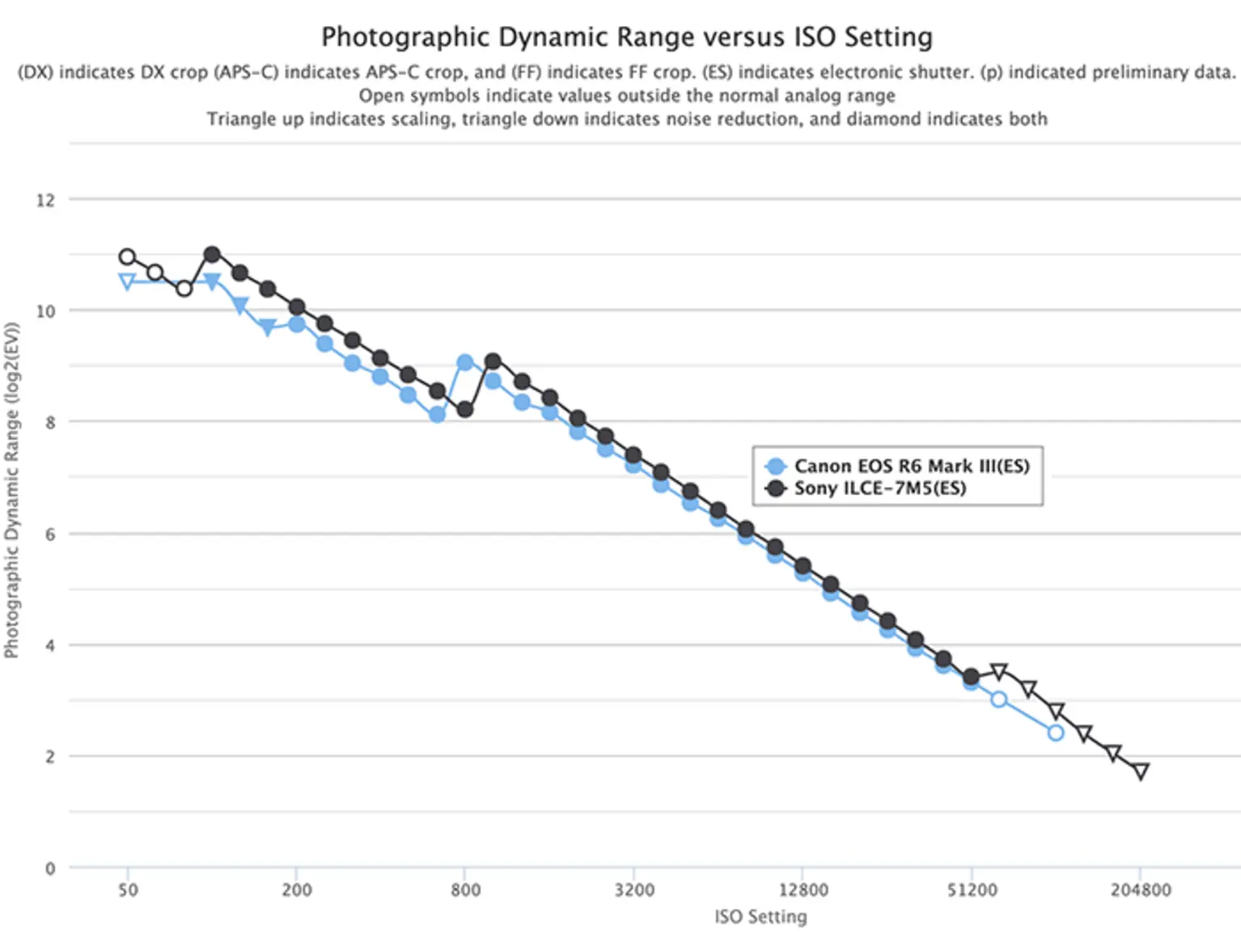
Even with these variations, the Sony A7 V dynamic range remains consistently strong, proving that Sony has optimized sensor readout and processing to minimize losses when shooting silently.
Real‑World Impact
Dynamic range isn’t just about numbers — it directly affects how flexible your files are in post. In our A7 V Sample Images & Gallery, we saw how shadows could be lifted cleanly and highlights recovered without banding or color shifts. This makes the A7 V particularly appealing for hybrid shooters who demand both still and video excellence.
Compared to the A7 V vs A7 IV, the new model shows a clear step forward in tonal flexibility, thanks to its improved sensor and processing pipeline. For those upgrading from the A7 IV, dynamic range alone may justify the move.
Price & Availability
Sony A7 V — Check Price
For full stock tracking and restock alerts, see our Sony A7 V In Stock & Availability Tracker.
Conclusion: Sony A7 V Dynamic Range is a Game‑Changer
The Sony A7 V dynamic range tests confirm what many suspected: Sony has delivered a camera that not only competes but surpasses its rivals in tonal flexibility. With up to 2 stops advantage over the Canon R6 III at mid‑range ISOs, the A7 V provides photographers with more usable data in every frame.
Combined with its improved autofocus, robust build, and expanded feature set detailed in our Sony A7 V Teardown, the dynamic range performance makes the A7 V one of the most technically advanced mid‑range full‑frame cameras available today.
If you’re considering the A7 V, don’t miss our guides on Best Lenses for Sony A7 V, Best Memory Cards, Best Accessories, and our Kit Lens vs Body‑Only Buying Guide.
From a pure dynamic range perspective, the Sony A7 V is the technical superior camera in its class — a fact that will resonate with professionals and enthusiasts alike.