Understanding mirrorless lens compatibility is one of the most important — and most confusing — parts of choosing a camera system in 2025. While mirrorless cameras offer incredible flexibility, lenses are still mount-specific, and not every lens works across brands or sensor sizes.
In this guide, we break down how mirrorless lens compatibility actually works across today’s major systems — including Sony E / FE, Canon RF, Nikon Z, and the L-Mount Alliance. Whether you’re upgrading from APS-C to full-frame or investing in your first serious lens lineup, this article will help you avoid costly mistakes.
This mini-guide is part of the DCN Mirrorless Hub, designed to help photographers and creators understand not just individual cameras — but entire ecosystems. For a deeper look at one specific system, you can also explore our Sony E-Mount System Guide.
💡 Quick takeaway: Choosing the right lens mount matters more than choosing the camera body — because lenses define your system for years.
Do Mirrorless Lenses Work Across Different Brands?
Short answer: No — mirrorless lenses do not natively work across different camera brands. Each mirrorless system uses its own proprietary lens mount, which determines physical fit, electronic communication, autofocus behavior, and image stabilization support.
Unlike older DSLR systems, modern mirrorless mounts are deeply integrated with autofocus motors, in-body stabilization, and video features. This means that even if a lens physically fits using an adapter, full functionality is not guaranteed.
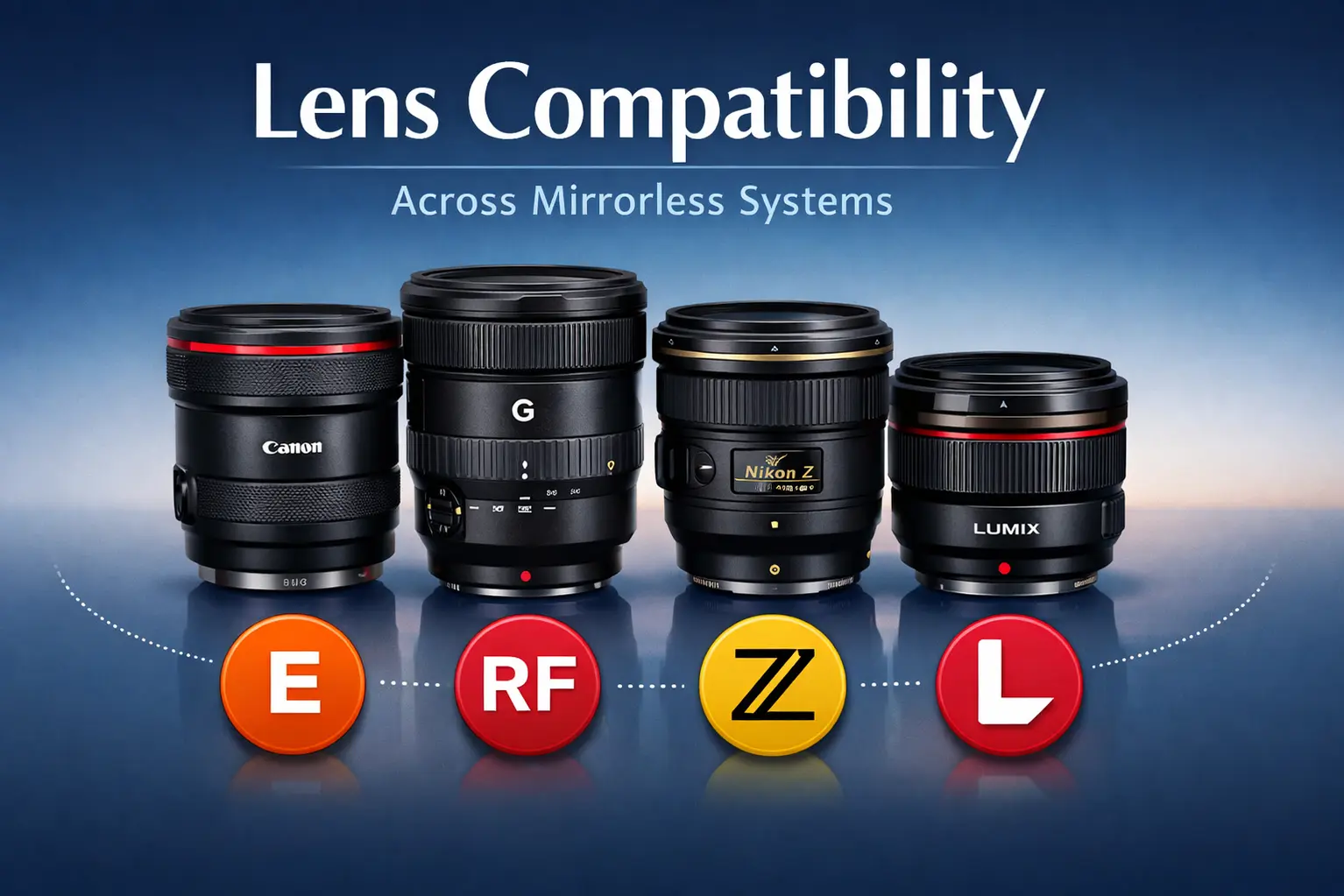
Native Mount Compatibility (2025 Overview)
- Sony E / FE lenses → Work on Sony APS-C and Full-Frame mirrorless bodies
- Canon RF lenses → Work only on Canon EOS R cameras
- Nikon Z lenses → Work only on Nikon Z mirrorless cameras
- L-Mount lenses → Shared across Panasonic, Leica, and Sigma bodies
This is why choosing a mirrorless system is not just about the camera body — it’s about committing to a lens ecosystem that matches your long-term needs.
🔍 Daisy explains: Camera bodies change every few years. Lenses stay with you for a decade or more. Always choose the mount first — then the camera.
What About Lens Adapters? Pros, Cons & Limitations
Lens adapters make it possible to use certain lenses on mirrorless cameras — but they rarely deliver the same experience as native lenses. While adapters can help photographers transition between systems, they also come with clear trade-offs.
When Lens Adapters Make Sense
- Using older DSLR lenses on mirrorless bodies (EF → RF, F → Z)
- Slow-paced photography like landscapes or studio work
- Transition periods when switching systems gradually
Common Limitations of Lens Adapters
- Slower or inconsistent autofocus performance
- Reduced video AF reliability and tracking
- Limited support for in-body image stabilization
- Extra size and weight added to the setup
In fast-moving scenarios like vlogging, wildlife, sports, or hybrid video shooting, native mirrorless lenses consistently outperform adapted lenses — especially in autofocus accuracy and tracking.
🎯 Daisy’s advice: Adapters are great as a temporary solution. If you’re investing long-term, native lenses are always the smarter choice.
APS-C vs Full-Frame Lens Compatibility Explained
One of the biggest advantages of some mirrorless systems is the ability to use APS-C and full-frame lenses on the same mount. However, compatibility does not always mean identical performance.
Same Mount, Different Sensor — How It Works
In systems like Sony E-mount, both APS-C and full-frame cameras share the same physical mount. This allows lenses to mount without adapters, but the camera’s sensor size determines how the lens behaves.
Using Full-Frame Lenses on APS-C Cameras
- Fully compatible — autofocus and stabilization work normally
- Field of view is cropped (1.5× for APS-C mirrorless systems)
- Often sharper edge-to-edge due to using the lens “sweet spot”
This setup is popular among photographers who plan to upgrade to full-frame later, as their lenses remain fully usable.
Using APS-C Lenses on Full-Frame Cameras
- Camera automatically switches to crop mode
- Reduced image resolution
- Not recommended for long-term full-frame use
While this works in emergencies, APS-C lenses on full-frame bodies defeat the purpose of owning a full-frame camera.
📐 Daisy explains: Think of APS-C lenses as system-specific tools. Full-frame lenses are future-proof investments.
Lens Compatibility by Mirrorless System (Quick Reference)
To make things simple, here’s a quick breakdown of how lens compatibility works across the major mirrorless camera systems in 2025. If you’re deciding between brands, this section alone can save you hours of research.
Sony E / FE Mount
- APS-C & Full-Frame: Share the same E-mount
- Lens flexibility: Full-frame lenses work perfectly on APS-C bodies
- Third-party support: Excellent (Sigma, Tamron, Samyang)
Sony’s E-mount is one of the most flexible ecosystems, making it popular among hybrid shooters and long-term upgraders. See Best Sony E-mount Lenses.
Canon RF Mount
- APS-C & Full-Frame: Same RF mount, but limited lens crossover
- Third-party lenses: Very limited (Canon-controlled)
- Adapters: EF → RF works well, especially for photography
Canon RF prioritizes native lens performance, but offers less freedom for budget-focused buyers.
Nikon Z Mount
- APS-C & Full-Frame: Share the Z mount
- Optical quality: Excellent across S-line lenses
- Adapters: F → Z FTZ adapter works reliably
Nikon Z lenses are known for optical consistency, making system upgrades smooth for existing Nikon users. See Best Nikon Z Lenses.
L-Mount Alliance (Panasonic, Leica, Sigma)
- Shared mount: Same lenses across multiple brands
- Lens variety: Strong third-party and premium options
- Best for: Video, hybrid, and professional workflows
The L-mount alliance offers one of the most open and collaborative lens ecosystems in mirrorless photography.
🔗 Daisy’s shortcut: If you value flexibility and lens choice, Sony E and L-Mount systems are the easiest to grow with.
Choosing the Right Lens Mount for the Long Term
When choosing a mirrorless camera system, it’s easy to focus on megapixels, video specs, or the latest camera release. But in the long run, your lens mount matters far more than your camera body.
A camera body will likely be replaced every few years. Lenses, on the other hand, often stay in a photographer’s kit for a decade or more. That’s why committing to the right mirrorless mount early can save you money — and frustration — down the line.
Ask Yourself These Questions Before Choosing a System
- Do I plan to upgrade from APS-C to full-frame in the future?
- Do I need strong third-party lens options to manage costs?
- Is video autofocus and tracking critical for my workflow?
- Do I shoot fast action, travel, or hybrid photo/video?
If flexibility and future-proofing are your priorities, systems with shared mounts across sensor sizes — like Sony E-mount or Nikon Z — offer the smoothest upgrade paths. If you prefer tightly controlled native performance, ecosystems like Canon RF deliver excellent results with fewer variables.
🧭 Daisy’s final advice: Start with lenses you’ll still love in five years. The right camera body will always follow.
Final Thoughts: Choose the System, Not Just the Camera
When buying a mirrorless camera, the body is only the beginning. Lens compatibility defines how flexible, future-proof, and cost-effective your entire photography or video setup will be over time.
Each mirrorless system comes with its own strengths — from native lens depth and third-party support to autofocus behavior and video optimization. Choosing the right system early helps avoid unnecessary adapter limitations, resale losses, and ecosystem lock-in frustrations.
Whether you’re a beginner planning your first kit or an advanced user considering a system switch, understanding
which lenses work with which mounts is one of the smartest long-term decisions you can make.
In short: don’t just compare camera specs.
Compare systems, lens roadmaps, and upgrade paths.
Explore Our Complete Mirrorless System Guides: