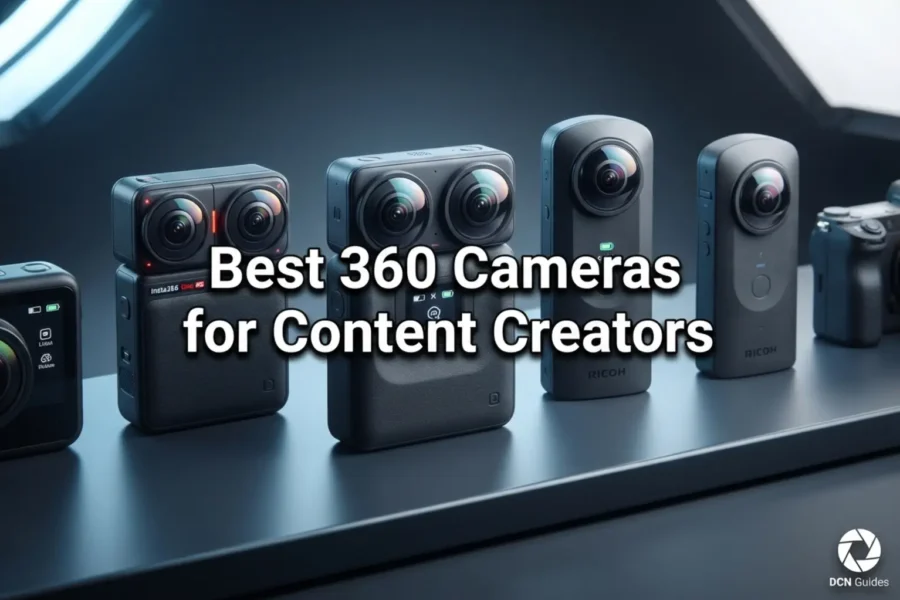
The fast-evolving photography and video equipment landscape inside our gear guides category has undergone a massive shift toward immersive multi-angle capture. For modern solo filmmakers, outdoor enthusiasts, and social media specialists, traditional single-lens cameras often present a clear compromise: you must choose what to frame before pressing record. 360-degree cameras eliminate this friction entirely by recording everything around you simultaneously, allowing you to reframe shots, adjust angles, and track subjects long after the shoot is finished.
Whether you are capturing high-speed action, producing immersive virtual tours, or publishing vertical videos for social platforms, choosing the right 360 camera requires balancing sensor size, resolution headroom, stabilization algorithms, and software workflow ease. Below is our comprehensive 2026 buying guide analyzing the top 360 cameras available for content creators, complete with technical feature breakdowns, software comparisons, and practical buying advice.
Why 360 Cameras Have Become Mandatory Gear for Creators
Traditional camera rigs demand constant pan-and-tilt adjustments, dedicated camera operators, or complex multi-camera setups. A dual-lens 360 camera records an entire spherical field of view onto a single storage card, providing several major operational advantages for solo shooters:
- Shoot First, Frame Later: Record high-resolution spherical footage without worrying about subject framing during action sequences. In post-production, keyframe your camera angles to output perfectly framed horizontal (16:9) cinematic videos or vertical (9:16) social clips.
- The Invisible Selfie Stick Effect: Advanced real-time optical stitching automatically removes mounting poles from the final image, creating floating third-person camera angles that mimic drone footage without airspace restrictions.
- Unbreakable Horizon Lock & Stabilization: Proprietary gyroscopic stabilization algorithms provide 360-degree horizon leveling, maintaining rock-steady footage even during violent flips, tumbles, or off-road vehicle maneuvers.
For creators seeking traditional point-and-shoot action setups alongside spherical rigs, our dedicated guide to the best action cameras provides a direct comparison between wide-angle single-lens bodies and dual-lens 360 systems.
Top 360 Cameras for Content Creators: Quick Comparison
Choosing the right camera depends on your primary shooting environment—whether you prioritize extreme low-light dynamic range, pocketable daily portability, or rugged waterproofing. Below is an overview comparing the leading market options:
| Camera Model | Max Video Resolution | Sensor Size | Waterproof Rating | Best For |
|---|---|---|---|---|
| Insta360 X6 | 8K / 30fps & 5.7K / 60fps | 1/2-Inch CMOS | 33ft (10m) Native | All-Around 8K Action & Vlogging |
| Insta360 1-Inch 360 Edition | 6K / 30fps | Dual 1-Inch CMOS | IPX8 Splashproof | Low-Light & High Dynamic Range |
| GoPro Max | 5.6K / 30fps | 1/2.3-Inch CMOS | 16ft (5m) Native | Rugged Audio & GoPro Ecosystem Integration |
| Ricoh Theta Z1 | 4K / 30fps (RAW Stills) | Dual 1-Inch CMOS | Non-Waterproof | Real Estate & Professional Virtual Tours |
In-Depth Review of the Best 360 Cameras
1. Insta360 X6 – The Undisputed 8K Flagship Standard
The Insta360 X6 represents the benchmark for consumer 360-degree video capture. By elevating native spherical recording resolution to 8K at 30fps, the X6 resolves the primary limitation of earlier 360 cameras: loss of sharpness during cropping. When reframing an 8K spherical video into a standard flat 1080p clip, the resulting image retains exceptional clarity, fine texture detail, and crisp line definition.
Insta360 X6 Highlights
- 8K/30fps & 5.7K/60fps Video: High frame rates enable smooth slow-motion reframing during action sports.
- Removable Lens Guards: Screw-on tough glass lens protectors keep dual fisheye elements safe during high-impact shoots.
- 2.5-Inch Gorilla Glass Screen: Ultra-bright touchscreen simplifies outdoor menu navigation and live preview.
For creators following next-generation flagship developments, check out our technical spec predictions on the upcoming Insta360 X6 price, specs, and release date breakdown.
2. Insta360 ONE RS 1-Inch 360 Edition – Premium Low-Light Performance
Co-engineered with Leica, the Insta360 ONE RS 1-Inch 360 Edition replaces standard action-camera sensors with dual large 1-inch CMOS sensors. This increased physical surface area delivers substantially cleaner shadow detail, reduced digital noise in low-light indoor shooting, and superior dynamic range during high-contrast sunset scenarios.
While slightly larger than candy-bar style cameras, its image fidelity makes it the leading choice for commercial creators, architectural photographers, and high-end travel filmmakers who demand image quality comparable to dedicated mirrorless bodies.
3. GoPro Max – Exceptional Audio & Ecosystem Reliability
The GoPro Max remains a sturdy option for creators already operating within the GoPro mounting ecosystem. Featuring built-in folding mounting fingers, six directional spatial audio microphones, and hyper-smooth stabilization, the Max functions as a robust hybrid between a traditional action camera and a dual-lens 360 recorder.
4. Competitive Market Outlook: The DJI Factor
With DJI dominating drone and gimbal stabilization sectors, rumors concerning an upcoming dual-lens competitor carry significant market attention. Industry analysts tracking DJI Osmo 360 leaks suggest that DJI’s entry into spherical video could introduce advanced tracking algorithms, direct mic wireless integration, and integrated thermal dissipation designs.
Daisy’s Take on 360 Camera Workflows
The secret to great 360 video isn’t just the hardware—it’s the editing desktop suite! Always shoot at the highest native resolution available (8K or 5.7K) so you have plenty of pixel headroom when zooming in or reframing tight close-ups for vertical TikTok or YouTube Shorts content.
How to Choose the Right 360 Camera for Your Workflow
Evaluating potential cameras against your specific publishing format prevents overspending on unnecessary specs or purchasing gear unsuited to your environment:
- Resolution vs. Crop Quality: Remember that a camera’s advertised 360 resolution is stretched over a full 360-degree sphere. A 5.7K 360 camera yields approximately 1080p cropped flat video, while an 8K 360 camera produces crisp 1440p to 4K cropped output.
- Audio Recording Capabilities: Immersive video requires clean audio. Look for camera bodies equipped with directional spatial microphone arrays or native wireless Bluetooth mic support for run-and-gun interviewing.
- Software & Mobile App Ecosystem: Editing 360 footage requires intuitive keyframing tools. Choose brand ecosystems with feature-rich mobile apps and dedicated desktop plugins (e.g., Adobe Premiere Pro or Final Cut Pro integration) to streamline post-production.
For broader comparisons across traditional vlogging tools, review our expert selections for top-rated vlogging cameras.
Check current prices and bundle availability across major authorized retailers:Search 360 Cameras on Amazon |
Find 360 Gear at B&H Photo |
View Deals on Adorama
Shop Top-Rated 360 Action Cameras
Compare authorized retailer listings, bundle kits, and live stock status:
Check Insta360 X6 Amazon Prices
Buy Insta360 Gear at B&H Photo
View Adorama 360 Camera Listings
Pro Tip: Always pair dual-lens 360 cameras with durable lens guards and fast V30/A2 rated MicroSD cards to handle high-bitrate 8K spherical recording without dropped frames!
Final Verdict
Investing in a modern 360 camera unlocks unmatched creative freedom for content creators, eliminating framing anxiety and enabling floating camera perspectives impossible with standard hardware. For all-around performance, waterproofing, and stunning reframed image quality, 8K models like the Insta360 X6 stand out as the top recommendation for most creators today. If low-light performance is your top priority, large-sensor alternatives like the Insta360 1-Inch Edition deliver professional-grade results.
We will continue evaluating new spherical hardware, software updates, and market developments across our platform. Stay tuned to Daily Camera News for full reviews, technical comparisons, and workflow guides.
Frequently Asked Questions (FAQ)
Frequently Asked Questions About 360 Cameras
Q: What is the main advantage of a 360 camera over a standard action camera?
A: A 360 camera records everything in a complete spherical field of view simultaneously. This allows creators to reframe camera angles, switch between horizontal and vertical formats, and utilize invisible selfie stick effects after shooting is complete.
Q: Why is 8K resolution important for 360 video?
A: Because 360-degree video resolution is spread across an entire sphere, higher native capture resolution (like 8K) ensures that reframed, cropped standard video clips retain crisp HD or 4K sharpness.
Q: How does the invisible selfie stick effect work?
A: 360 cameras utilize two opposing fisheye lenses with overlapping fields of view. The camera software stitches the two images together along a blind spot where the pole is mounted, automatically erasing the pole from the final footage.