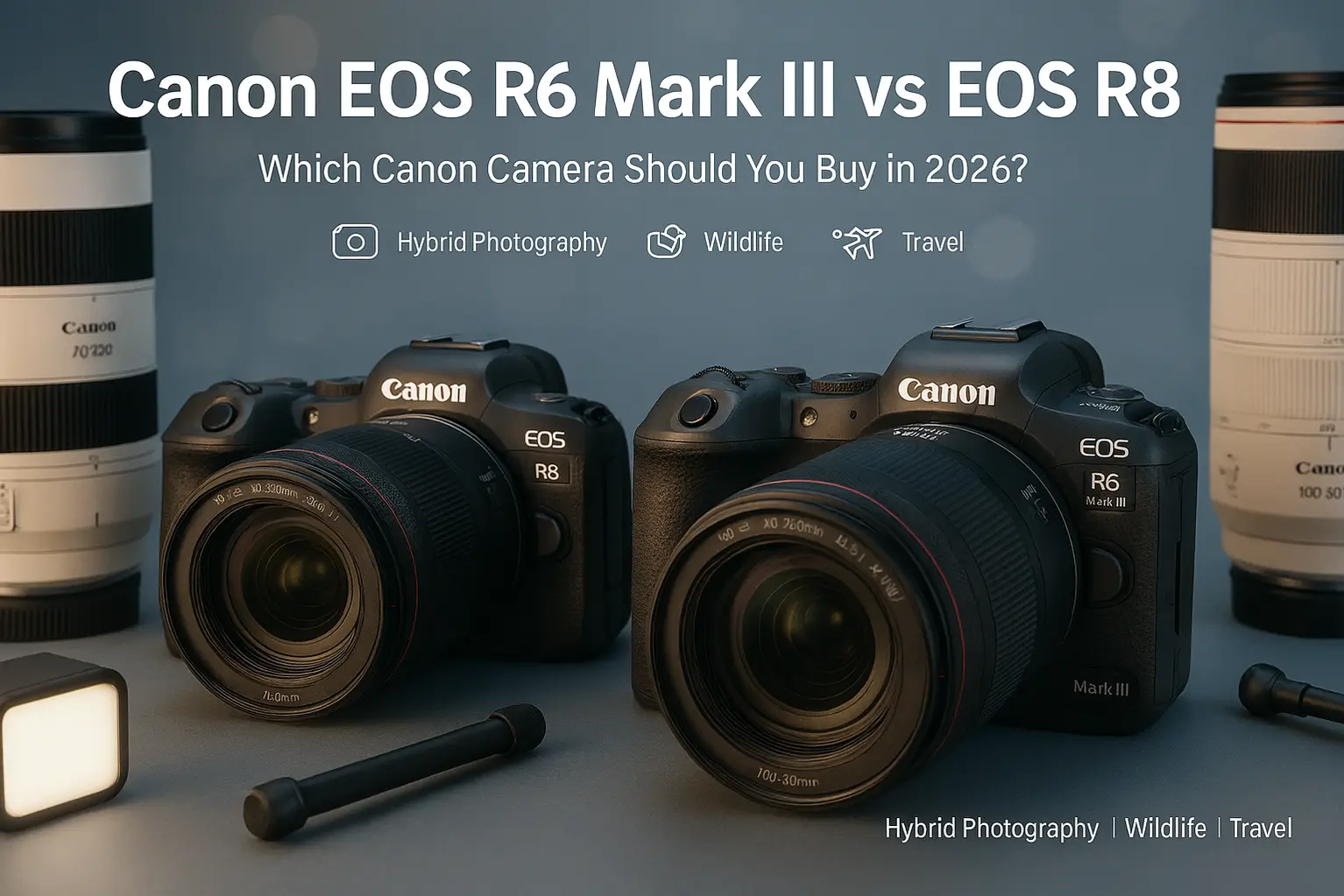
If you’re trying to decide which Canon camera you should buy in 2026, this Canon EOS R6 Mark III vs EOS R8 comparison is exactly what you need.
At first glance, these two mirrorless cameras may look similar — both are modern RF-mount bodies with excellent image quality and Canon’s latest autofocus technology. But when you look closer, the EOS R6 Mark III vs R8 debate quickly becomes a question of priorities: performance vs portability, long-term investment vs affordability, and hybrid shooting vs everyday photography.
Whether you’re upgrading from an older Canon DSLR, moving into full-frame for the first time, or choosing a second body for video and action work, this guide breaks down who each camera is really for — without spec overload or marketing fluff.
Who Is Each Camera For?
Canon EOS R6 Mark III — Who Should Buy It?
The Canon EOS R6 Mark III is for photographers and creators who don’t want their camera to be the limiting factor.
If you regularly shoot in challenging conditions — fast action, low light, long sessions, or mixed photo-video workflows — this camera is built to keep up.
- Wildlife & sports photographers who rely on fast autofocus, high burst rates, and consistent tracking
- Hybrid shooters balancing photography and video in the same project
- Content creators & YouTubers who record long takes and need thermal reliability
- Enthusiasts upgrading from DSLRs who want a true long-term investment
- Professionals or serious hobbyists who shoot in low light or demanding environments
Psychological fit:
You value confidence, reliability, and headroom. You’d rather pay more once than feel the need to upgrade again in two years.
“If missing the shot would bother you more than carrying extra weight, the R6 Mark III is your camera.”
Canon EOS R8 — Who Should Buy It?
The Canon EOS R8 is designed for photographers who want full-frame image quality without the size, weight, or cost of a pro body.
It delivers excellent results while staying approachable, compact, and travel-friendly.
- Travel & street photographers who prioritize lightweight gear
- Everyday shooters capturing family, lifestyle, and casual content
- APS-C upgraders moving into full-frame for the first time
- Beginner-to-intermediate hybrid users focused on short-form video
- Creators on a budget who want modern Canon autofocus and color science
Psychological fit:
You value simplicity, portability, and value. You want great results without carrying or managing a heavier, more complex system.
“If you want full-frame quality in a camera that never feels like a burden, the EOS R8 makes a lot of sense.”
2026 Context: Why This Comparison Matters
The Canon EOS R6 Mark III vs EOS R8 comparison matters more in 2026 than it did just a few years ago.
Not because these cameras are brand new — but because the Canon RF system has fully matured, and expectations from hybrid cameras are now much higher.
The Canon RF Ecosystem Is Now Fully Mature
Canon’s RF mount is no longer an early-stage mirrorless platform.
With a complete lineup of RF and RF L-series lenses covering everything from travel to wildlife and video,
the system has reached a point where long-term planning actually matters.
If you’re not fully familiar with how the RF system has evolved, this guide is essential:
Canon EOS R System Guide — Cameras, Lenses & Ecosystem Explained
In this environment, the difference between the R6 Mark III and the EOS R8 is not just about specs — it’s about how comfortably each camera fits into Canon’s modern RF workflow.
Hybrid Expectations Have Changed in 2026
Today’s photographers expect their cameras to handle both stills and video without compromise. Features like reliable autofocus, strong low-light performance, and consistent video recording are no longer optional.
Future-Proofing Means System Fit — Not Just Specs
In 2026, future-proof doesn’t mean chasing the highest resolution or the latest codec. It means choosing a camera that:
- Feels natural as your skills improve
- Pairs well with current and future RF lenses
- Handles both photography and video reliably
- Won’t feel limiting two or three years down the line
R6 Mark III users often build around pro RF zooms and long-term kits, while EOS R8 users typically prioritize portability, price, and simplicity. If you want to explore how each camera fits into its own ecosystem:
- Canon EOS R6 Mark III — All Guides & Reviews
(Best Lenses Guide) - Canon EOS R8 — All Guides & Reviews
(Best Lenses Guide)
And if you’re still deciding where these cameras sit within Canon’s broader lineup,
this comparison also connects directly to our overall ranking: Best Canon Mirrorless Cameras — Updated Rankings
Understanding this 2026 context makes the decision clearer — because the right choice isn’t about which camera is “better,” but which one fits your shooting style, expectations, and long-term plans.
Quick Answer: Canon EOS R6 Mark III vs EOS R8
Short version?
👉 Choose the Canon EOS R6 Mark III if you want maximum performance, durability, and long-term flexibility.
👉 Choose the Canon EOS R8 if you want full-frame image quality in a lighter, more affordable body.
The R6 Mark III is built for enthusiasts and professionals who shoot action, wildlife, sports, or hybrid photo-video and need in-body stabilization, faster operation, and better thermal performance.
The EOS R8 is ideal for travel, everyday photography, content creation, and photographers upgrading from APS-C who want simplicity without sacrificing image quality.
“If you plan to grow into demanding shooting scenarios, buy the camera you won’t outgrow — not just the one that fits today.”
👉 Keep reading for a side-by-side breakdown, real-world use cases, and a final recommendation based on how you actually shoot.
Best Picks: Canon EOS R6 Mark III vs EOS R8
Here’s a quick look at which Canon camera is best for different needs in 2026 — from all-around performance to lightweight hybrid use:
Canon EOS R6 Mark III — See EOS R6 Mark III details
Canon EOS R6 Mark III (Best Overall)
Top choice if you want the best hybrid performance, low-light ability, and long-term value.
Canon EOS R8 — See EOS R8 tag page
Canon EOS R8 (Best Lightweight Hybrid)
Great choice if you prioritize portability and hybrid photo/video performance on a budget.
Canon EOS R6 Mark III — hybrid workflows & sustained recording
Canon EOS R6 Mark III (Best for Video Reliability)
Excellent choice if you need dependable 4K/7K video with minimal thermal limitations.
Canon EOS R8 — great value option
Canon EOS R8 (Best Budget Full-Frame)
Best choice for enthusiasts who want Canon full-frame quality on a tighter budget.
Canon EOS R6 Mark III vs EOS R8: Decision-Based Comparison
If you’re trying to decide between the Canon EOS R6 Mark III and the EOS R8 in 2026, this table breaks the comparison down by real-world use cases — not just specs.
Use it to quickly see which camera fits your shooting style, budget, and long-term goals.
| Use Case | Canon EOS R6 Mark III | Canon EOS R8 |
|---|---|---|
| Autofocus Performance | ★★★★★ Excellent for wildlife, action, and fast subjects |
★★★★☆ Very good, but smaller buffer for bursts |
| Low-Light Photography | ★★★★★ Better dynamic range and ISO flexibility |
★★★★☆ Strong performance, slightly less forgiving |
| Video Reliability | ★★★★★ Designed for long takes, minimal thermal limits |
★★★☆☆ Excellent quality, but thermal limits on long recordings |
| Build & Handling | ★★★★★ Weather-sealed, dual card slots, pro ergonomics |
★★★☆☆ Lightweight body, fewer physical controls |
| Long-Term Investment | ✅ Recommended More future-proof for advanced users |
⚠️ Depends Great now, but fewer pro features long-term |
| Best For | Hybrid shooters, wildlife, events, video creators Check current price |
Lightweight hybrid users, travelers, enthusiasts Check current price |
Use Case: Canon EOS R6 Mark III vs EOS R8
Best for Wildlife & Action
For photographers capturing fast-moving subjects, the Canon EOS R6 Mark III excels with its superior autofocus system, larger buffer, and better low-light performance. The EOS R8 performs well too but is slightly limited during extended continuous shooting sessions.
Best for Travel & Everyday
If portability and convenience are key, the EOS R8 shines with its lightweight body while still offering full-frame quality. The R6 Mark III is larger but offers more features for hybrid photography and video if you prioritize performance over compactness.
Best for Video & Content Creation
Hybrid shooters and video creators benefit from the R6 Mark III with its superior video reliability, no overheating issues, and advanced IBIS stabilization. The EOS R8 is capable for short projects or casual video but may hit thermal limits during extended 4K/7K shooting.
Final Recommendation: Canon EOS R6 Mark III vs EOS R8
When deciding between the Canon EOS R6 Mark III and the EOS R8, it ultimately comes down to priorities:
“If money is not the main concern, the EOS R6 Mark III is still the safest pick for hybrid shooters, wildlife photography, and video creators who want future-proof performance. If portability matters more or you’re a budget-conscious enthusiast, the EOS R8 is an excellent lightweight full-frame option.”
Check Prices & Buy
Canon EOS R6 Mark III – Amazon Canon EOS R6 Mark III – B&H
Canon EOS R8 – Amazon Canon EOS R8 – B&H
Tip: Use this guidance to pick the right Canon camera for your hybrid photography, travel, wildlife, or video needs.
Canon EOS R6 Mark III vs EOS R8 FAQ
- Which camera is better for video?
- The R6 Mark III offers superior video reliability with no overheating issues, while the EOS R8 is suitable for short projects or casual video.
- Which camera is best for beginners?
- The EOS R8 is lightweight, intuitive, and budget-friendly, making it ideal for beginners who want full-frame quality without complexity.
- Is the R6 Mark III worth the investment?
- Yes, it is future-proof and ideal for hybrid shooters, wildlife, and video professionals who require top-tier performance.
- Can the R8 handle wildlife photography?
- It can, but its buffer and continuous shooting performance are limited compared to the R6 Mark III for long action sequences.
- Which camera offers better low-light performance?
- The R6 Mark III excels in low-light scenarios due to better dynamic range and larger sensor capabilities.
- Which camera is more portable?
- The EOS R8 is smaller and lighter, perfect for travel and everyday shooting.