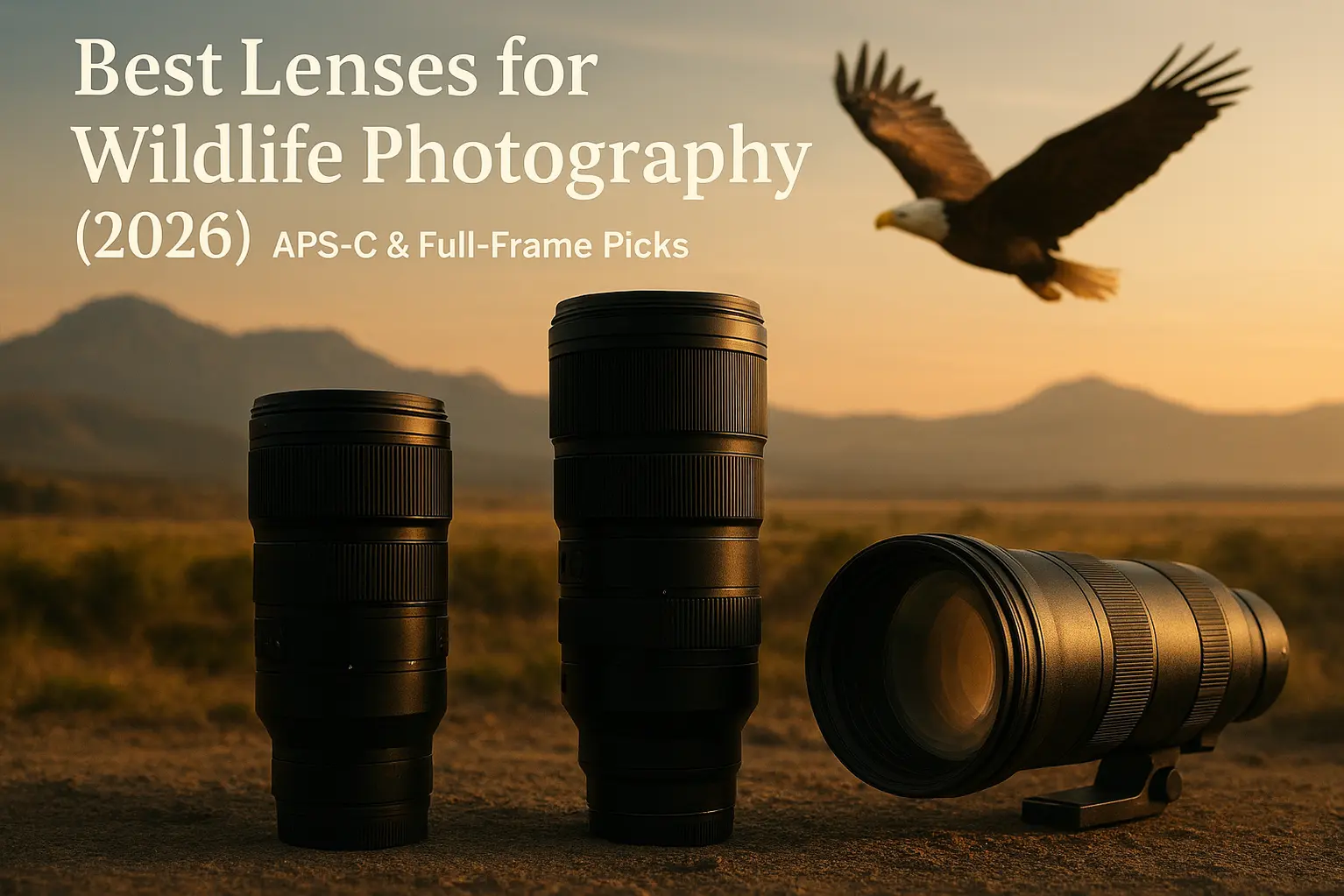
Choosing the right camera matters, but for wildlife photography, the lens often matters even more. In 2026, photographers have access to powerful long-reach telephoto lenses that deliver fast autofocus, sharp results, and reliable performance — without stepping into ultra-expensive super-telephoto territory.
This guide focuses on the best lenses for wildlife photography in 2026, comparing top APS-C and full-frame options for birds, fast-moving animals, and outdoor action. Whether you prioritize reach, portability, or low-light performance, these are the lenses that offer the best balance of performance and value.
If you’re serious about wildlife photography, choosing the right lens matters more than the camera body.
Who This Guide Is For
- Bird photographers who need maximum reach and fast autofocus
- Wildlife shooters working with APS-C or full-frame cameras
- Nature photographers capturing fast-moving animals
- Enthusiasts & semi-pros looking for the best wildlife lens in 2026
If you want the safest overall wildlife lens in 2026, the
Sony FE 200–600mm f/5.6–6.3 G OSS remains the most reliable choice
for most photographers. It offers an ideal balance of long reach, fast autofocus,
optical stabilization, and consistent real-world performance for birds and wildlife.
Best for bird photography, fast-moving wildlife, and photographers who want proven performance without stepping into ultra-expensive super-telephoto lenses.
Check Sony FE 200–600mm Prices
Tip: A proven wildlife lens with excellent autofocus and stabilization —
ideal for Sony full-frame and APS-C shooters who want dependable long-term value.
Best Wildlife Lenses
Choosing the right wildlife lens depends on your camera system, sensor size,
and shooting style. Below are the best-performing options for both APS-C and
full-frame shooters in 2026 — focusing on reach, autofocus reliability, and real-world usability.
APS-C Wildlife Lens Picks
APS-C cameras offer extra reach thanks to crop factor, making them ideal for bird and wildlife photography on a budget.
🥇 Fujifilm XF 150–600mm f/5.6–8 R LM OIS WR
The Fujifilm XF 150–600mm f/5.6–8 is the longest native wildlife lens for the X-mount
system, delivering an impressive 229–914mm full-frame equivalent reach.
It’s weather-sealed, surprisingly lightweight for its class, and optimized for
Fuji’s fast AF tracking.
- ✔ Massive reach with APS-C crop advantage
- ✔ Optical Image Stabilization for handheld shooting
- ✔ Weather-resistant build
Check Fujifilm XF 150–600mm Prices
Tip: Ideal for bird photographers who want extreme reach without moving to full-frame.
🥈 Tamron 150–500mm f/5–6.7 Di III VC VXD (Sony E)
The Tamron 150–500mm f/5–6.7 offers excellent flexibility for Sony E-mount shooters.
On APS-C bodies, it provides a 225–750mm equivalent reach while remaining
compact and travel-friendly compared to traditional super-telephotos.
Note: This lens is available for Sony E-mount only, but works great on both APS-C and full-frame Sony cameras.
- ✔ Fast VXD autofocus motor
- ✔ Strong vibration compensation (VC)
- ✔ Much lighter than 200–600mm class lenses
Check Tamron 150–500mm Prices
Tip: A great balance of reach, weight, and price — perfect for mobile wildlife shooters.
Full-Frame Wildlife Lens Picks
🥇 Sony FE 200-600mm f/5.6–6.3 G OSS
The Sony FE 200–600mm G OSS is a benchmark wildlife lens thanks to its internal zoom,
excellent autofocus performance, and consistent sharpness across the range.
It’s widely trusted by bird and wildlife photographers worldwide.
- ✔ Internal zoom for better balance
- ✔ Reliable subject tracking with Sony bodies
- ✔ Excellent image stabilization
🥈 Nikon Z 180–600mm f/5.6–6.3 VR
Nikon’s Z 180–600mm VR is a strong competitor, offering excellent optical quality
and fast autofocus optimized for Nikon’s mirrorless wildlife bodies.
It’s especially effective for birds-in-flight and distant subjects.
- ✔ Competitive pricing for native Z glass
- ✔ Effective vibration reduction (VR)
- ✔ Solid sharpness throughout the zoom range
Check Nikon Z 180–600mm Prices
🥉 Canon RF 200-800mm f/6.3–9 IS USM
The Canon RF 200–800mm f/6.3–9 pushes reach further than any lens in its class,
making it ideal for distant wildlife and bird photography where framing flexibility
matters more than low-light performance.
- ✔ Unmatched 800mm native reach
- ✔ Optical IS for handheld shooting
- ✔ Surprisingly affordable for its range
Main Comparison Table (APS-C vs Full-Frame)
| Decision Factor | APS-C Wildlife Lenses | Full-Frame Wildlife Lenses |
|---|---|---|
| Effective Reach (FF Equivalent) | ★★★★★ Extreme reach advantage (up to ~900mm equiv) |
★★★★☆ Long native reach without crop factor |
| Autofocus Performance | ★★★★☆ Fast and accurate on modern APS-C bodies |
★★★★★ Best subject tracking for birds & action |
| Low-Light Capability | ★★★☆☆ Smaller sensor limits ISO flexibility |
★★★★★ Cleaner high ISO and better dynamic range |
| Size & Weight | ★★★★☆ Lighter kits, easier for travel |
★★★☆☆ Heavier lenses, better balance on pro bodies |
| System Cost (Body + Lens) | ✅ Budget-Friendly Best value for most enthusiasts |
⚠️ Higher Investment Lens prices add up quickly |
| Best Use Case | Birds, travel wildlife, long-distance subjects Maximum reach with minimal cost |
Professional wildlife, low-light action Image quality & AF reliability |
| Who Should Choose This? | Hobbyists & advanced enthusiasts See Best APS-C Picks |
Serious wildlife & bird photographers See Best Full-Frame Picks |
Best Lens for Wildlife Photography
For serious wildlife photography, reliability matters more than specs.
Fast autofocus, consistent sharpness, and predictable handling are what separate
a good wildlife lens from a frustrating one.
🥇 Sony FE 200–600mm f/5.6–6.3 G OSS
The Sony FE 200–600mm f/5.6–6.3 G OSS is widely considered one of the most reliable
wildlife lenses available today. Its internal zoom design keeps balance consistent,
while Sony’s autofocus system delivers excellent subject tracking for birds and fast-moving animals.
- ✔ Internal zoom for better balance and dust resistance
- ✔ Outstanding autofocus reliability for birds-in-flight
- ✔ Excellent optical stabilization for handheld shooting
For photographers focused on wildlife shooting at long distances, fast autofocus and reach are critical.
Check Sony FE 200–600mm Prices
Tip: If you want a wildlife lens you can trust in unpredictable conditions,
this is the safest long-term investment.
Best Wildlife Lens for Travel Photography
When traveling for wildlife photography, weight and flexibility matter as much as reach.
A lens that’s too heavy often stays in the bag — and missed shots are worse than missing specs.
🥇 Tamron 150–500mm f/5–6.7 Di III VC VXD (Sony E)
The Tamron 150–500mm f/5–6.7 strikes an excellent balance between reach, size, and portability.
It’s significantly lighter than traditional 200–600mm lenses, making it ideal for
travel, hiking, and handheld wildlife shooting.
On APS-C Sony bodies, it delivers an impressive 225–750mm full-frame equivalent reach,
while remaining compact enough to carry all day.
- ✔ Much lighter than 200–600mm class lenses
- ✔ Fast and quiet VXD autofocus motor
- ✔ Effective vibration compensation (VC)
Tip: Perfect if you want one lens that handles wildlife, travel, and outdoor photography
without carrying a heavy super-telephoto.
Best Wildlife Lens for Video & Hybrid Shooters
Wildlife video demands smooth autofocus, reliable stabilization, and predictable handling.
A lens that works great for stills can easily fall apart once you start rolling video.
🥇 Sony FE 200–600mm f/5.6–6.3 G OSS
The Sony FE 200–600mm G OSS stands out as one of the most video-friendly super-telephoto
wildlife lenses available in 2026. Its internal zoom design keeps balance consistent
during zooms, making it far easier to use on monopods, gimbals, or video heads.
Autofocus is smooth and highly reliable for animal tracking, while Sony’s optical
image stabilization works seamlessly with in-body stabilization on modern Alpha cameras.
- ✔ Internal zoom for stable video balance
- ✔ Smooth, quiet autofocus for animal tracking
- ✔ Excellent OSS + IBIS synergy
Check Sony FE 200–600mm Prices
Tip: The safest choice if you shoot both wildlife photos and long wildlife video clips
on Sony Alpha cameras.
Final Recommendation
If you want the safest overall wildlife lens in 2026, the Sony FE 200–600mm f/5.6–6.3 G OSS remains the most reliable choice, offering excellent reach, autofocus consistency, and long-term system value.
If portability matters more than maximum reach, the Tamron 150–500mm f/5–6.7 is the smarter pick for travel-focused wildlife shooters who don’t want to carry a heavy super-telephoto.
However, if you regularly shoot in very low light or prioritize shallow depth of field, you may want to consider faster prime lenses or higher-end full-frame glass instead of APS-C-oriented zooms.
Frequently Asked Questions (Wildlife Lenses)
What is the best wildlife lens in 2026?
The Sony FE 200–600mm f/5.6–6.3 G OSS is widely considered the safest
overall wildlife lens in 2026 thanks to its reliable autofocus, internal zoom design,
and excellent reach for both photography and video.
Is APS-C or full-frame better for wildlife photography?
APS-C cameras offer extra reach due to the crop factor, making them ideal for birds
and distant wildlife, while full-frame systems perform better in low light and offer
greater dynamic range.
What focal length is best for wildlife photography?
For most wildlife situations, a focal length between 400mm and 600mm
is ideal. Smaller animals and birds often require even more reach, especially in open environments.
Are third-party lenses good for wildlife photography?
Yes. High-quality third-party lenses like the Tamron 150–500mm offer
excellent autofocus performance and image quality, often at a lower price and lighter weight
than native alternatives.
Which wildlife lens is best for travel?
The Tamron 150–500mm f/5–6.7 is one of the best travel-friendly wildlife lenses
thanks to its compact size, lighter weight, and versatile zoom range.
Do I need image stabilization for wildlife lenses?
Yes. Image stabilization is extremely important for handheld wildlife shooting,
especially at long focal lengths where even small movements can blur images.