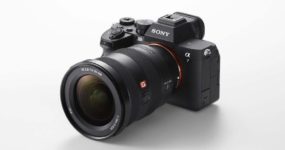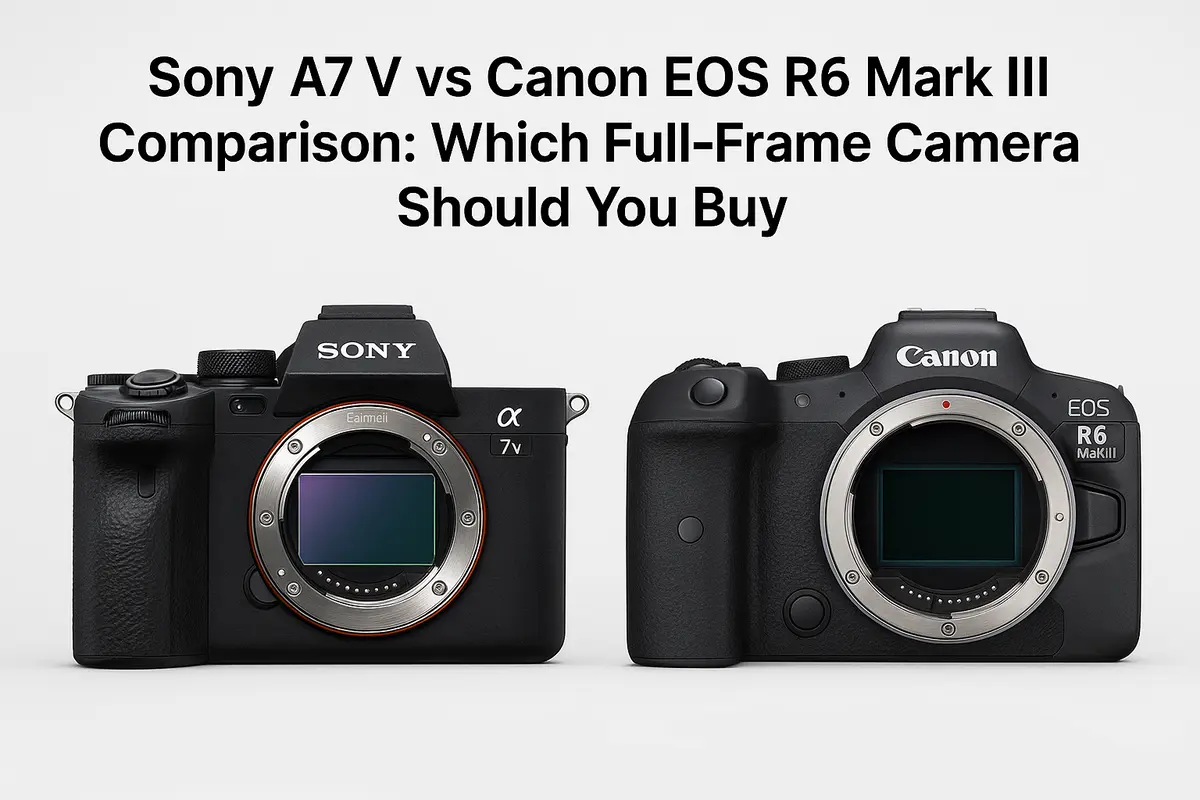
The Sony A7 V vs Canon EOS R6 Mark III comparison is one of 2025’s biggest full-frame camera battles. In this guide, we break down specs, price, autofocus, video performance, and real-world usability to help photographers decide whether the A7 V or R6 Mark III is the better upgrade.
If you are shopping for a powerful full-frame hybrid camera in 2025, the battle between the newly released and is one of the most compelling “mirrorless vs mirrorless” comparisons you can make. In this head-to-head comparison article, we’ll dig into specs, price, performance and real-world usability — so you can decide which full-frame body fits your style, whether you’re focused on photography, video, or a bit of both.
Specs Table
| Specification | Sony A7 V | Canon EOS R6 Mark III |
|---|---|---|
| Sensor | 33 MP partially stacked BSI full-frame CMOS | 32.5 MP full-frame CMOS (Dual Pixel AF II) |
| Image Stabilization (IBIS) | Up to 7.5 stops (center), ~6.5-edge | Up to 8.5 stops (center), 7.5 stops peripheral stabilization |
| Max Continuous Shooting (Electronic / Mechanical) | 30 fps (blackout-free e-shutter), 10 fps mechanical | 40 fps (electronic), 12 fps (mechanical/electronic first-curtain) |
| Video | 4K up to 60p (oversampled from 7K), 4K 120p (Super 35 crop), 1080p up to 240fps | 7K RAW up to 60p, 7K Open Gate 30p, 4K up to 120p, Full HD up to 180p |
| Autofocus / Subject Detect | AI-driven Real-time Recognition AF (humans, animals, birds, vehicles, insects, etc.) | Dual Pixel CMOS AF II — people, animals, vehicles; face registration + advanced tracking |
| Viewfinder / EVF | 3.69 M-dot EVF, 120 Hz refresh | 3.69 M-dot EVF, 120 Hz refresh |
| Rear Screen | 3.2″ 2.095 M-dot 4-axis vari-angle LCD | 3.0″ 1.62 M-dot fully-articulated vari-angle touchscreen |
| Memory Cards | Dual slot: CFexpress Type A (or UHS-II SD) + UHS-II SD | Dual slot: CFexpress Type B + UHS-II SD |
| Battery Life (CIPA) | ~750 shots (LCD), ~630 (EVF) | ~620 shots (LP-E6P battery) |
| ISO Range (native / expanded) | 100–51,200 (expandable 50–204,800) | 100–51,200 (expandable 50–102,400) |
| Body Weight | ~695 g (with battery & card) | ~699 g (with battery & card) |
Real-World Comparison: Which One Should You Buy?
| Use Case | Sony A7 V | Canon EOS R6 Mark III |
|---|---|---|
| Hybrid Shooting (Photo + Video) | ★★★★★ Strong video features, open-gate options |
★★★★☆ Excellent balance, more photo-leaning |
| Autofocus Reliability | ★★★★★ Outstanding subject recognition |
★★★★★ Very consistent Dual Pixel AF II |
| Long Video Recording | ★★★★☆ Very good, but thermal limits exist |
★★★★★ More reliable for long takes |
| Ease of Use & Ergonomics | ★★★★☆ Customizable but menu-heavy |
★★★★★ Intuitive controls, better grip |
| Long-Term Investment | ⚠️ Depends Great tech, higher lens cost |
✅ Recommended RF ecosystem maturity |
| Best For | Hybrid creators focused on video Check current price |
Reliable all-round hybrid shooters Check current price |
Top Improvements & Highlights in Sony A7 V
- Partially stacked 33 MP full-frame sensor + new BIONZ XR2 processor with dedicated AI — faster readout, better dynamic range and faster blackout-free bursts.
- Silent 30 fps continuous shooting (electronic shutter) with “Pre-Capture” feature — ideal for unpredictable action moments.
- Improved 5-axis IBIS (up to 7.5 stops) — handy for handheld shooting in low light or without stabilized lenses.
- More flexible 3.2″ 4-axis tilting screen — better ergonomics for video, vlogging, or waist-level shooting.
- Extended battery life (~750 shots) and modern connectivity (dual USB-C, faster Wi-Fi including 6 GHz, improved file transfer).
For new users, these Sony A7 V settings guide for beginners help you get the best image quality and autofocus performance right away.
Price & Value
As of launch, the Sony A7 V retails at about US $2,899 (body only), while the Canon EOS R6 Mark III costs around US $2,799 (body).
If you want to check current availability, you can look here:
Sony A7 V :
Canon EOS R6 Mark III :
Given their close price points, value mostly comes down to what you need — fast bursts and video flexibility (R6 Mark III) vs balanced hybrid performance and future-proof Sony lens ecosystem (A7 V).
Sensor, Autofocus & Performance
Sony’s move to a partially stacked 33 MP sensor + BIONZ XR2 makes the A7 V significantly faster than previous generation. Autofocus benefits from AI-based Real-time Recognition AF, with human, animal, bird, vehicle, even insect detection, and impressive tracking performance.
On the Canon side, R6 Mark III continues to leverage its strong legacy of autofocus with Dual Pixel CMOS AF II. It boasts 6,097 AF points for stills, 4,641 for video, and advanced subject detection (people, animals, vehicles) with a face-registration feature that can lock on up to 10 registered faces — useful for events, weddings or busy scenes.
In burst shooting, R6 Mark III leads with up to 40 fps (electronic) and 12 fps mechanical; A7 V offers 30 fps electronic. The difference matters if you shoot sports or fast-action subjects.
Video Capabilities
For videographers, R6 Mark III delivers impressive flexibility: internal 7K RAW up to 60p, 7K “Open Gate” 30p (using the full sensor), oversampled 4K up to 120p (UHD / DCI), Full HD up to 180 fps, plus Canon Log 2/3, waveform monitor, metadata tagging, full-size HDMI, 4-channel audio, and more pro-level tools.
The A7 V, while capable, is more modest: 4K up to 60p (oversampled from 7K), 4K 120p in Super 35 crop, Full HD up to 240 fps for slow motion, with S-Log2/3, S-Cinetone, HLG and LUT support. It lacks internal RAW video and “Open Gate” flexibility.
In short: for cinematic video, heavy color-grading, or flexible framing — R6 Mark III is stronger. For lighter hybrid shooting or casual video + stills workflows — A7 V is a balanced performer.
Handling & Usability
The A7 V improves ergonomics over previous Sony bodies, with a more comfortable grip and a 3.2″ 4-axis vari-angle screen that flips widely — great for handheld video, vlogging, waist-level shooting or creative angles.
R6 Mark III continues Canon’s familiar layout, with a 3.0″ fully articulating vari-angle screen — ideal for video and vloggers, especially those used to EOS bodies. The menu and handling are intuitive for longtime Canon users, while Sony’s menus remain more complex. Dual card slots (CFexpress + SD), full-size HDMI, and robust weather sealing make the R6 Mark III a solid choice for demanding shooting conditions.
Battery Life & Connectivity
The Sony A7 V uses the NP-FZ100 battery with CIPA-rated ~750 shots (LCD) / ~630 (EVF), which is a bit better than many competing mirrorless bodies.
Canon’s R6 Mark III, with LP-E6P battery, delivers roughly 620 shots (CIPA) per charge.
On connectivity: A7 V offers dual USB-C ports (fast transfer + charging), modern Wi-Fi including 6 GHz bands (2.4/5/6GHz), and good streaming or remote-control options.
R6 Mark III supports Wi-Fi, Bluetooth, USB-C, full-size HDMI, microphone/headphone jacks, and even UVC live streaming for 4K/60p — a boon for hybrid shooters and content creators.
Who This Camera Is For
Sony A7 V is ideal for:
- Enthusiast / semi-pro photographers who want a well-rounded hybrid body for both stills and occasional video.
- Portrait, landscape, travel, street, documentary photographers who value silent shooting, good IBIS, compact-ish body and wide lens ecosystem.
- Creators switching from older Sony bodies (A7 III / A7 IV) who want modern buffer speeds, autofocus, and improved usability without going up to ultra-high-res bodies.
Canon EOS R6 Mark III is a strong choice for:
- Hybrid shooters and content creators needing professional-grade video — 7K RAW, Open Gate, high-frame-rate slow-motion, and full video workflow tools.
- Event, wedding, sports and wildlife photographers needing fast burst shooting (40 fps), robust autofocus, and reliable performance.
- Photographers already invested in RF (or EF + adapter) lens ecosystem, who prefer Canon ergonomics, menu UX and proven reliability.
Bottom Line
In the 2025 showdown between Sony A7 V and Canon EOS R6 Mark III, neither camera is a “bad choice.” The Sony A7 V stands out as an extremely balanced full-frame hybrid camera — excellent for photos, solid video, great autofocus, and all wrapped in a slightly more affordable price point. It’s ideal if you want a versatile all-rounder body and access to Sony’s vast lens ecosystem.
On the other hand, the Canon EOS R6 Mark III pulls ahead if you demand professional-level video (7K RAW, Open Gate, 4K120p), faster burst shooting for action, and mature autofocus with broad subject detection. If you shoot events, video projects, wildlife, or anything requiring speed and flexibility — the R6 Mark III gives you a serious hybrid power tool without going into cinema-body pricing.
For many photographers and hybrid creators in 2025, the decision hinges on your primary use case: if stills and general shooting dominate, go Sony — if high-end video and action matter most, go Canon. Both offer full-frame image quality, superb autofocus, and modern conveniences, making this one of the best camera duels in recent years.
FAQ: Canon EOS R6 Mark III vs Sony A7 V
- Which camera is better for hybrid photo and video shooting?
- The Canon EOS R6 Mark III is the better hybrid option thanks to its open-gate video capabilities, higher burst rates, and stronger video reliability for long recording sessions.
- Is the Sony A7 V better for photography?
- Yes. With its 33 MP sensor and excellent dynamic range, the Sony A7 V is a strong choice for photographers focused on landscapes, portraits, and studio work.
- Which camera is better for video creators in 2026?
- The Canon EOS R6 Mark III is better suited for video creators, offering 7K RAW, open-gate recording, higher frame rates, and fewer thermal limitations.
- Is the Canon EOS R6 Mark III worth the higher price?
- If you shoot fast action, wildlife, or hybrid content regularly, the R6 Mark III justifies its price with better performance, durability, and future-proof features.
- Which camera is more beginner-friendly?
- The Sony A7 V is more beginner-friendly due to its simpler video workflow, lighter learning curve, and strong autofocus for everyday photography.
- Which camera is the better long-term investment?
- For long-term hybrid shooters, the Canon EOS R6 Mark III is the more future-proof option, especially for creators investing in Canon RF lenses and video workflows.