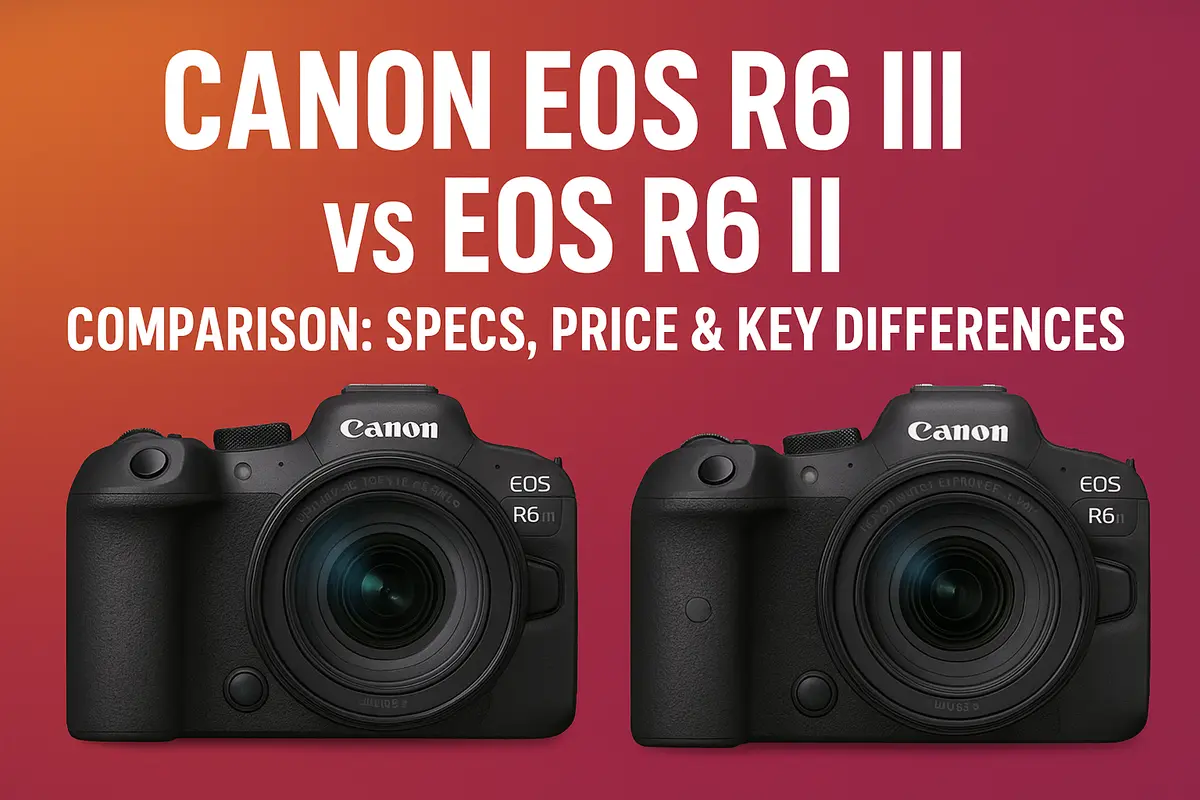
When Canon announced the EOS R6 III in late 2025, photographers immediately began comparing it to the popular EOS R6 II from 2022. Both cameras are full-frame mirrorless models in Canon’s RF lineup, but the three-year gap between them has introduced some significant upgrades. This article breaks down the differences in sensor, performance, video, stabilization, and usability to help you decide which model fits your needs.
📸 Sensor & Image Quality
- EOS R6 II: 24.2MP full-frame CMOS sensor
- EOS R6 III: 32.5MP full-frame CMOS sensor
The jump from 24MP to 32.5MP is one of the most notable upgrades. The R6 III delivers higher resolution images, ideal for cropping flexibility and large-format printing. Both cameras use Canon’s Dual Pixel CMOS AF II, ensuring fast and accurate autofocus, but the R6 III’s extra pixels give it an edge for detail-oriented shooters.
👉 Buy Now
⚡ Speed & Performance
- Continuous Shooting: Both cameras achieve 12 fps mechanical shutter, but the R6 III can push up to 40 fps electronic shutter, compared to 40 fps on the R6 II.
- Processor: Both use Canon’s DIGIC X engine, ensuring responsive performance.
The R6 III introduces a pre-shoot burst mode, capturing frames before the shutter is fully pressed, which is a huge advantage for wildlife and sports photographers.
🎥 Video Capabilities
- EOS R6 II: 4K up to 60fps, Full HD at 180fps
- EOS R6 III: Up to 7K RAW video, oversampled 4K, and advanced open-gate capture
Videographers will appreciate the R6 III’s ability to record 7K RAW internally, offering cinematic flexibility. The R6 II remains strong for hybrid shooters, but the R6 III clearly targets professionals who demand cutting-edge video quality.
👉 Buy Canon EOS R6 II
🛡️ Stabilization & ISO
- Both cameras feature in-body image stabilization (IBIS) rated up to 8 stops.
- ISO Range:
- R6 II: Native ISO 100–102,400, expandable to 204,800
- R6 III: Native ISO 100–64,000, expandable to 102,400
Interestingly, the R6 II offers a slightly higher maximum ISO, making it better for extreme low-light shooting. However, the R6 III’s higher resolution sensor balances noise reduction with detail retention.
📐 Design & Usability
- Dimensions: Nearly identical (138.4 × 98.4 × 88.4 mm)
- Weight: R6 II ~588g body only; R6 III ~609g
- Storage: R6 III adds CFexpress + UHS-II SD slots, while R6 II uses dual SD.
The R6 III’s CFexpress support is a major plus for professionals handling large RAW files and high-bitrate video. Otherwise, ergonomics remain familiar, making the transition between models seamless.
🔑 Key Differences at a Glance
| Feature | EOS R6 II | EOS R6 III |
|---|---|---|
| Sensor | 24.2MP | 32.5MP |
| ISO Range | 100–102,400 (204,800 expanded) | 100–64,000 (102,400 expanded) |
| Burst Shooting | 40 fps electronic | 40 fps electronic + pre-shoot burst |
| Video | 4K 60p, FHD 180p | 7K RAW, oversampled 4K |
| Storage | Dual SD | CFexpress + SD |
| Weight | 588g | 609g |
🏆 Conclusion: Which Should You Choose?
The EOS R6 II remains an excellent choice for enthusiasts and hybrid shooters, offering strong performance at a lower price point. However, the EOS R6 III is clearly aimed at professionals who need higher resolution, advanced video, and faster workflows.
👉 Shop the Cameras Today
📦 Kit Options:
- With RF 24-105mm F4-7.1 IS STM: ~$3150 – Amazon / B&H Photo/ Adorama
- With RF 24-105mm F4.0 L IS USM: ~$4050 – Amazon / B&H Photo/ Adorama
If you’re a content creator or professional photographer, the R6 III is worth the upgrade. For hobbyists or those focused on stills, the R6 II continues to deliver outstanding value.