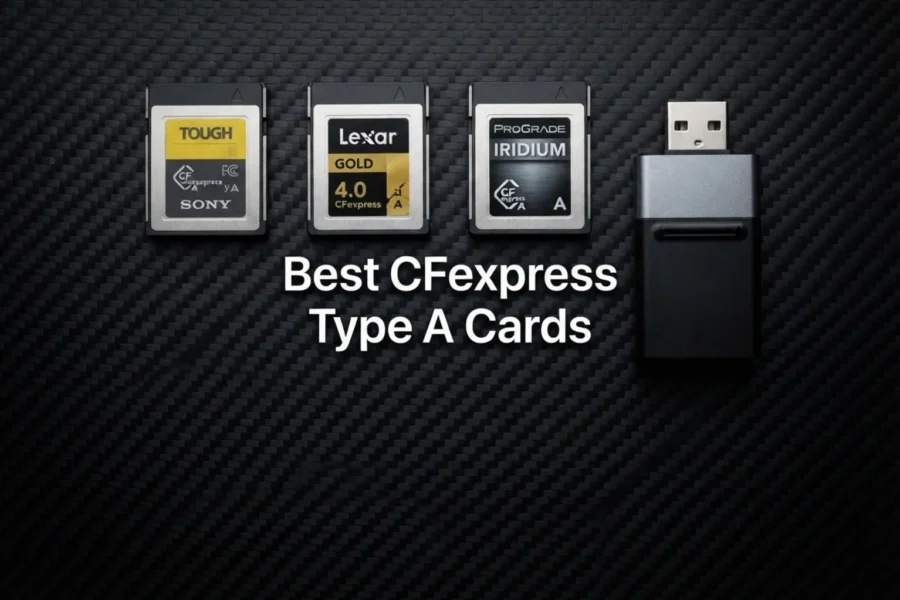
Memory card selection for Sony mirrorless and Cinema Line cameras (such as the Sony A1, A7 IV, A7R V, A9 III, FX3, and FX6) has evolved significantly with the rise of the CFexpress Type A format. Combining the ultra-compact footprint of SD cards with high-throughput PCIe interfaces, Type A media unlocks high-bitrate video formats—including All-Intra 4K at 120fps and raw burst continuous shooting—without hitting camera buffer bottlenecks.
With the release of CFexpress 4.0 cards offering theoretical transfer rates up to 1,800 MB/s, creators now enjoy drastically accelerated offload speeds during post-production. This guide evaluates the best CFexpress Type A memory cards available in 2026 across durability, sustained write performance, VPG certification, and overall value per gigabyte.
Daisy’s Take: Don’t let huge 1,800 MB/s headline read numbers trick you into overspending if you only shoot stills on an older camera body! Existing Sony cameras utilize PCIe Gen3 slots internally, capping in-camera recording speeds to CFexpress 2.0 levels (~700-800 MB/s). However, upgrading to a CFexpress 4.0 Type A card cuts your computer offload and backup times in half when paired with a USB4 reader!
Quick Comparison: Best CFexpress Type A Cards at a Glance
| Memory Card | Standard | Max Read / Write | Video Rating | Key Advantage |
|---|---|---|---|---|
| Sony TOUGH CEA-G Series | CFexpress 2.0 / 4.0 | Up to 800 / 700 MB/s (2.0) | VPG-200 / VPG-400 | Ultra-rugged design, bend proof up to 150N, water/dust resistant |
| Lexar Professional GOLD 4.0 | CFexpress 4.0 | Up to 1,800 / 1,650 MB/s | VPG-200 / VPG-400 | Ultra-fast post-production ingest speed & large capacity options |
| ProGrade Digital Iridium 4.0 | CFexpress 4.0 | Up to 1,800 / 1,700 MB/s | VPG-400 Certified | Guaranteed minimum sustained write speed for cinema workflows |
| Delkin Devices BLACK 4.0 | CFexpress 4.0 | Up to 1,830 / 1,710 MB/s | VPG-200 / VPG-400 | Extreme buffer flush speeds & 48-Hour replacement warranty |
| Angelbird AV PRO SE 2.0 | CFexpress 2.0 | Up to 820 / 730 MB/s | VPG-200 Certified | Exceptional price-to-performance ratio for mid-range budgets |
1. Best Overall & Most Durable: Sony TOUGH CEA-G Series
Sony’s proprietary TOUGH CEA-G CFexpress Type A line remains the gold standard for build quality and environmental protection in severe environments. Designed specifically for Sony’s dual-slot architecture, the TOUGH casing is resin-molded without fragile external write-protect switches or plastic ribs, yielding 18x greater bend resistance (150 Newtons) than standard memory card specifications.
Key Specifications
- Interface Standard: CFexpress 2.0 (PCIe Gen3 x1) / CFexpress 4.0 (newer capacities)
- Transfer Speeds: Max Read 800 MB/s | Max Write 700 MB/s
- Durability: IP57 dust and waterproof, crushproof up to 150N, drop-tested to 15 feet
- Video Guarantee: VPG-200 / VPG-400 compliant for zero frame drop video recording
While priced at a premium per gigabyte, the absolute rigidity of the TOUGH exterior ensures peace of mind when working on high-risk adventure or documentary assignments where card breakage or water ingress could cause irreversible data loss.
Check Prices & Availability
2. Best High-Speed 4.0 Performance: Lexar Professional GOLD 4.0
The Lexar Professional GOLD Series CFexpress 4.0 Type A card leverages PCIe Gen4 x1 architecture to double read and write performance when connected to compatible host systems. Delivering read speeds up to 1,800 MB/s and write speeds reaching 1,650 MB/s, it drastically collapses file transfer times during data offloading.
Key Specifications
- Interface Standard: CFexpress 4.0 (PCIe Gen4 x1, backward compatible with 2.0)
- Transfer Speeds: Max Read 1,800 MB/s | Max Write 1,650 MB/s
- Sustained Write Claim: Up to 1,400 MB/s sustained performance
- Thermal Management: Advanced thermal throttling preventers for prolonged high-bitrate video ingest
In high-speed continuous shooting tests, the Lexar GOLD 4.0 clears camera buffer locks rapidly on bodies like the Sony A7R V and A9 III, ensuring instant readiness for follow-up bursts.
Check Prices & Availability
3. Best for Cinema Video Production: ProGrade Digital Iridium 4.0
Designed specifically to meet the high sustained write demands of cinema cameras, the ProGrade Digital CFexpress 4.0 Type A Iridium line features official VPG-400 (Video Performance Guarantee) certification. This guarantees that write speeds will never drop below 400 MB/s, preventing interrupted recordings in continuous high-bitrate video modes.
Key Specifications
- Interface Standard: CFexpress 4.0
- Transfer Speeds: Max Read 1,800 MB/s | Max Write 1,700 MB/s
- Video Certification: Official VPG-400 rated across major capacity tiers
- Health Management: Supports ProGrade Digital Refresh Pro software for health monitoring and factory reset optimization
Daisy’s Pro Tip: If you regularly record in Sony’s XAVC S-I (All-Intra) 4K 120fps or Slow & Quick Motion modes on the FX3 / FX6, always confirm your card carries an official VPG-200 or VPG-400 badge to prevent unexpected recording termination!
Check Prices & Availability
4. Best Buffer Clearing & Protection: Delkin Devices BLACK 4.0
The Delkin Devices BLACK 4.0 CFexpress Type A combines top-tier burst shooting response times with one of the best warranty structures in the industry. Beyond its 1,830 MB/s read capabilities, Delkin includes a 48-hour replacement guarantee with no questions asked.
Key Specifications
- Interface Standard: CFexpress 4.0
- Transfer Speeds: Max Read 1,830 MB/s | Max Write 1,710 MB/s
- Sustained Write: 500 MB/s minimum sustained write guarantee
- Warranty: Lifetime Warranty with 48-Hour advance replacement protection
Check Prices & Availability
5. Best Budget-Friendly Choice: Angelbird AV PRO SE 2.0
For creators seeking CFexpress speed advantages without paying premium flagship prices, the Angelbird AV PRO SE CFexpress 2.0 Type A provides reliable, sustained performance at an accessible price per gigabyte.
Key Specifications
- Interface Standard: CFexpress 2.0
- Transfer Speeds: Max Read 820 MB/s | Max Write 730 MB/s
- Sustained Write: 650 MB/s continuous sustained write performance
- Certification: Official VPG-200 certified
Check Prices & Availability
Understanding CFexpress 2.0 vs. 4.0 & Card Readers
When selecting Type A media, it is vital to understand where performance bottlenecks occur:
- In-Camera Performance: Existing Sony Alpha and Cinema camera bodies utilize PCIe Gen3 interface controllers. Consequently, a CFexpress 4.0 card will run at CFexpress 2.0 speeds inside the camera itself (~700 to 800 MB/s maximum write).
- Offloading & Backup Speeds: The primary benefit of purchasing a CFexpress 4.0 card today is post-production speed. When paired with a USB4 / Thunderbolt 4 CFexpress 4.0 Card Reader (such as the Sony MRW-G3 or ProGrade USB4 reader), offloading 512GB of raw video to an NVMe SSD takes less than 5 minutes.
- Backward Compatibility: All CFexpress 4.0 Type A media is fully backward compatible with older CFexpress 2.0 hardware slots and readers.
Best Memory Card Deals at B&H Photo World Backup Day 2026
Frequently Asked Questions (FAQ)
Frequently Asked Questions
Q: Do I need a CFexpress Type A card, or can I use SD UHS-II cards in my Sony camera?
A: Sony’s dual-format slots accept both SD UHS-II and CFexpress Type A cards. While SD V90 cards handle most photo modes and standard compressed video modes, CFexpress Type A is mandatory for highest-quality XAVC S-I 4K 120fps video recording, S&Q slow-motion modes, and uncompressed continuous raw photo bursts.
Q: Will a CFexpress 4.0 Type A card make my Sony A7 IV shoot faster?
A: No. Because camera bodies like the Sony A7 IV and A7R V feature PCIe Gen3 hardware slots internally, in-camera buffer clearing speeds will be identical between high-end 2.0 and 4.0 cards. However, 4.0 cards offload files to your computer twice as fast when using a USB4 card reader.
Q: What does VPG-200 or VPG-400 mean on a CFexpress card?
A: VPG stands for Video Performance Guarantee. A VPG-200 or VPG-400 rating ensures that the card’s sustained write speed will never drop below 200 MB/s or 400 MB/s respectively during continuous video recording, preventing dropped frames or stopped recordings.