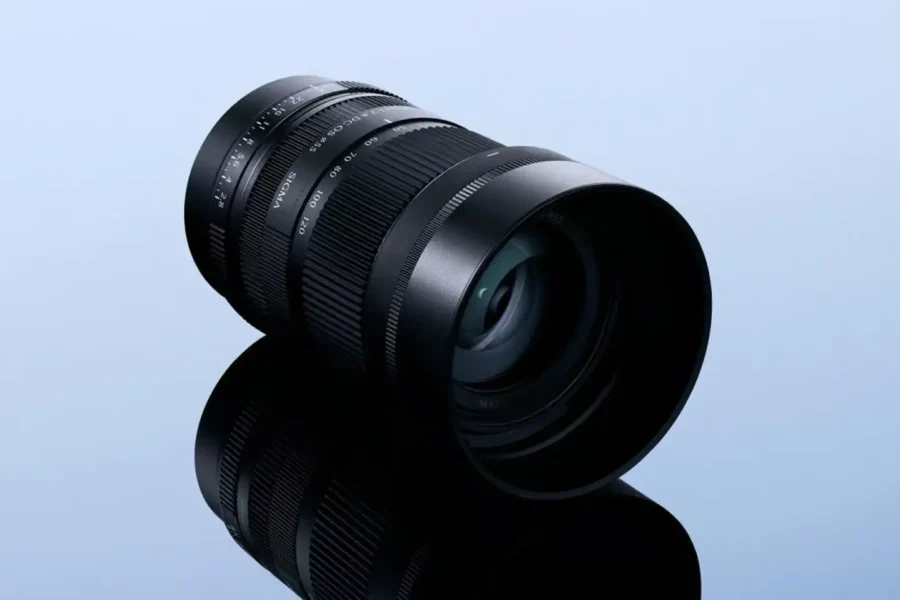
Crop-sensor photographers and hybrid video creators have long requested a lightweight, fast telephoto zoom designed from the ground up specifically for APS-C mirrorless cameras. Historically, securing a constant f/2.8 telephoto reach meant mounting heavy full-frame 70-200mm optics that outweighed the camera body itself. Sigma has officially answered this demand with the press release announcement of the Sigma 50-120mm f/2.8 DC OS Contemporary.
Offering a 35mm full-frame equivalent focal length of approximately 75-180mm (75-192mm on 1.6x crop systems), this fast tele-zoom incorporates an advanced optical image stabilizer (OS), a high-speed High-response Linear Actuator (HLA) focus drive, and a weather-sealed mount into a chassis that weighs under 400 grams. Below is our complete technical breakdown of Sigma’s latest optical triumph. For more coverage on third-party developments, visit our dedicated Sigma lens hub, or browse our curated roundups covering everyday photography essentials, the best Sony E-mount lenses, and the best Nikon Z lenses.
Quick Summary: Key Specifications at a Glance
Here is a comprehensive breakdown of the official technical specifications provided in Sigma’s launch release:
| Specification | Sigma 50-120mm f/2.8 DC OS Contemporary Details |
|---|---|
| Lens Format | APS-C / Crop-Sensor Mirrorless (DC) |
| Focal Range | 50-120mm (75-180mm full-frame equivalent on 1.5x crop) |
| Maximum Aperture | Constant f/2.8 across the entire zoom range |
| Minimum Aperture | f/22 |
| Optical Construction | 18 elements in 13 groups (Includes SLD & Aspherical elements) |
| Diaphragm Blades | 9-blade rounded diaphragm for smooth bokeh |
| Autofocus System | HLA (High-response Linear Actuator) motor |
| Image Stabilization | Built-in Optical Stabilization (OS) algorithm |
| Filter Thread Diameter | Compact 67mm filter size |
| Dimensions & Weight | 72.0mm x 106.5mm | 390g (13.8 oz) |
1. Compact Portability Meets Fast Constant Aperture
The primary engineering achievement of the Sigma 50-120mm f/2.8 DC OS Contemporary is its physical scale. By tailoring the image circle specifically for APS-C sensors rather than full-frame sensors, Sigma eliminated unnecessary glass volume without compromising edge-to-edge optical sharpness. At just 106.5mm in length and weighing a mere 390 grams, it balances perfectly on compact mirrorless bodies during long handheld shoots.
Maintaining a constant f/2.8 maximum aperture throughout the 50-120mm range provides several distinct advantages. It allows creators to maintain low ISO settings during dim indoor sports or evening outdoor events, while delivering expressive shallow depth-of-field background isolation for portraiture, wedding details, and wildlife subjects.
Search Sigma 50-120mm f/2.8 DC OS Contemporary
Check live pre-order listings, pricing, and stock availability across authorized camera retailers:
Check Price on Amazon
Pre-Order at B&H Photo
Pairing Tip: Combine the 50-120mm f/2.8 with the legendary Sigma 18-50mm f/2.8 DC DN Contemporary to build an ultra-lightweight, dual-lens constant f/2.8 setup covering 27mm to 180mm equivalent range!
2. Advanced Optical Design & Stabilization Performance
Sigma engineered the internal arrangement with 18 elements in 13 groups, featuring Special Low Dispersion (SLD) and high-refraction glass elements engineered to suppress chromatic aberrations, color fringing, and geometric distortion. Multi-layer coatings significantly reduce ghosting and flare when shooting directly toward bright backlight sources.
To ensure steady handheld shooting at the 120mm telephoto end, the lens incorporates Sigma’s proprietary Optical Stabilizer (OS) algorithm. This system provides several stops of shake compensation, allowing photographers to slow down shutter speeds during low-light handheld shooting without introducing camera blur. When paired with camera bodies featuring in-body image stabilization (IBIS), the two systems combine for rock-steady video clip recording.
Explore Fast APS-C Mirrorless Camera Bodies
Find current deals on high-speed crop-sensor mirrorless camera bodies:
3. High-Speed HLA Autofocus Motor & Video Capabilities
Autofocus execution is handled by Sigma’s premium linear drive motor: the HLA (High-response Linear Actuator). Delivering high drive power with near-silent mechanical operation, the HLA motor enables rapid initial focus acquisition and smooth, uninterrupted subject tracking across the frame.
Video creators will appreciate the suppressed focus breathing characteristics engineered into the optical formula. Focus breathing—where the field of view shifts slightly during focus pulls—is minimized, ensuring clean transitions during cinema production. Additionally, the electronic focus ring provides smooth, linear manual focusing feel for precise video pull control.
4. Weather-Sealed Mount & Multi-System Availability
Designed to withstand challenging outdoor environmental conditions, the lens features a rubber sealing gasket around the brass bayonet mount to resist dust and moisture intrusion. The front glass element is treated with a water- and oil-repellent coating that makes cleaning smudges or water droplets straightforward during outdoor field shoots.
Sigma confirmed that the 50-120mm f/2.8 DC OS Contemporary will launch initially across major mirrorless mounts including Sony E-mount, L-Mount, Fujifilm X-mount, and Canon RF-S systems, bringing fast telephoto zoom performance to every major crop-sensor ecosystem.
Compare authorized pricing, bundle deals, and stock availability across top camera retailers:
Search Sigma Lenses on Amazon | Shop Sigma Optics at B&H Photo | Browse Optics at Adorama
Frequently Asked Questions (FAQ)
Frequently Asked Questions About the Sigma 50-120mm f/2.8 DC OS
Q: What is the 35mm full-frame equivalent focal range of the 50-120mm lens?
A: On a standard 1.5x crop APS-C sensor (such as Sony E-mount, Fujifilm X, or L-Mount), it delivers a 75-180mm equivalent field of view. On a 1.6x Canon RF-S sensor, it provides an 80-192mm equivalent reach.
Q: Does the Sigma 50-120mm f/2.8 feature built-in optical stabilization?
A: Yes, it features Sigma’s built-in Optical Stabilizer (OS) system, offering several stops of shake compensation for handheld photography and stable video clips.
Q: Can I use this APS-C lens on a full-frame camera body?
A: Yes, you can mount Sigma DC lenses on full-frame mirrorless bodies, but the camera will automatically switch into crop mode to match the APS-C image circle.